Introduction
Most children who struggle with maths aren't struggling because they aren't trying. They're struggling because somewhere along the way, a foundational concept didn't fully land — and nobody caught it before the next chapter began.
ASER Rural 2024 makes this visible at scale: only 30.7% of Class V children in rural India can do basic division. By Class VIII, that number barely reaches 45.8%. These aren't new failures — they're old gaps that were never closed.
AI is now being deployed specifically to solve this detection problem. Not after the exam, but before the gap widens into something harder to fix.
The core limitation of traditional assessment is this: a test score tells you what a child got wrong, not why. Was it a careless slip, or a fundamentally broken mental model of how numbers work? That distinction determines everything about what help is actually needed — and it's exactly what AI is designed to surface.
This article walks through exactly how AI identifies those gaps — the mechanisms, the signals, and what it means for how your child learns next.
Key Takeaways
- Math learning gaps are missing foundational concepts that silently compound into larger struggles as topics build on each other
- AI detects gaps by telling the difference between one-off mistakes and recurring error patterns rooted in conceptual misconceptions
- Detection follows a clear sequence: adaptive diagnostic, pattern recognition, structured gap report, then a personalised learning path
- Every student interaction generates new data, making gap detection progressively more accurate over time
- AI works best alongside teachers — surfacing patterns that would take hours to identify manually, while leaving instructional judgement where it belongs
What Are Math Learning Gaps — And Why Are They Hard to Spot?
A math learning gap isn't simply a wrong answer. It's a missing or broken understanding of a concept that a student needs to progress further. What makes gaps stubborn is that students often develop workarounds — partial rules, memorised procedures, or educated guessing — that produce correct answers just often enough to avoid detection.
Why Traditional Assessments Miss Them
A percentage score tells you how many questions were wrong. It doesn't tell you whether the child:
- Misunderstood the underlying concept entirely
- Applied the right idea but made a procedural error in execution
- Has a flawed mental model that produces consistent but incorrect reasoning
Research distinguishes these clearly: conceptual errors reflect misunderstanding of principles, while procedural errors reflect mistakes in applying steps or rules. These require completely different teaching responses — yet a standard test treats both identically.
Why Early Detection Matters
Math is hierarchical — gaps in foundational concepts don't stay isolated. They compound.
Siegler et al. (2012) found that early fraction and division knowledge uniquely predicted high school algebra achievement, even after controlling for other factors. A 1 SD increase in early fractions knowledge was associated with a 0.15 SD increase in later algebra knowledge. The National Mathematics Advisory Panel identifies whole numbers, fractions, and foundational geometry as the "Critical Foundations of Algebra."
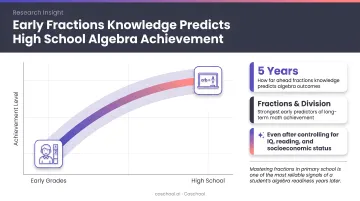
A gap in fractions at Grade 4 doesn't just make fractions harder — it makes ratios harder, which makes algebra harder, which quietly closes doors to STEM pathways years down the line.
How AI Identifies Math Learning Gaps: The Step-by-Step Process
AI gap detection doesn't work like a single test. It operates through a continuous sequence of data collection, pattern analysis, and interpretation — with each layer building on the last.
The Initial Diagnostic: How AI Reads a Student's Starting Point
The process begins with an adaptive diagnostic assessment. Unlike a fixed test with predetermined questions, the AI adjusts difficulty in real time based on how the student responds : moving up when answers are correct and confident, probing downward when errors appear. This maps the full terrain of what a student knows and doesn't know across sub-skills, rather than producing a single aggregate score.
Critically, the AI isn't only recording right or wrong answers. It captures:
- Time taken per question (hesitation often signals uncertainty)
- Number of attempts before arriving at an answer
- Sequence of errors and whether mistakes cluster around a specific concept type
- Consistency across different question formats and problem types
This behavioural data matters. Research on intelligent tutoring systems found that including richer assistance metrics (not just correctness) significantly improves predictive accuracy in student modelling. A right answer reached after four attempts and two hints tells a very different story than one answered immediately.
Recognising Patterns: Errors vs. Misconceptions
That behavioural data becomes meaningful when the AI starts classifying what it reveals — specifically, distinguishing between two very different problems.
| Error Type | What It Looks Like | What It Means |
|---|---|---|
| Procedural error | Consistently subtracting when addition of negatives is required; misapplying order of operations | The student understands the concept but executes the steps incorrectly |
| Conceptual misconception | Believing multiplication always makes numbers larger (breaks down with fractions); treating a fraction's numerator and denominator as independent whole numbers | The student has a flawed mental model, not just an execution problem |
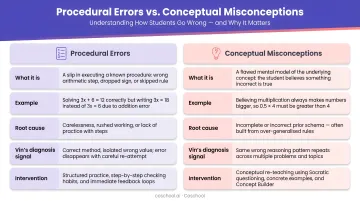
The AI cross-references a student's error patterns against a library of known misconceptions. Research has mapped recurring misconceptions across fractions, proportional reasoning, algebra, and number sense — and AI systems match observed patterns against these to pinpoint which misconception is most likely at play.
One wrong answer? Probably a slip. The same error type appearing across five different question contexts (different numbers, different formats, different contexts) signals a genuine gap in understanding.
Using Conversational AI and NLP to Probe Deeper
Advanced AI platforms go beyond answer selection. Natural Language Processing lets the AI interpret a student's written or spoken reasoning, revealing whether they understand why a process works, not just whether they can execute it.
This is where Socratic tutoring becomes diagnostic. Coschool's SchoolAI deploys Vin, an AI tutor that never gives direct answers; it asks guiding questions that lead students to discover understanding themselves. When a student explains their reasoning out loud, even incorrectly, that explanation carries information a multiple-choice answer never could.
Vin's RUAH question framework (Recall, Understand, Apply, Higher-Order) structures this probing across four cognitive levels:
- Recall — Can the student remember the rule or formula?
- Understand — Can they explain what it means?
- Apply — Can they use it in a familiar problem?
- Higher-Order — Can they reason with it in an unfamiliar situation?
A student who can recall a rule but fails at Apply is in a very different position from one who fails at Understand. The RUAH framework makes that distinction explicit and actionable.
From Raw Data to Insight: What AI Actually Produces
Once pattern analysis is complete, the AI generates a structured gap report. Rather than listing wrong topics, it maps which specific concepts within a topic are understood, partially understood, or missing entirely.
What a Gap Report Typically Includes
- The specific sub-skill where understanding breaks down
- The likely underlying misconception (not just "fractions" but "student treats numerator and denominator as separate whole numbers")
- Prerequisite concepts that may need revisiting before the gap can close
- A recommended learning sequence targeted at the exact point of confusion
This distinction matters practically. A student who doesn't understand ratio as a relationship between two quantities doesn't need to redo an entire chapter on proportional reasoning. They need targeted work on what a ratio means before they can apply it correctly.
Teacher and Parent Visibility
Gap reports surface through dashboards built for different audiences — each showing the same underlying data through a different lens.
SchoolAI's Teacher Dashboard shows both class-wide patterns and individual insights at the same time. Teachers can see which specific questions tripped up most students before the next class — making it straightforward to determine whether a gap belongs to one student or signals a section-wide misconception that needs reteaching.
For parents, SchoolAI's platform goes beyond scores. Instead of "struggling with math," it communicates specific areas of difficulty with a 3-level drill-down per concept — giving families concrete information for meaningful conversations rather than vague worry.
How AI Keeps Refining Its Understanding Over Time
Gap detection isn't a one-time diagnostic. Every interaction a student has with the platform generates new data that updates the AI's model of that student's understanding.
This is the mechanism behind knowledge tracing: AI systems observe a student's answer sequence over time, continuously adjusting their estimate of which skills have been mastered and which remain fragile. The model becomes more accurate as evidence accumulates — sharpening its picture of each student with every session.
The Adaptive Feedback Loop
After a gap is identified and targeted practice assigned, the AI monitors whether the intervention is working:
- If errors decrease and confidence increases, the gap is closing
- If the same errors persist, the system escalates — through adjusted practice, prerequisite review, or teacher alert
- If a student suddenly performs well on a topic after consistent struggle, that pattern flags for teacher verification
SchoolAI's closed-loop architecture runs through a 7-stage workflow: Assign → Practise → Evidence → Intervene → Inform → Adapt → Govern. The Adapt stage generates dynamic lesson plans calibrated to section-level gaps and individual trajectories, so each day's class responds directly to what the previous day's homework revealed.
The results from schools using this continuous model are measurable: 8–11% class average improvement term-on-term, with bottom-quartile students gaining +9 to +17 marks.
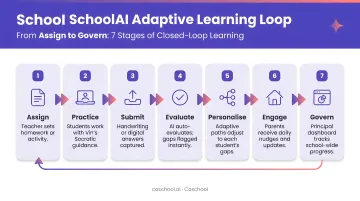
These gains don't happen in isolation from teachers. Throughout every stage, the platform surfaces AI-identified patterns as starting points for educator judgement — keeping teachers in control of what happens next, not removing them from the equation.
What This Means for Your Child's Math Journey
The practical shift AI gap detection enables is specificity. Instead of knowing "my child is struggling with maths," a parent can know: "my child has not yet grasped what a ratio represents as a relationship between two quantities, and this is affecting their word problem performance."
That precision turns vague parental anxiety into a specific starting point for help — and those are very different things to work with.
AI gap detection is not about labelling a child as behind. Every student has gaps — the question is whether those gaps are found and addressed before the next layer of learning depends on them. Catching a gap at Grade 5 is far more actionable than discovering it at Grade 9 when algebra has already been undermined.
Schools that integrate AI gap detection into everyday learning — not as a one-off test but as a continuous process woven into homework, practice, and teaching — create conditions where students never accumulate a backlog of unresolved confusion.
This is the philosophy behind SchoolAI: gap identification and remediation happening together, continuously, embedded within the school's existing workflow rather than added on top of it.
Frequently Asked Questions
How can AI platforms identify learning gaps in math students?
AI platforms analyse patterns across multiple student interactions — tracking not just right or wrong answers but time taken, attempt sequences, and error consistency. When the same type of mistake appears across different question formats, the system identifies it as a likely gap rather than an isolated slip.
What types of math learning gaps can AI detect?
AI can detect procedural errors (incorrect rule application) and conceptual misconceptions across number sense, fractions, proportional reasoning, algebra, and equations. Detection accuracy improves when the system is trained on topic-specific data and matched against a curated misconception library.
How is AI gap detection different from a regular math test?
A regular test produces a score. AI gap detection reveals why a student got something wrong — by tracking error patterns, response behaviour, and consistency across similar problems. The output is a diagnostic picture, not a performance ranking.
Is AI-identified gap detection accurate enough to trust?
Accuracy varies significantly by context. A 2025 middle-school algebra benchmark found GPT-4-turbo reaching up to 83.9% accuracy under constrained conditions, but broader precision in open settings was substantially lower. AI gap detection works best as a starting point that teachers validate — not as a standalone verdict.
What should parents do once AI identifies a learning gap in their child?
Use the gap report as a conversation starter with the teacher, focusing on the specific concept identified rather than broad re-practice. Track whether errors on that concept decrease over the following few sessions to confirm the gap is actually closing.
Can AI replace a teacher in identifying math learning gaps?
No. AI surfaces patterns that would take educators hours to identify manually, but teacher expertise remains essential for interpreting findings, understanding student context, and designing instruction that actually responds to what students need.