Introduction
Most students finish a school year having completed dozens of assignments, sat through exams, and moved from one chapter to the next — without ever pausing to notice how much they've actually grown. The work disappears into folders or gradebooks. The learning stays invisible.
Portfolios fix this — but only when they're built for students, not for teachers or parents.
Many teachers associate portfolios with extra paperwork: something assembled before Parent-Teacher Meetings, skimmed once, then archived. That version doesn't work.
This guide takes a different approach: portfolios as tools that make learning visible to the learner, building the self-awareness that drives real motivation and genuine improvement.
The goal — whether you teach Class 6 in Delhi or Class 10 in Hyderabad — is a classroom where students can point to their own work and say, "I know what I've learned, I know where I struggled, and I know what I want to do next."
Key Takeaways
- Portfolios are curated collections of student work — their power comes from reflection, not just accumulation.
- The process portfolio (capturing drafts, revisions, and attempts) is most effective for helping students see their own growth.
- Students should do the selecting, reflecting, and presenting — teachers play a coaching role, not an evaluating one.
- Consistent, low-stakes documentation habits matter far more than polished final products.
- Tools like SchoolAi can support portfolio practice by giving students access to real learning data — assignment attempts, gaps identified, and progress over time — that makes reflection concrete.
Why Portfolios Help Students See Their Own Learning
Assessment Shifts from Passive to Active
Traditional assessments happen to students. A test is set, taken, marked, and returned — the student receives a number but rarely gains insight into their own learning process. Portfolios invert this. When a student selects work, explains why they chose it, and reflects on what it shows, they become the assessor. That shift is where learning becomes visible.
This isn't just a philosophical claim. A 2024 multi-method study on portfolio assessment in primary education reported a medium effect size of 0.573 on academic achievement — a meaningful result across 23 datasets. What drives that effect isn't the portfolio artefact itself; it's the student participation in selection, reflection, and self-evaluation.
Metacognition in Practice
When a student places a Week 3 essay beside a Week 12 revision, they're not just comparing papers. They're evaluating quality, identifying what changed, and recognising their own development — all forms of metacognition. This matters because the Education Endowment Foundation's Teaching and Learning Toolkit rates metacognition and self-regulation approaches at +8 months average progress, based on 355 studies — one of the highest-impact, lowest-cost strategies available to classroom teachers.
Portfolios build these habits directly. Selecting evidence, applying criteria, and writing reflection notes are the practice itself — not a byproduct of it.
Who Benefits Most
Students who struggle on traditional assessments often carry an inaccurate picture of their own abilities. A test score reveals what they couldn't do on one particular morning. A portfolio captures what a single test cannot:
- Effort sustained across multiple drafts
- Persistence through difficult concepts
- Creativity in how problems are approached
- Growth that only becomes visible over time
This broader picture reshapes motivation. When students can look back at concrete evidence of progress — not just a rank — they develop a more accurate sense of what they're capable of. Goal-setting becomes meaningful once a student can point to exactly where they started.
The 4 Types of Student Portfolios and When to Use Each
Not all portfolios serve the same purpose. Choosing the right type before you start saves considerable confusion later.
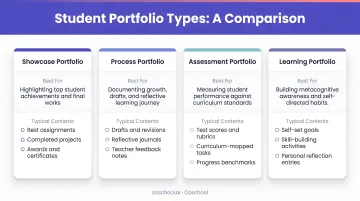
| Portfolio Type | What It Contains | Best Used When |
|---|---|---|
| Showcase | Student's best, selected work | College readiness, parent communication, end-of-year presentations |
| Process | Drafts, revisions, work-in-progress | Writing, art, science — subjects where growth over time is the point |
| Assessment | Work mapped to specific outcomes or rubrics | Formal evaluation aligned to curriculum standards |
| Hybrid | Combination of the above | Most K–12 classrooms, where goals span multiple purposes |
Which Type Builds Self-Awareness?
For the specific goal of helping students see their own learning, the process portfolio is the most effective. It makes the learning journey explicit — the work itself tells the growth story. A student who flips through five drafts of the same paragraph and explains what changed between each one has done more genuine learning than one who submitted a single polished piece with no trace of the thinking behind it.
Showcase portfolios are well-suited to student-led conferences and communicating achievement to parents. Without the progression of work underneath, though, they risk becoming highlight reels — curated snapshots that obscure how learning actually happened rather than revealing it.
How to Use Portfolios to Make Learning Visible: A Step-by-Step Guide
The sequence matters here. Jumping to "collect work" before establishing purpose and reflection habits produces a filing system — not evidence of learning.
Define Purpose and Set the Stage
Before students add a single piece of work, they need to understand two things: why this portfolio exists and who will see it.
A portfolio built for the student's own growth looks different from one prepared for a parent presentation. Both are valid, but mixing up the audience mid-way creates confusion about what to include and how honest to be.
Classroom activity to start: Ask each student to write down one thing they feel they're good at in this subject and one thing they want to improve. This two-sentence baseline becomes the foundation the entire portfolio builds on. Everything they add later can be measured against it.
Help Students Select and Curate Work
Curating means choosing with intention. Students who grab whatever's nearby are just filling space — the skill is learning to select work that actually says something about their thinking.
Scaffold selection without taking ownership away. Instead of telling students what to include, try prompts like:
- "Find one piece where you surprised yourself."
- "Choose something that felt hard at the time but makes sense now."
- "Pick one piece you'd do differently if you started again today."
These prompts direct attention without prescribing content. The student still makes the decision; the prompt just gives them a lens.
Guide Meaningful Reflection
Reflection is what separates a portfolio from a scrapbook. Without it, even well-chosen work stays inert — the student moves on without extracting what the work actually taught them.
For each piece, students should briefly address three questions:
- What were you trying to do?
- What did you actually learn?
- What would you change?
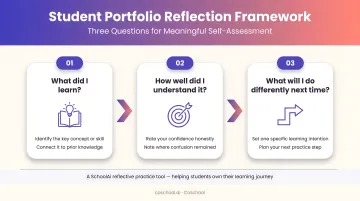
Model what good reflection looks like — share an anonymised example (or write one yourself as the teacher) next to a weaker one. The difference between "I worked hard on this" and "I noticed my arguments got stronger when I started using examples from the text, not just my own opinion" is the difference between surface acknowledgment and genuine self-assessment.
Teacher Review and Feedback Loop
At this stage, the teacher's job is to push thinking further, not assign a score. Respond to the student's reflections with questions that deepen their analysis:
- "You noticed your writing improved — what specifically did you change between draft one and this version?"
- "You said this project was hard. What made it hard, and how did you work through it?"
Build in a brief portfolio check-in once per term — ten to fifteen minutes per student where teacher and student review together, name patterns, and agree on one or two concrete goals for the next period. This conversation can reveal more about a student's learning than a formal assessment.
Portfolio Presentation or Sharing
When a student walks a parent or peer through their portfolio — explaining choices, acknowledging struggles, pointing to growth — they consolidate more learning in that single conversation than weeks of passive homework can produce. The act of articulating growth makes it real.
Student-led conferences don't need to be elaborate. Even a ten-minute conversation where the student says "here's what I was working on, here's what changed, and here's what I want to do next" builds communication skills, reinforces ownership, and makes growth feel worth acknowledging — not just worth grading.
Best Practices for Keeping Portfolios Meaningful
Build Consistency, Not Perfection
A portfolio updated every two weeks with honest, small reflections is far more valuable than one assembled the night before a deadline. Build portfolio time into the classroom rhythm — even ten minutes after a major assignment is enough to photograph work, add a brief note, and flag it for the next review.
The frequency itself is part of the benefit. Regular documentation builds the habit of noticing your own learning, which is a skill that outlasts any single portfolio.
Protect Student Voice
Teachers and parents should be able to respond and comment. But the portfolio belongs to the student. Over-prescribing what to include — mandating exactly five pieces in exactly this format — strips the ownership that makes portfolios work in the first place.
Students who feel the portfolio is their own thing, not a compliance task, engage with it differently.
Use Peer Review — With Structure
Having students share one portfolio entry with a classmate and exchange brief structured feedback builds reflection habits and community at the same time. One caution from research: a 2014 study of peer assessment in seventh-grade science portfolios found that unstructured peer feedback had lower reliability and included fewer constructive suggestions than expert feedback. The implication isn't to avoid peer review — it's to scaffold it clearly.
Give students a simple framework: What's working well in this piece? What one thing would make it stronger? Two focused questions beat open-ended commentary every time.
Connect Real-Time Data to Portfolio Reflection
Platforms that surface ongoing learning data can strengthen portfolio practice. SchoolAI, for instance, connects classroom performance directly to portfolio documentation: the Teacher Dashboard tracks question-level accuracy, homework completion, and concept gaps over a full academic year, while the Digital Portfolio in the Parent Engagement Platform captures academic and personal milestones alongside those insights.
The practical upshot is that reflections get sharper. When a student can point to a specific shift — say, accuracy on a concept type moving from 40% to 75% over a term — their written reflection has something concrete to explain. Key capabilities that support this kind of grounded reflection include:
- Performance trends over time: concept-level accuracy tracked across the full year, not just the last assignment
- Homework completion patterns: visibility into consistency, not just correctness
- Milestone documentation: academic and personal growth captured alongside data in one place
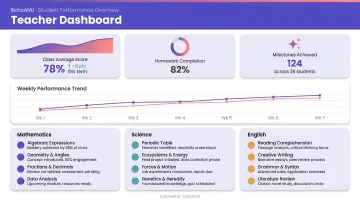
The numbers surface what happened. The portfolio reflection explains how and why.
Frequently Asked Questions
What are the 4 types of portfolios for students?
The four main types are showcase (best work, selected by the student), process (drafts and revisions showing development), assessment (work mapped to specific curriculum outcomes), and hybrid (a combination of the above). The best choice depends on the learning goal — for building self-awareness, process portfolios are most effective.
What are student portfolio examples?
Examples vary by subject and type: revised essay drafts with reflection notes, artwork with artist's statements, lab reports showing methodology changes, project documentation with photos, self-recorded voice reflections, and annotated test results. What makes any of these meaningful is the reflection the student adds — without it, a portfolio is just a folder.
How do student portfolios support self-reflection and metacognition?
Portfolios build metacognition by requiring students to select, describe, and judge their own work — not just complete it. That active self-evaluation deepens understanding, surfaces personal learning patterns, and helps students identify both strengths and gaps over time.
How often should students update their portfolios?
After each significant assignment or unit is ideal, rather than one large update at the end of term. Frequency is what makes growth visible and keeps reflection habits active — a brief weekly documentation routine beats a quarterly scramble.
How do teachers assess portfolios without undermining student ownership?
Focus assessment on the quality of reflection and evidence of growth over time, not on individual artefacts in isolation. Rubrics built around self-awareness, improvement, and goal-setting keep the emphasis on learning rather than performance. Framing feedback as a coaching conversation rather than a grade is what preserves the student's sense of ownership.
What are good achievements for students to include in a portfolio?
Not just prizes or high grades. A significant revision that genuinely improved a piece of work, a project that required learning something unfamiliar, a moment where understanding visibly shifted — these are the achievements a portfolio is built to capture. Growth is the achievement, not just the outcome.