Classroom management isn't a single technique or a fixed set of rules. Teachers draw from multiple approaches depending on their students, their goals, and the context they're working in. According to RAND's 2024 State of the American Teacher Survey, 45% of K-12 teachers cite managing student behaviour as one of their top job stressors — rising to 66% among teachers with five or fewer years of experience.
This article covers 10 distinct types of classroom management: the 4 classic styles rooted in educational research, plus 6 strategy-based approaches used in modern classrooms. Understanding all 10 helps teachers make informed, deliberate choices rather than defaulting to habit.
Key Takeaways
- Classroom management covers strategies, structures, and relational practices that create a productive learning environment
- Baumrind's parenting research underlies the 4 classic styles: Authoritarian, Authoritative, Permissive, and Indulgent
- Six additional types (proactive, restorative, SEL-based, technology-integrated, and others) reflect how classroom practice has evolved beyond the classic four
- Research consistently identifies authoritative management as most effective for most classrooms
- Blending multiple types is common and often more effective than any single approach
What Is Classroom Management?
Classroom management is the collection of strategies, routines, structures, and relational practices a teacher uses to create an environment where meaningful learning can take place.
That definition is broader than many teachers initially assume. Research by Simonsen et al. on evidence-based classroom management identifies three core functions: maximising instructional time, arranging activities to increase engagement and achievement, and applying proactive behaviour strategies before disruptions arise — rather than reacting after the fact.
This means classroom management encompasses:
- How physical space is organised and used
- How lessons are paced and delivered
- How relationships between teacher and students are built
- How behavioural expectations are established and reinforced
- How engagement is maintained across different learner types
Teachers design and continuously adjust this system to fit their students. It is not a fixed rulebook, but a living practice that evolves with each classroom.
Why Classroom Management Matters
The stakes are real and measurable. OECD TALIS 2018 data shows lower-secondary teachers spend an average of 13% of class time keeping order rather than teaching. That's roughly one in eight minutes not spent on learning — compounded across an entire school year.
That lost time has a compounding human cost. Research across three major studies tells a consistent story:
- 59% of teachers reported frequent job-related stress and 60% reported burnout (RAND 2024) — poor classroom management is a leading driver of both
- 32% of public-school teachers say student misbehaviour actively interferes with their teaching (NCES)
- Teacher-led classroom management programmes significantly reduce disruptive and aggressive student behaviour (Oliver, Wehby & Reschly)
In diverse classrooms — where students bring different learning needs, emotional states, and home backgrounds — no single approach works for every group. That's why knowing the full range of classroom management types matters: the right fit depends on your students, your subject, and the moment.
The 4 Classic Types of Classroom Management
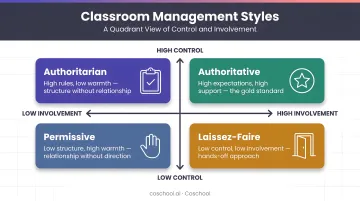
These four styles form the foundational framework for understanding classroom management. They're derived from Diana Baumrind's influential 1966 parenting research and later adapted to education through the demandingness/responsiveness model, mapping teacher behaviour along two axes: level of control and level of student involvement.
Authoritarian Classroom Management
Authoritarian management sits at high control, low student involvement. The teacher is the sole authority. Rules are non-negotiable, expectations are rigid, and compliance is unconditional.
Where it works: It provides clear structure and consistent expectations — useful in high-stakes environments or with students who need firm boundaries initially.
Where it falls short:
- Studies show authoritarian teachers are often perceived as harsh and unfair
- Tends to suppress student autonomy and intrinsic motivation
- Produces compliance through fear rather than respect
- Clark et al.'s 2023 study found authoritarian management profiles negatively correlated with engagement and motivation
Authoritative Classroom Management
Authoritative management balances high control with high student involvement. Teachers set firm expectations, but also build genuine relationships, invite student feedback, and treat students as partners in the classroom.
This style is widely regarded as the most effective approach for most classrooms. Wentzel's study of 452 sixth graders found that Baumrind-style high expectations consistently predicted students' motivation and academic outcomes, while lack of nurturance was the strongest negative predictor of both social behaviour and academic performance.
The distinction from authoritarian is straightforward. Students know what's expected and why, and they feel respected within that structure. High standards and genuine care aren't opposites — they work together.
Permissive Classroom Management
Permissive teachers operate with low control and low involvement. There are few rules, minimal structure, and limited consequences for poor behaviour.
Where it works: With highly self-directed learners or certain creative workshops, loosened structure can open space for exploration.
Where it falls short:
- Without accountability, students often fail to reach their academic or social potential
- Classrooms can drift into unproductive chaos
- The evidence supporting permissive approaches as a primary style remains thin
Indulgent Classroom Management
Indulgent management combines high student involvement with low classroom control. These teachers genuinely care about student wellbeing and invest in relationships, but they struggle to redirect students or enforce expectations when needed.
Where it works: Strong rapport and emotional safety make students feel heard and supported, which matters in relationship-building phases.
Where it falls short:
- Students often see the teacher as a peer rather than an authority figure
- Academic rigour weakens when expectations go unenforced
- The SAGE Encyclopedia of Classroom Management confirms that warmth without structure limits student growth
6 More Types of Classroom Management
Beyond the classic four styles, classroom management can also be understood through the strategies and philosophies teachers actively use. These six types reflect the practical approaches found in contemporary classrooms.
Behaviour Management
Behaviour management focuses specifically on establishing, teaching, and reinforcing clear behavioural expectations. It's less about style and more about system.
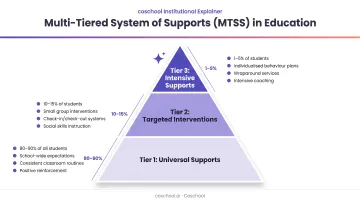
The PBIS framework — one of the most evidence-based implementations — organises behaviour management across three tiers:
- Tier 1: Universal expectations for all students
- Tier 2: Targeted support for students showing early signs of struggle
- Tier 3: Individualised plans for students with persistent behavioural needs
Behaviour management works best when implemented proactively — teaching expectations before issues arise, not just reacting to them. It's particularly effective for classrooms with students who need predictable structure and consistent feedback.
Content Management
Content management addresses the physical and instructional environment: how space is arranged, how materials are organised, how transitions are handled, and how lessons are paced.
It differs from behaviour management in that it doesn't target student conduct directly. Instead, it removes the conditions that enable disruptive behaviour. A classroom where students always know what to do next, where materials are accessible, and where transitions are smooth naturally produces fewer disruptions.
The IES Practice Guide recommends modifying the classroom learning environment as one of the primary levers for decreasing problem behaviour — before any direct behavioural intervention is needed.
Proactive (Preventive) Classroom Management
Proactive management is about anticipating problems before they occur. It includes co-creating norms with students, establishing routines from day one, and designing engaging lessons that reduce opportunities for off-task behaviour.
Teachers who wait for problems spend considerably more time on correction. That 13% of class time lost to order-keeping (TALIS 2018) is a reactive tax — proactive systems eliminate it before it accumulates.
Core proactive practices include:
- Explicitly teaching and reviewing expectations — not just posting rules
- Building predictable daily routines students can internalise
- Designing tasks that maintain high opportunities for students to respond
Restorative Classroom Management
Restorative management focuses on repairing relationships and understanding the root cause of behaviour rather than simply punishing it. This can include restorative circles, peer mediation, and structured reflection conversations.
RAND's randomised controlled trial across 44 Pittsburgh schools found restorative practices reduced suspension rates by 36% (versus 18% in control schools), and 63% of staff reported improved student relationships by year two. The same study, however, found academic outcomes for middle-school students in grades 6–8 worsened in treatment schools.
Restorative management works best where trust-building is a priority and where punitive consequences alone have not resolved recurring behavioural issues. It's not a universal substitute for structure — it's a complement to it.
SEL-Based (Social-Emotional Learning) Classroom Management
SEL-based management integrates social-emotional skills — self-regulation, empathy, conflict resolution — directly into classroom routines. The goal is to develop students' internal capacity to manage their own behaviour, rather than relying solely on external rules.
The outcomes research is strong. Durlak et al.'s meta-analysis of 213 school-based SEL programmes involving 270,034 K-12 students found improvements across social-emotional skills, behaviour, and academic performance — including an 11 percentile-point academic achievement gain for SEL participants.
Adoption reflects this evidence: 83% of U.S. public-school principals reported using an SEL curriculum in 2023–2024, up from 76% two years earlier. The main implementation barriers are:
- Teacher time — cited by 62% of principals
- Insufficient training — 53%
- Lack of funding — 45%
Technology-Integrated Classroom Management
Technology-integrated management uses digital tools — platforms, apps, and AI-driven systems — to support engagement tracking, learning gap identification, personalised instruction, and parent communication.
AI adoption is growing but uneven. RAND found 25% of teachers and nearly 60% of principals used AI tools for instructional purposes in 2023-2024, with significant variation by subject area.
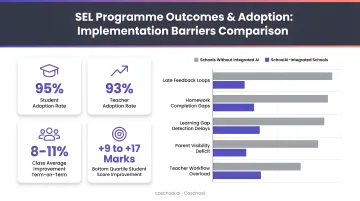
SchoolAI by Coschool shows what effective implementation looks like. The platform's Teacher Dashboard surfaces homework completion rates, question-level performance, and common error patterns before the next class — giving teachers actionable data without extra checking time. Partner school outcomes include 95% student adoption, 93% teacher adoption, an 8–11% class average improvement Term-on-Term, and teachers saving 2–3 hours daily on tasks like homework evaluation and lesson planning.
The key design principle — one the U.S. Department of Education also emphasises — is keeping humans in the loop. Vin, SchoolAI's AI tutor, never gives direct answers; it guides students toward them under teacher control. Technology-integrated management works when it extends teacher capacity rather than replacing teacher judgment.
How to Choose the Right Type of Classroom Management
There is no universally correct approach. The right type aligns with your students' needs, your goals, your context, and your own personality as a teacher. Most experienced teachers blend multiple types — behaviour management for structure, authoritative relationships as the relational layer, and proactive planning to head off problems early.
Key factors to weigh when selecting an approach:
- Student age and developmental stage — younger students often need more structure; older students typically respond better to higher involvement and autonomy
- Nature of behavioural challenges — recurring disengagement may call for SEL or restorative approaches; acute disruption may need clearer behaviour management systems
- Class size — larger classes benefit from stronger content and proactive management structures
- Primary goal — purely academic performance versus holistic development will shape which types to prioritise
- Your own personality — a teacher who is naturally warm and relational will find authoritative approaches more sustainable than rigid authoritarian ones
The most common mistake is defaulting to one style because it feels familiar — without checking whether it actually serves the students in front of you. Low engagement, worsening behaviour patterns, or rising teacher stress are signals that the current approach needs revisiting. Start by observing what's not working, then make one deliberate shift at a time.
Frequently Asked Questions
What are the types of classroom management?
Classroom management types fall into two categories: the 4 classic styles (Authoritarian, Authoritative, Permissive, Indulgent) derived from Baumrind's parenting research, and strategy-based types such as behaviour management, content management, proactive, restorative, SEL-based, and technology-integrated management.
What are the 4 C's of classroom management?
The 4 C's — Content, Conduct, Community, and Covenant — organise classroom management around four pillars: what students learn, how they behave, the relationships they build, and the shared norms that set expectations. ASCD links this framework directly to 21st-century learning readiness.
What is the Big 8 classroom management?
The Big 8 refers to eight evidence-based strategies identified by Missouri SW-PBS and grounded in PBIS principles: classroom expectations, procedures and routines, encouraging expected behaviour, discouraging inappropriate behaviour, active supervision, opportunities to respond, activity sequencing and choice, and task difficulty.
What is the most effective type of classroom management?
Studies across multiple school contexts identify authoritative management as most effective, given its balance of firm expectations and genuine student involvement. In practice, experienced teachers typically blend multiple types — combining authoritative relationships with proactive planning and behaviour management systems.
What is the difference between proactive and reactive classroom management?
Proactive management prevents problems through clear routines, co-created norms, and engaging instruction designed before issues arise. Reactive management responds to problems after they occur. Effective teachers use both, but prioritise proactive strategies — the TALIS 2018 data showing 13% of class time spent on order-keeping reflects the cost of over-reliance on reactive approaches.
How can technology support classroom management in 2026?
AI-powered platforms can help teachers track engagement, identify learning gaps before they compound, personalise instruction at scale, and streamline parent communication — all of which reduce the management burden on teachers. What determines outcomes is how well the technology embeds into existing teacher workflows rather than creating new ones alongside them.