Introduction
Picture this: a student spends three evenings studying for a unit test, feels confident walking in, and still underperforms. The problem isn't effort — it's that they didn't know what they didn't know. That gap between perceived and actual understanding is exactly where most traditional study methods fail.
AI-powered self-assessment tools are changing that equation. Instead of finding out where you went wrong after the exam, students can identify knowledge gaps during preparation, when there's still time to fix them.
A February 2025 EdWeek poll of 1,186 respondents found 60% of teachers now integrate AI into their lessons — a figure that reflects how quickly classroom practice is moving. That shift is redefining assessment itself: from a one-time event into a continuous, personalised feedback loop.
This guide covers the best AI tools for student self-assessment and learning, plus a clear framework for choosing the right one.
Key Takeaways
- AI self-assessment tools give students real-time, data-driven feedback — spotting gaps before exams, not after
- The best tools combine adaptive learning, conversational feedback, and progress tracking over time
- Coschool's SchoolAi is purpose-built for Indian K-12 schools — connecting students, teachers, and parents in one closed loop
- Key selection criteria: personalization depth, ease of independent use, feedback quality, school integration, and student safety
What Is AI-Powered Student Self-Assessment?
Student self-assessment is the practice of evaluating your own understanding, identifying weak areas, and directing your own learning accordingly. Research supports it: Karaman's 2021 meta-analysis of over 7,650 participants found an overall effect of g = 0.37 on academic performance from self-assessment interventions.
The challenge is accuracy. Students tend to overestimate their own performance — research by Leon, Panadero et al. found an overestimation effect of g = 0.206, which diminished when students received objective external feedback. This is the core problem that AI helps solve.
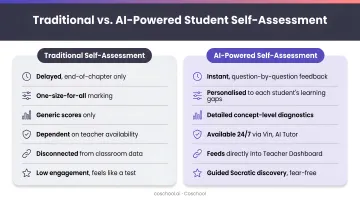
Traditional self-assessment relies on static quizzes or personal judgment calls. AI-powered approaches use natural language processing, adaptive algorithms, and learning analytics to give students an unbiased read on where they actually stand. The feedback is immediate, specific, and actionable — delivered in the moment rather than as a summary after the fact.
Here's what that shift looks like in practice:
- Traditional: end-of-chapter quiz scores with no diagnostic depth
- AI-powered: real-time gap detection with targeted follow-up prompts
- The result: students correct misconceptions while the concept is still fresh
Best AI Tools for Student Self-Assessment & Learning
These tools were evaluated for feedback quality, adaptability, student-friendliness, and practical school use.
Coschool SchoolAI
Built on 33+ years of education institution experience through People Combine Group, Coschool's SchoolAI is India's school-integrated closed-loop learning platform. Its AI tutor, Vin — India's first school-integrated AI tutor — uses Socratic questioning to guide students toward answers rather than simply providing them.
What makes it distinct for self-assessment:
- Vin never gives direct answers — only progressive guiding questions
- A 3-strike support system unlocks hints after three wrong attempts and alerts the teacher if a student stays stuck
- Hesitation detection flags disengagement before a student even asks for help
- Unlimited retries with no fear of judgment
The platform's revision tools directly support exam preparation:
- Recap Map — a clickable chapter overview with nodes for videos, definitions, and key concepts
- Exam Booster — curated high-yield questions students can answer directly or explore with Vin
- Create Your Own Test — students select question type, count, and chapter scope to self-test on demand
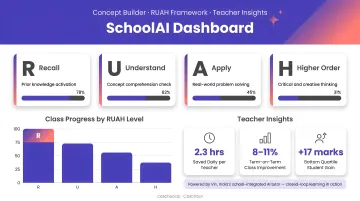
SchoolAI also tracks progress across a RUAH question framework (Recall, Understand, Apply, Higher-Order), so students can assess their own depth of understanding at each cognitive level, not just surface recall.
Across partner schools — including The Heritage School Delhi, Meridian School Hyderabad, and The Sri Ram School Hyderabad — SchoolAI has reported 95% student adoption, 93% teacher adoption, and 8–11% class average improvement term-on-term.
| Attribute | Detail |
|---|---|
| Key Features | Conversational AI tutor (Vin), RUAH framework, Exam Booster, Recap Map, Create Your Own Test, real-time progress insights for teachers and parents, 3-strike support system, hesitation detection |
| Best For | K–12 school students seeking guided, curriculum-aligned self-assessment with teacher and parent visibility |
| Availability | School-integrated platform for Indian private schools; contact Coschool for institutional access |
Kahoot!
Kahoot! is a widely used gamified learning platform that lets teachers and students create interactive quizzes for formative self-assessment in classroom and remote settings. It now includes AI-assisted quiz generation from PDFs, URLs, and topics.
Its game-based format boosts willingness to self-test — students who might resist a traditional quiz will play a Kahoot! round repeatedly. Instant feedback after each question helps students flag exactly which topics need more work. A solo play mode supports independent, self-paced practice outside the classroom.
| Attribute | Detail |
|---|---|
| Key Features | Gamified quizzes, AI-assisted content creation, pre-made content library, real-time performance analytics, solo and classroom modes |
| Best For | Students and teachers who want an engaging, competitive self-assessment format for topic revision |
| Pricing | Free plan (up to 40 participants); paid plans from $3/month billed annually — verify current tiers at kahoot.com/schools/plans |
Quizizz (now Wayground)
Quizizz has rebranded as Wayground — an AI-powered quiz platform built for self-paced learning. Students take assessments independently and receive detailed feedback on performance.
Unlike live-only tools, Wayground lets students revisit incorrect answers with AI-driven explanations, and its adaptive question banks personalise difficulty over time. For independent exam preparation, the ability to generate quizzes from text, web links, or files — then self-test with performance tracking — makes it practical.
| Attribute | Detail |
|---|---|
| Key Features | Self-paced quiz mode, AI-generated questions, adaptive question banks, detailed performance reports |
| Best For | Students who prefer independent, self-directed revision with structured progress tracking |
| Pricing | Free Basic plan available; verify current paid tiers at wayground.com/home/plans |
Khan Academy (with Khanmigo)
Khan Academy is a globally recognized free learning platform, now enhanced with Khanmigo — an AI tutor powered by GPT-4 that guides students through subjects using Socratic questioning rather than just providing answers.
Khanmigo's conversational approach mirrors a human tutor, encouraging students to reason through problems themselves. It provides step-level feedback during problem-solving, making it suited to deep self-assessment rather than surface-level quizzing. Coverage spans maths, science, humanities, and more.
Note: Khan Academy's efficacy page confirms that Khanmigo outcome studies are ongoing — long-term data isn't published yet, though the Socratic design approach is well-established.
| Attribute | Detail |
|---|---|
| Key Features | GPT-4 Socratic tutoring (Khanmigo), mastery-based progress tracking, subject-specific exercises, free core platform access |
| Best For | Students wanting a free, subject-rich AI tutor that builds understanding rather than just testing recall |
| Pricing | Khan Academy free; Khanmigo $4/month or $44/year for parents and learners, free for teachers — verify at khanmigo.ai/pricing |
Socrative
Socrative is a real-time classroom response tool that enables teachers to run formative assessments, exit tickets, and polls — giving both students and teachers immediate visibility into learning progress at the end of a lesson.
Its exit ticket feature is particularly useful: students quickly gauge their own understanding before a learning gap has a chance to solidify. The option to display results without individual student names encourages more honest participation. It's not an AI tutor, but as a low-friction formative check built into classroom rhythm, it fills a specific and valuable gap.
| Attribute | Detail |
|---|---|
| Key Features | Exit tickets, live quizzes, anonymous polling, instant class-wide and individual results |
| Best For | Teachers and students who need quick, low-pressure formative checks tied directly to classroom instruction |
| Pricing | Free tier (5 quizzes, 1 room, 50 students); paid plans from $10/seat/month — verify at socrative.com/pricing |
How We Chose the Best AI Tools for Student Self-Assessment
A common mistake when evaluating AI learning tools is prioritising surface-level features — gamification, slick interfaces — over whether the tool actually closes knowledge gaps. The more useful question: does this help students understand what they got wrong and improve?
Here's the evaluation framework:
- Feedback quality — Is it immediate, specific, and actionable, or just a final score?
- Personalization and adaptability — Does the tool adjust to the individual student's performance over time?
- Independent usability — Can students use it without constant teacher setup?
- School integration — Do teachers and parents get meaningful visibility into student progress?
- Student safety — Does the platform comply with relevant data protection standards and use age-appropriate guardrails?
- Accessibility — Is there a workable free option, or is meaningful functionality paywalled?

These criteria aren't arbitrary. A 2022 meta-analysis of 48 studies and 116,051 students found that formative assessment produced a +0.31 effect size on achievement when student-directed — not just administered by teachers. That distinction shaped every tool on this list.
The best tools here share one trait: they position students as active evaluators of their own learning, not passive recipients of scores.
Conclusion
The right AI self-assessment tool doesn't just grade answers — it helps students understand why they got something wrong and what to do next. That distinction separates tools that feel productive from tools that actually are.
For individual students studying independently, a free subject-rich tool like Khan Academy with Khanmigo is a strong starting point. For classroom use with quick formative checks, Kahoot! and Socrative work well. For structured independent revision, Wayground's adaptive question banks deliver solid value.
For Indian schools that need a platform connecting student learning, teacher oversight, and parent engagement in one integrated system — with curriculum alignment to NCERT, CBSE, ICSE, and NEP 2020 — Coschool's SchoolAI is built specifically for that context. Schools looking to bring personalised self-assessment into their classrooms can contact Coschool to explore institutional access.
Frequently Asked Questions
What is AI-powered student self-assessment?
AI-powered self-assessment uses adaptive algorithms and real-time analytics to help students evaluate their own knowledge, identify gaps, and receive personalized feedback. Unlike traditional self-quizzing, it delivers objective, data-driven insight into actual understanding, not just a confidence check.
How do AI tools help students identify knowledge gaps?
AI tools track patterns across a student's responses, flag consistently incorrect concepts, and generate targeted practice or explanations. The focus shifts from final scores to targeted areas for improvement, so students leave knowing exactly what to work on.
Can AI assessment tools replace teachers in the classroom?
No — and they shouldn't try to. AI tools extend teacher capabilities by surfacing data and providing 24/7 support, but teachers remain essential for interpreting nuanced student needs, providing emotional guidance, and making high-stakes academic decisions.
Are AI learning tools safe and appropriate for school-age students?
Look for platforms that comply with India's Digital Personal Data Protection Act, 2023 (or equivalent regulations such as FERPA and COPPA for international contexts), use age-appropriate content, and allow teacher and parent oversight. SchoolAI, for instance, blocks copy-paste, restricts internet access, and requires verifiable parental consent for users under 18.
What features should I look for in an AI self-assessment tool?
Prioritize real-time adaptive feedback, personalized learning paths, progress tracking over time, ease of independent use, and the ability for teachers or parents to monitor performance. Avoid tools that only show final scores without explaining what went wrong.
Do AI self-assessment tools actually improve academic performance?
Research supports frequent, low-stakes formative assessment — which AI enables at scale — as a proven strategy for improving retention and outcomes. The key is timely, specific feedback that students can act on. Students see the most improvement when they engage with that feedback rather than just collecting scores.