Gallup's 2024 survey of K-12 students found that fewer than two in ten students strongly agree that what they learn in class feels important, interesting, challenging, or aligned with their natural talents. That's a striking signal — not just about engagement, but about ownership.
This guide defines self-directed learning (SDL), distinguishes it from self-regulated learning, outlines its core characteristics and benefits, walks through the five practical steps, and explains how teachers can genuinely support it — including where technology fits in.
Key Takeaways
- Self-directed learning (SDL) is an approach where learners take initiative in diagnosing their own needs, setting goals, identifying resources, and evaluating outcomes.
- SDL is broader than self-regulated learning (SRL): SRL is one process nested inside SDL, not a synonym for it.
- Key benefits: deeper engagement, stronger critical thinking, lifelong learning habits, and greater confidence.
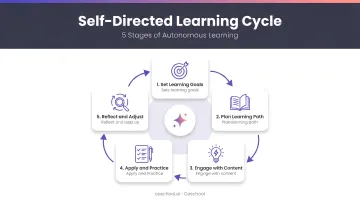
- SDL follows five cyclical steps: diagnose needs → set goals → identify resources → implement a plan → evaluate outcomes.
- In SDL, teachers shift from information-givers to learning architects — more strategic, not less important.
What Is Self-Directed Learning?
Malcolm Knowles, who established the foundational definition in 1975, described SDL as:
"A process in which individuals take the initiative, with or without the help of others, in diagnosing their learning needs, formulating learning goals, identifying human and material resources for learning, choosing and implementing appropriate learning strategies, and evaluating learning outcomes."
SDL isn't just students studying independently. It's a complete process of owning the why, what, how, and how well of learning.
A common misconception is that SDL means unstructured or unsupervised learning. It doesn't. Learners still operate within a framework; teachers and platforms can provide scaffolding, curriculum alignment, and feedback. What changes is who holds the wheel.
Distinguishing SDL from Self-Regulated Learning (SRL)
These two terms get conflated often. They're related but not interchangeable.
| Self-Directed Learning (SDL) | Self-Regulated Learning (SRL) | |
|---|---|---|
| Scope | Broad — a mindset and approach to learning | Narrow — a task-level cognitive process |
| Trigger | Internally driven; learner decides to pursue it | Often externally prompted (test, assignment) |
| Ownership | Learner selects goals, resources, and evaluation criteria | Tasks may be teacher-set; learner manages their approach |
| Key traits | Curiosity, accountability, adaptability, perseverance | Planning, monitoring, self-assessment |
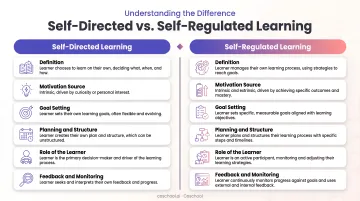
According to research distinguishing these constructs, SDL is a macrolevel construct while SRL operates at the microlevel, functioning as a mechanism within SDL rather than a synonym for it.
This distinction has direct consequences for classroom design. A teacher who assigns a reflection worksheet and labels it "self-directed learning" may be supporting SRL without ever giving students genuine ownership over goals or resources. The two can coexist, but only SDL asks: who decided what to learn, and why?
Key Characteristics of Self-Directed Learners
Self-directed learners share a recognisable profile — though none of these traits are fixed. They're developed, not born with.
Core traits:
- Learn to understand, not just to pass — curiosity drives them more than grades
- Honestly map their own gaps — they know what they don't yet know
- Goal orientation — they set specific objectives connected to real-world relevance, not just syllabus completion
- Accountability — they take responsibility for their progress without needing constant external enforcement
- Reflective habit — they regularly assess whether their approach is working and adjust accordingly
That last trait is worth pausing on. SDL isn't a fixed personality trait some students "have." It's a skillset that develops with the right environment and modelling. A student who struggles with self-direction in Grade 5 can become a genuinely autonomous learner by Grade 9 — if the conditions are right.
Those conditions don't emerge by accident. Creating them is the teacher's work — which means SDL doesn't reduce the need for skilled educators. It redefines what skilled teaching actually involves: less transmission, more scaffolding of the learner's own capacity to think and progress independently.
Benefits of Self-Directed Learning
Deeper Engagement and Critical Thinking
When students have a say in what they learn and how, engagement shifts from compliance to curiosity. A 2022 systematic review of 31 longitudinal studies involving over 20,000 students found that teacher autonomy support — a core SDL mechanism — is one of the most important teaching-practice determinants of student engagement.
SDL also builds skills that go well beyond subject knowledge:
- Research and independent inquiry
- Decision-making under uncertainty
- Time management and self-organisation
- Problem-solving and resilience
The demand for these capacities is well-documented. The WEF's Future of Jobs Report 2025 reports that employers expect 39% of workers' core skills to change by 2030, and that analytical thinking is considered essential by 7 in 10 companies. SDL directly trains the capacities that underpin those skills.
Personalisation That Actually Works
Traditional schooling applies the same pace, format, and sequence to every student. SDL breaks that constraint. Learners can engage with content through formats that suit them:
- Video explanations and visual demonstrations
- Discussion and collaborative problem-solving
- Project-based and hands-on work
- Practice problems at their own pace
When students move at their own pace with content that meets them where they are, the result is genuine mastery — not surface-level familiarity.
Lifelong Learning Habits and Confidence
SDL trains students to notice their own knowledge gaps and take initiative to address them. That orientation doesn't stop at graduation — it becomes the foundation for continuous growth throughout a career.
There's also a confidence dimension. As students set goals, work through challenges, and meet their own objectives, they build self-efficacy — the belief that effort produces results. This matters most for students who've struggled in traditional systems, where fixed-pace instruction often confirms gaps rather than closing them.
The Five Steps of Self-Directed Learning
Most SDL models, including Knowles' foundational framework, follow a clear cyclical progression. These steps aren't always linear — learners often loop back — but they provide a reliable structure.
Step 1: Diagnose Learning Needs
Before setting any goal, a learner must honestly assess what they already know and where the gaps are. This might involve a diagnostic test, a reflective prompt, a conversation with a teacher, or simply working through a problem set and noticing where understanding breaks down.
The quality of everything that follows depends on how honest and accurate this self-assessment is. Scaffolding helps here — especially for younger learners.
Step 2: Set Learning Goals
Goals in SDL should be specific, meaningful, and connected to real-world purpose. Frameworks like SMART goals or Bloom's Taxonomy objectives give learners clear direction and measurable criteria for success.
A goal like "understand photosynthesis" is vague. A goal like "be able to explain the light-dependent and light-independent reactions with an example" is specific enough to evaluate.
Step 3: Identify Resources and Strategies
The learner selects resources and methods that suit their goals and learning style. Access to diverse options matters far more than following a single prescribed textbook.
Options might include:
- Explanatory videos for concept introduction
- Practice problems for skill-building
- Peer discussion for reasoning out loud
- Mentors or teachers for clarification
- Online platforms for self-paced exploration
SchoolAi's Self-Learn Module is built on exactly this idea: students pick from five learning paths (Quick Review, Thorough Understanding, Problem-Solving Focus, Exam Simulation, and Mixed) based on what they actually need.
Step 4: Implement the Learning Plan
Active engagement during this phase produces better retention than passive consumption. Spaced repetition, deliberate practice, and problem-solving all outperform re-reading or rewatching.
The key at this stage is staying engaged with the material rather than just going through the motions. Socratic questioning tools like Vin, Coschool's school-integrated AI tutor, support this by guiding students to answers through questions rather than actively support this kind of engaged implementation.
Step 5: Evaluate Outcomes and Reflect
SDL is cyclical. Once a learning phase is complete, the learner evaluates whether goals were met through self-assessment, feedback, or tangible evidence of skill, then uses that reflection to identify the next set of needs.
Tools like Coschool's Create Your Own Test and Recap Map give students structured ways to self-assess their readiness and reflect on remaining gaps, turning revision from passive review into active evaluation.
How Teachers Can Support SDL in the Classroom
The teacher's role in SDL isn't diminished — it's redesigned. Instead of being the primary source of all knowledge, teachers become architects of the learning environment. They design the conditions in which SDL can happen.
Practical Strategies
Harvard Graduate School of Education's research by Karen Brennan identifies three structures that support self-directed work: personal interests, access to others, and time. These translate into specific classroom practices:
- Share clear learning objectives so students understand what they're working toward
- Help students identify their own questions and interests within a topic
- Incorporate daily goal-setting and reflection — portfolios and progress journals make learning visible
- Give learners choice in how they demonstrate knowledge — not every concept needs a written test
- Model curiosity — ask genuine questions in class, not just rhetorical ones
- Develop feedback protocols so students can learn from peers, not just from you
- Provide constructive, gap-specific feedback that guides students toward what to work on next
Where Technology Helps
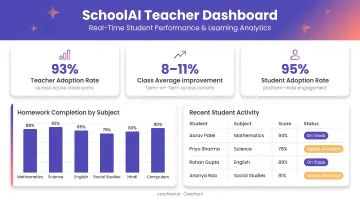
Strategies get teachers most of the way there. The harder problem is scale: sustaining 40 individual learning journeys simultaneously is beyond what any set of strategies alone can manage. Platforms like SchoolAI are designed to extend teacher judgment here — not replace it.
SchoolAI's Teacher Dashboard surfaces real-time data on completion rates, time spent, question-level performance, and common error patterns. Teachers can see exactly where each student struggled before the next class begins — enabling targeted facilitation rather than generic re-teaching.
The Dynamic Lesson Plan Generator then calibrates plans to section-level gaps, so each class receives instruction matched to its actual learning state rather than a generic syllabus position.
The result is SDL-supporting infrastructure that fits within existing timetables and curricula — schools don't need to overhaul existing schedules to make it work.
Common Challenges and How to Overcome Them
| Challenge | What It Looks Like | Practical Fix |
|---|---|---|
| Learner readiness | Younger students struggle with full autonomy before building self-awareness and planning skills | Use Grow's Staged Model — start structured, gradually release responsibility. Offer constrained choices (pick from three resources, not open search) as an intermediate step |
| Teacher adaptation | The facilitator role requires restraint, which feels counterintuitive mid-lesson when students look stuck | Professional development, peer collaboration, and structured SDL frameworks ease the shift — it's less about abandoning what works and more about knowing when to step back |
Frequently Asked Questions
What are the steps of self-directed learning?
The five core steps are: diagnosing learning needs, setting goals, identifying resources and strategies, implementing the learning plan, and evaluating outcomes. The process is cyclical — after evaluation, learners diagnose their next set of needs and the cycle restarts.
What's the difference between DLL and DLP?
A Daily Lesson Log (DLL) is a standardised weekly template recording how prepared lessons were delivered; a Detailed Lesson Plan (DLP) is a more comprehensive document covering objectives, content, methods, and assessment for a specific lesson. In SDL-informed classrooms, both can be adapted to include learner-driven activities and flexible pacing.
What is the difference between self-directed learning and self-regulated learning?
Self-regulated learning (SRL) is a task-level process of planning, monitoring, and self-assessing — typically triggered by an external prompt like an assignment or test. SDL is the broader mindset that encompasses SRL while also including internally driven traits: curiosity, accountability, and the initiative to learn without being prompted.
What are the main characteristics of a self-directed learner?
Key traits include intrinsic motivation, goal orientation, honest self-awareness about learning gaps, accountability for one's own progress, and a reflective habit of continuously evaluating and improving their approach to learning.
Can self-directed learning work for young or primary school students?
Yes — with appropriate scaffolding. For younger learners, teachers provide more structure and gradually release responsibility as students build self-awareness and confidence. SDL isn't an all-or-nothing approach; even small choices (how to practise, what to review first) begin developing the orientation.
What is the role of a teacher in self-directed learning?
Teachers in SDL act as facilitators — designing the environment, providing resources and feedback, modelling curiosity, and helping students identify their own gaps. The shift is from delivering content at the front of the room to building the conditions where students can genuinely direct their own progress.