
Introduction
When curriculum lacks clear guiding principles, teachers are left to fill the gaps on their own — every single day. That means different students in different classrooms learning different things at different depths, not because of teacher capability, but because of systemic design failure.
This is a planning problem, not a people problem.
The data bears this out. According to RAND's 2025 research on K-12 instructional material use, 45% of teachers are "cobblers" — assembling curriculum from multiple sources, including self-created materials, spending 30 extra minutes per week on planning compared to teachers using structured materials. Multiplied across thousands of classrooms, that's a significant collective cost with no guarantee of coherence.
What follows are 20 principles of curriculum development organized into four clusters — covering design intent, learner focus, implementation, and continuous improvement. They apply across grade levels, from primary through secondary, and are meant to function as a working framework, not a checklist.
Key Takeaways
- Curriculum development is the structured process of deciding what students learn, how it's sequenced, how it's taught, and how progress is measured
- Strong curricula are built on principles that prioritize student need, instructional coherence, and continuous improvement
- The 20 principles are organized into four clusters: Student-Centered Design, Coherence and Rigor, Assessment and Teacher Support, and Inclusion and Innovation
- These principles apply across school types and grade levels
- Applying these principles leads to greater classroom consistency, stronger teacher practice, and more equitable student outcomes
What Is Curriculum Development and Why Do Principles Matter?
Curriculum development is the deliberate, structured process of deciding what students will learn, in what sequence, how it will be taught, and how progress will be assessed — across an entire course or school year, not lesson by lesson.
Without shared guiding principles, curriculum decisions become reactive, arbitrary, or driven by individual preference rather than evidence and student needs. Principles create alignment across teachers, grades, and schools.
Two terms often get conflated here:
- Curriculum development — the design process: the framework, philosophy, and structure that defines what learning should look like
- Curriculum planning — the tactical execution: scheduling, mapping, and sequencing that design into classroom-ready plans
Principles govern development. That design, in turn, determines how teachers structure lessons, how assessments are built, and how learning is sequenced from one grade to the next.
Principles 1–5: Student-Centered Learning Design
These five principles anchor the entire curriculum in the learner — their needs, their development, and their lived experiences.
Principle 1: Learner-Centeredness
Curriculum must be designed around the developmental needs, prior knowledge, and learning styles of students — not primarily around content coverage. Instruction should begin with understanding who the learner is.
The Learning Policy Institute's science-of-learning synthesis identifies student agency, belonging, and developmental relationships as core school design principles. In practice, this means curriculum designers must ask who these students are and what they already know before deciding what must be taught.
Principle 2: Relevance to Real-World Contexts
Learning sticks when students understand why it matters. Curriculum should connect content to real-world problems, current events, and students' own lives.
This is not just a motivation strategy — the National Academies' How People Learn II synthesizes research showing that connecting new knowledge to students' existing contexts improves transfer and retention. Relevance gives new knowledge a meaningful anchor.
Principle 3: Developmentally Appropriate Practice
Activities, assessments, and content must match the cognitive, social, and emotional stage of the learner. NAEYC's 2020 DAP position statement emphasizes that educators should factor in each child's individuality, shared developmental patterns, and broader context when making instructional decisions.
Developmentally inappropriate tasks lead to disengagement or frustration — not growth. The target zone is challenge without overwhelm. In practical terms, this means:
- Matching task complexity to current cognitive readiness
- Adjusting pacing when students show signs of frustration or boredom
- Differentiating within the same lesson rather than using a single standard
Principle 4: Active and Experiential Learning
Effective curriculum designs include opportunities for students to apply, explore, and construct knowledge through doing. A 2023 meta-analysis of project-based learning found that PBL significantly improved students' academic achievement, affective attitudes, and thinking ability compared to passive instruction.
Students who build, investigate, or present retain more and transfer knowledge to new situations more readily than those who listen and memorize alone.
Principle 5: Social-Emotional Integration
Academic and social-emotional development cannot be separated. CASEL's research summary reports that a meta-analysis of 213 school-based SEL programs involving 270,034 K-12 students found an 11 percentile-point academic achievement gain for SEL participants.
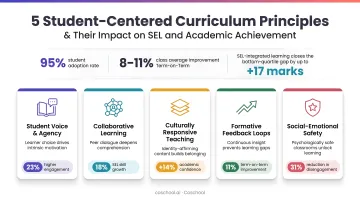
When SEL is embedded in the curriculum — not bolted on as a separate event — students develop self-regulation, empathy, and collaboration alongside academic skills.
Principles 6–10: Coherence, Rigor, and Purposeful Sequencing
These principles determine whether a curriculum builds cumulative knowledge or resets with every new unit. Get them right, and every lesson compounds on the last. Get them wrong, and even strong teaching can't compensate for the structural gaps underneath.
Principle 6: Coherence and Vertical Alignment
Coherence means lessons, units, and courses build logically on one another. Vertical alignment means each grade level genuinely prepares students for the next.
Without coherence, students encounter gaps or redundancy rather than progressive depth. A student who revisits the same concept three years running without advancement hasn't been taught poorly — they've been failed by curriculum architecture.
Principle 7: Rigor and Depth of Knowledge
Rigor means designing deliberate moments in the curriculum where students must think analytically, apply knowledge, and construct meaning — not simply recall facts.
Norman Webb's Depth of Knowledge (DOK) framework, explained by Edutopia's 2023 coverage, provides a practical lens for evaluating cognitive complexity across tasks and lessons. DOK levels range from recall (Level 1) to extended thinking (Level 4). Rigor is intentional design, not incidental difficulty.
Principle 8: Clear and Measurable Learning Objectives
Every unit and lesson should begin with objectives that clearly state what students will know and be able to do. Wiggins and McTighe's Understanding by Design framework makes the case plainly: start with desired results, then evidence, then the learning plan.
Vague objectives produce vague assessment and inconsistent instruction. Well-written objectives drive backward design — they are the fixed point everything else is built around.
Principle 9: Scope and Sequence Planning
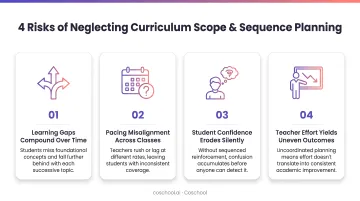
Scope defines what is covered. Sequence defines the order. Without deliberate decisions on both, important content gets skipped, repeated unnecessarily, or introduced before students are ready.
UNESCO's curriculum glossary and India's National Curriculum Framework for School Education 2023 both treat scope and sequence as foundational structural requirements. Well-planned scope and sequence decisions produce curricula that build progressively; poorly planned ones result in content that lurches forward with no logical throughline.
Key risks of neglecting scope and sequence:
- Critical concepts introduced before prerequisite knowledge is in place
- Topics repeated across grades without meaningful progression
- Important content skipped entirely due to poor planning
- Teachers forced to reteach foundational gaps mid-unit
Principle 10: Interdisciplinary and Thematic Integration
Siloed subject learning limits how students transfer and apply knowledge. A 2025 Review of Educational Research meta-analysis synthesised effects of integrated STEM education in K-12 settings, finding positive outcomes for integrated approaches versus traditional single-subject models.
Curriculum that intentionally connects themes, concepts, and skills across subjects — such as embedding literacy skills in science units — helps students build richer understanding and see learning as interconnected, not compartmentalised.
Principles 11–15: Assessment, Flexibility, and Teacher-Friendliness
These principles determine whether a curriculum can actually be used well in real classrooms — by real teachers, with real students, day after day.
Principle 11: Continuous and Embedded Assessment
Assessment should not be limited to end-of-unit tests. Curriculum design must embed ongoing checks for understanding throughout instruction so teachers can identify gaps in real time and adjust before those gaps compound.
IES/REL Central's 2017 review found formative assessment generally has a positive effect on elementary student achievement. The EEF's 2025 toolkit estimates feedback at an average of 5 months' additional progress — making embedded assessment one of the highest-leverage tools in curriculum design.
Platforms like SchoolAi (by Coschool) put this into practice through a 7-stage closed-loop workflow: teachers assign homework, Vin supports students with Socratic guidance, and teachers receive homework insights — including which questions tripped up most students — before the next class begins. This enables intervention before gaps compound rather than after.
Principle 12: Evidence-Based Instructional Design
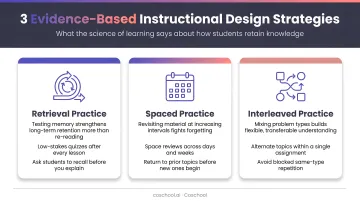
Dunlosky et al.'s foundational learning-science review identified practice testing and distributed practice as two of the highest-utility learning strategies available to educators — yet both remain underused in most curriculum designs.
The research case is clear. Curriculum designers should build in:
- Retrieval practice — low-stakes recall exercises spaced throughout a unit
- Spaced review — revisiting material at increasing intervals rather than in one block
- Interleaved problem sets — mixing problem types to strengthen discrimination between concepts
Each of these strategies has consistent empirical support. The curriculum should build them in by design, not leave them to individual teacher discretion.
Principle 13: Flexibility with Fidelity
A good curriculum sets clear intent and structure (fidelity), but allows teachers professional latitude to adapt instruction to the students in front of them (flexibility). The U.S. Department of Education's implementation science work frames this balance as a core challenge in scaling any educational program.
Over-prescription removes teacher agency; no structure creates inconsistency across classrooms. The goal is a curriculum coherent enough to deliver consistent outcomes and flexible enough for teachers to adapt it to the students actually in front of them.
Principle 14: Usability for Teachers
A curriculum is only as effective as a teacher's ability to use it confidently. RAND's 2025 data is clear: when materials are difficult to use, teachers modify, supplement, or abandon them. Only 7% of teachers in the Harvard CEPR study used their official curriculum exclusively.
Teacher usability is a design requirement, not an afterthought. If goals are unclear, pacing is unrealistic, or materials are inaccessible, the curriculum that exists on paper will not be the curriculum delivered in classrooms.
SchoolAi's "transformation without disruption" philosophy was built with this constraint in mind. Dynamic lesson plans calibrated to each section's learning state, one-click homework assignment, and automated homework checking give teachers 2–3 hours back daily — without requiring any change to their existing timetable or curriculum structure.
Principle 15: Formative and Summative Assessment Balance
Both formative (ongoing, low-stakes) and summative (end-point, higher-stakes) assessments serve distinct purposes. The OECD's 2025 teaching report frames formative assessment as evidence gathered around learning goals to support next steps — not as a preliminary version of the final exam.
A strong curriculum maps both types intentionally:
- Formative data informs instruction in real time
- Summative data evaluates mastery and curriculum effectiveness
The right balance shifts depending on where students are in the learning cycle — formative tools dominate during instruction, summative tools confirm readiness at the close.
Principles 16–20: Inclusion, Technology, and Continuous Improvement
These principles reflect what effective curriculum development must account for in 2026 — a world defined by diversity, technology, and the need to continuously evolve.
Principle 16: Inclusivity and Cultural Responsiveness
Curriculum must reflect and respect the cultural backgrounds, identities, and lived experiences of all students. UNESCO defines inclusive education as identifying and removing barriers across curricula, pedagogy, and teaching. Ladson-Billings' culturally relevant pedagogy framework, summarised by the California Department of Education, points to three pillars:
- Academic success — holding all students to high expectations regardless of background
- Cultural competence — affirming student identity within the learning experience
- Sociopolitical consciousness — developing students' awareness of their role in the broader world
A culturally responsive curriculum is not about adding a multicultural unit. It means designing learning experiences that affirm every student's identity while maintaining rigorous standards for all.
Principle 17: Family and Community Partnership
When curriculum design actively considers the home learning environment and creates touchpoints for family involvement, it strengthens student outcomes. EEF's 2025 parental engagement evidence summary estimates an average of 4 months' additional progress from well-designed parental engagement.
Parents and caregivers are not peripheral to the curriculum — they are partners in the learning process, particularly in foundational years. SchoolAi's parent platform operationalises this through daily homework visibility, specific dinner-table conversation prompts, and weekly learning updates — making family engagement concrete and actionable rather than aspirational.
Principle 18: Technology Integration as a Design Principle
In 2026, technology is not a supplement to curriculum — it is a design variable. UNESCO's 2024 AI Competency Framework for Students defines 12 competencies across 4 dimensions, while the U.S. Department of Education's 2023 AI report emphasises human oversight in all AI-assisted learning environments.
The goal is technology that serves learning, not learning that serves technology. That distinction shapes everything: AI tools should be embedded within curriculum boundaries, controlled by teachers, and evaluated against learning outcomes — not adopted because they're available.
Principle 19: Iterative Review and Continuous Improvement
Curriculum is a living document. High-performing schools build in cycles of review — using student outcome data, teacher feedback, and changing community needs — to refine and update the curriculum regularly. IES's 2025 continuous improvement toolkit describes this as sustained, collective, context-specific work.
Curriculum that is never revisited becomes outdated and misaligned. The review cycle should be built into the academic calendar, not triggered only when outcomes collapse.
Principle 20: Personalised and Adaptive Learning Design
Effective curriculum design in 2026 builds in personalisation from the start — ensuring that the pace, depth, and mode of instruction can adapt to each student's needs without requiring a complete overhaul.
Coschool's SchoolAi is built on this principle. Vin, India's first school-integrated AI tutor, provides personalised Socratic guidance within existing curriculum boundaries. The Self-Learn Module's five learning paths give students agency over depth and pace. The EDGE Programme goes further — creating personalised learning paths per student per chapter, based on individual performance profiles, so high-performing students are appropriately challenged while struggling students receive targeted support.
The outcomes are measurable: SchoolAi partner schools consistently report 8–11% class average improvement Term-on-Term and +9 to +17 marks improvement for bottom-quartile students.
How Schools Can Apply These 20 Principles in 2026
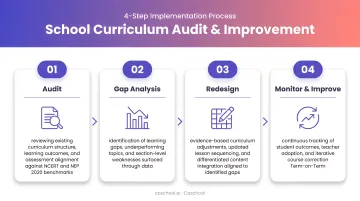
Applying all 20 principles at once is not the goal. Schools should start by auditing their existing curriculum against these principles and identifying the **3–5 gaps with the most immediate impact on student outcomes**.
A practical starting point:
- Convene a cross-functional review team — teachers, department heads, and school leadership — to assess the current curriculum's coherence, usability, and assessment integration before redesigning anything from scratch
- Audit for the highest-leverage gaps first — coherence, clear objectives, and formative assessment integration typically produce the most immediate gains
- Prioritize teacher usability — a well-designed curriculum that teachers can't or won't use is no curriculum at all
- Build review cycles into the calendar — schedule termly or annual curriculum review sessions using student performance data, not just intuition
These review cycles matter more now than they did five years ago. As AI tools embed deeper into school workflows, principles like personalised learning, continuous assessment, and technology integration are shifting from aspirational to expected. Schools that act on these gaps now will be better positioned when those expectations become standard — not scrambling to catch up.
For schools ready to act on these principles, Coschool's SchoolAI is built around this exact philosophy. Its closed-loop model connects classroom teaching, student practice, and learning gap detection in real time — through tools like Vin (an AI tutor that guides rather than answers) and teacher dashboards that surface insights without adding to a teacher's workload. Crucially, it integrates into existing curriculum, timetables, and teaching staff rather than displacing them.
Frequently Asked Questions
What are the principles of curriculum planning?
Curriculum planning principles are the guiding values and design criteria — such as coherence, learner-centeredness, and alignment to objectives — that shape how a curriculum is structured, sequenced, and delivered. They ensure curriculum decisions are driven by student need and evidence rather than personal preference or habit.
What are the 7 steps in curriculum planning?
The typical steps are: needs assessment, defining learning objectives, selecting content, choosing instructional strategies, identifying resources, implementing the plan, and evaluating and revising outcomes. Each step builds on the previous to ensure curriculum decisions are deliberate and aligned.
What are the 7 principles of CBC?
Competency-Based Curriculum (CBC) principles typically include learner-centeredness, relevance, flexibility, inclusivity, coherence, assessment for learning, and community involvement. Specific frameworks vary by country and education authority, but these principles appear consistently across CBC models globally.
What is the most important principle of curriculum development?
While all principles work together, learner-centeredness is widely considered foundational. A curriculum that ignores the student's needs, prior knowledge, and developmental stage is unlikely to produce meaningful or lasting outcomes — even when every other principle is applied correctly.
How does technology support modern curriculum development?
Technology supports curriculum development by enabling adaptive learning pathways, real-time formative assessment, and data-driven curriculum review. This helps schools move beyond uniform delivery toward instruction that responds to each student's actual progress. The key is embedding technology within curriculum design, not layering it on top as an afterthought.