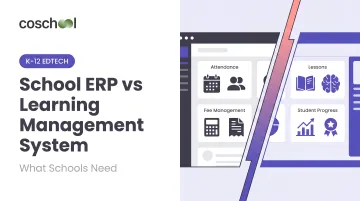
This scenario plays out across thousands of Indian schools daily. The confusion between School ERP and LMS is understandable — both are "school software," both promise to solve problems, and both get lumped into the same budget conversation. But they solve completely different problems for completely different people.
This article clarifies what each system actually does, where the real differences lie, and how school leaders can make a clear-headed decision about which investment their school needs right now.
Key Takeaways
- A School ERP manages the operational backbone — admissions, fees, HR, attendance, timetables, and compliance reporting.
- An LMS manages the learning experience — content delivery, assessments, student progress tracking, and teacher-student interaction.
- ERP serves administrators; LMS serves teachers, students, and learning outcomes.
- The right choice depends on your school's most urgent pain point: operational chaos vs. learning quality gaps.
- The strongest LMS options today close the loop between classroom teaching, student practice, and real-time learning insights — rather than just delivering content and stopping there.
School ERP vs LMS: Quick Comparison
| Dimension | School ERP | Learning Management System |
|---|---|---|
| Primary Purpose | Centralises administrative and financial operations | Delivers, manages, and tracks learning experiences |
| Primary Users | Principals, admin staff, finance, HR | Teachers, students, parents |
| Core Functions | Enrollment, fees, attendance, payroll, timetables, compliance | Course content, assignments, assessments, progress tracking |
| Impact on Learning | Indirect — frees admin time, doesn't improve learning | Direct — shapes quality and personalisation of teaching |
| Deployment Complexity | High — multiple departments, data migration required | Faster rollout — most schools deploy within days; adoption is limited to teachers and students |
What Is a School ERP?
A School ERP (Enterprise Resource Planning) system is a centralised software platform that integrates the administrative, financial, and operational functions of a school into one unified system. The concept adapted from business ERP software to meet the specific needs of educational institutions, replacing disconnected spreadsheets, paper registers, and siloed departmental tools.
Why It Matters at Scale
India's school system operates at a scale that makes manual administration genuinely unworkable. UDISE+ 2024-25 data reports 1,471,473 schools, 246,932,680 students, and 10,122,420 teachers across the country. Student-wise data collection now captures 60+ fields per student with a unique Educational ID — a compliance burden that manual systems cannot manage reliably.
The operational impact of proper ERP adoption is documented. In Uttar Pradesh, the Vidya Samiksha Kendra reduced school-level registers from 20 to 12, and the Manav Sampada HR platform now supports 7 lakh teachers for payroll, leave, and transfer settlements — concrete evidence that the right administrative system removes real operational friction.
Core ERP Modules for Indian Schools
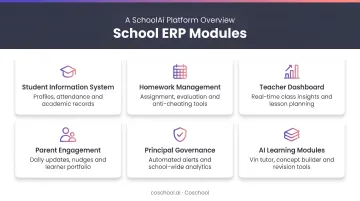
A functional School ERP typically covers:
- Admissions and enrollment management — application processing, document collection, student records
- Fee and payment tracking — collection, receipts, outstanding balances, GST compliance
- Staff and HR management — payroll, leave, transfers, service records
- Attendance automation — daily student and staff attendance with reporting
- Timetable generation — period scheduling, teacher allocation, room management
- Regulatory reporting — CBSE OASIS, UDISE+ submissions, board compliance
What a School ERP Cannot Do
An ERP records that a student attended class. It cannot tell you what that student understood during that class. ERP systems do not create lesson plans, assess learning quality, personalise instruction, or engage students with content.
When Schools Need ERP First
ERP delivers the clearest value for:
- Schools growing rapidly from 500 to 2,000+ students, drowning in paper records
- Multi-campus institutions managing staff and finances across locations
- Schools struggling with fee leakage, audit failures, or compliance stress
- Institutions where manual processes are creating data errors and administrative bottlenecks
What Is a Learning Management System?
An LMS is a digital platform designed to create, organise, deliver, and track educational content and learning experiences. Its focus is entirely on what happens between teachers and students — not between administrators and spreadsheets.
Core LMS Functions
A fully functional LMS provides:
- Course content libraries and structured lesson delivery
- Assignment creation, submission, and management
- Quizzes, assessments, and grading tools
- Student progress dashboards and learning analytics
- Communication between teachers, students, and parents
- Tracking of who has mastered material and who needs additional support
The LMS Evolution: From Content Repositories to Closed-Loop Learning
Early LMS platforms were essentially digital filing cabinets: teachers uploaded materials, students downloaded them, and the feedback loop between content delivery and learning outcomes was weak or non-existent.
Modern AI-powered platforms have fundamentally changed this. Coschool's SchoolAi operates on a closed-loop learning model — a 7-stage workflow that connects classroom teaching, student practice, learning insights, and personalised action in real time.
Vin, SchoolAi's school-integrated AI tutor, never gives students direct answers. Instead, it asks guiding questions that lead students to discover answers themselves, building genuine understanding rather than memorisation. That distinction separates an LMS that delivers content from one that actively drives learning outcomes.
Why Indian Schools Specifically Need This
Large class sizes create a structural problem that no amount of good teaching can fully solve alone. UDISE+ 2024-25 reports a pupil-teacher ratio of 23 at the higher secondary level — one teacher, 23 students, with no realistic way to track individual understanding manually.
The learning gap data is stark. ASER 2024 found that only 23.4% of Std III children in government schools could read Std II-level text, and only 30.7% of Std V children nationwide could solve a basic division problem. These gaps compound over time, and technology-assisted personalised learning is one of the few tools that can address them at scale.
Research backs this up: a peer-reviewed randomised controlled trial across Indian schools found that technology-aided instruction raised test scores by 0.37 standard deviations in maths and 0.23 standard deviations in Hindi over just 4.5 months.

When Schools Need an LMS First
An LMS delivers strongest results when:
- Students are underperforming and teachers lack structured tools to identify why
- Class sizes make differentiated instruction impossible without technology
- Parents have low visibility into their child's daily learning progress
- The school is targeting improved board exam results
- Teachers are stretched thin and need real-time insight into who needs help
Which Should Your School Choose?
The most honest answer: it depends on where your school is bleeding most.
The Decision Framework
Choose ERP first if your primary challenge is operational:
- Fee leakage or audit failures
- Manual attendance registers consuming staff time
- HR and payroll running on spreadsheets
- Rapid enrollment growth outpacing your administrative capacity
- Multiple campuses with no unified data view
Choose an LMS first if your primary challenge is learning quality:
- Student outcomes are inconsistent and you can't track why
- Teachers have no structured way to see who is falling behind
- Parents are disengaged and asking for more transparency
- Your school is investing in board exam performance
- Homework is submitted but never meaningfully evaluated
The Case for Both — and How to Sequence
As schools scale, both problems grow simultaneously. A school with only an ERP is operationally organised but academically opaque. A school with only an LMS may have excellent learning infrastructure sitting on top of administrative dysfunction that undermines it.
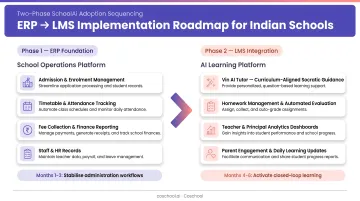
For most Indian schools, implementing both at once is not practical. The phased approach that works:
- Stabilise operations first — get ERP in place so admin chaos isn't burning teacher time and leadership bandwidth
- Layer in learning infrastructure — once the operational foundation is solid, an LMS (or an AI-powered closed-loop platform) can focus everyone on outcomes
Budget sequencing matters here. SchoolAi by Coschool uses a B2B2C model — schools pay a fully-refundable setup fee with no recurring subscription, while parents cover per-student usage through credits. This means SchoolAi can sit alongside an existing ERP without competing for the same institutional budget.
What Integration Between ERP and LMS Unlocks
Sequencing the two systems correctly is only half the gain. When ERP and LMS actually work in parallel, a more complete picture emerges:
- Attendance data from the ERP connects with learning progress data from the LMS
- A student marked present but performing poorly in assessments becomes visible to leadership
- Compliance data and academic outcome data sit in the same governance layer
Neither system alone can provide this view. Together, they give school leaders a complete picture: visibility into both whether students showed up and whether they actually learned something when they did.
Frequently Asked Questions
What is the difference between ERP and LMS?
A School ERP manages administrative and operational functions — fees, HR, attendance, and compliance reporting. An LMS manages learning delivery and student progress. They serve different purposes and different users within the same institution, and neither replaces the other.
Can a school use both an ERP and an LMS at the same time?
Yes, and many schools do. Integration between the two creates a more unified picture — connecting operational data like attendance and enrollment with learning data like assessment scores and progress tracking. The two systems complement rather than compete.
Which should a school implement first — ERP or LMS?
Start with whichever addresses your most urgent pain point. If administrative chaos is costing time and causing compliance risk, begin with ERP. If student underperformance, teacher overload, or poor parent visibility is the bigger problem, an LMS may be the more urgent investment.
Does an LMS replace a School ERP?
No. An LMS cannot process fee payments, generate HR reports, or manage regulatory compliance. An ERP cannot deliver lessons, assess student understanding, or personalise teaching. They serve entirely different institutional functions.
What features should schools look for in an LMS?
Prioritise ease of use for teachers, real-time progress tracking, assignment and assessment tools, and parent communication features. AI-driven personalisation — adapting to each student's pace and surfacing gaps before they compound — is increasingly a must-have, not a bonus.
How is AI changing what schools should expect from an LMS?
AI-powered platforms now go well beyond content delivery. They identify knowledge gaps in real time, guide students through Socratic questioning instead of giving away answers, and generate lesson plans calibrated to each section's current learning state. Teachers and principals get actionable data on who needs support — before the next class begins.
A School ERP and an LMS are not competing products — they solve different problems for different people within the same institution. ERP keeps the school running; an LMS determines whether students are actually learning. Identifying which gap your school needs to close first is the most practical question any school leader can ask before committing to a platform.