Introduction
Online learning has a peculiar problem: your child can appear completely absorbed — headphones on, screen lit, working through lesson after lesson — while the actual understanding simply isn't sticking. Unlike a classroom where a teacher catches comprehension gaps in real time, home-based learning can feel opaque to parents. You see activity, but learning is a different thing entirely.
OECD PISA 2022 data found that one in two students frequently struggled to motivate themselves during remote learning — a figure that should give every parent pause. Yet most families default to checking whether lessons were "completed" and calling it done.
Checking "completed" is not the same as checking for learning. This guide gives you a practical framework for what to actually monitor, three approaches to tracking it, and clear guidance on what to do when the signals point to trouble — without turning into a full-time supervisor.
Key Takeaways
- Track four things: lesson completion, comprehension depth, active engagement, and emotional well-being
- Use three approaches together: platform dashboards, structured conversations, and a simple weekly log
- Distinguish activity (time logged in) from actual learning (understanding and application)
- Involve your child in reviewing their own progress data — it builds ownership and measurable academic gains
- Adjust oversight by age: younger children need closer monitoring; older students need more autonomy
What to Monitor: Key Indicators of Online Learning Progress
Tracking everything creates noise. Track the right signals and you get a clear picture of learning health with a fraction of the effort.
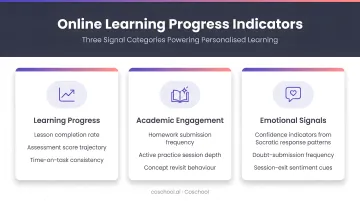
Academic Performance Indicators
Grades are lagging indicators — useful, but they tell you what happened weeks ago. More valuable are the patterns hiding underneath:
- Completion rates on assignments and quizzes across subjects
- Score consistency — are results stable, improving, or quietly eroding?
- Recurring error patterns in specific topics, not just isolated bad days
That last point deserves particular attention. Duncan et al.'s 2007 longitudinal research found that early math skills had the largest predictive coefficient (.33) for later academic achievement across six data sets.
A child consistently stumbling over fractions or reading comprehension isn't having a bad week. They have a foundational gap that compounds with every new chapter built on top of it.
Watch for subject-specific struggles persisting across two or more assessments before acting. One bad quiz is noise. A pattern is a signal.
Engagement and Participation Indicators
There's a meaningful difference between a child who is logged in and a child who is learning. Passive attendance (video playing, tab open) looks identical to active engagement on a surface check.
Observable active engagement signals:
- Attempts on practice exercises (not just completion)
- Revisiting lessons or replaying specific segments
- Asking questions in class chats or to an AI tutor
- Voluntarily talking about what they studied
OECD PISA 2022 found that students who reported teacher availability scored 15 points higher in mathematics on average. At home, the same dynamic holds: children who actively seek help and act on feedback consistently outlearn those who passively sit through content.
Emotional and Behavioural Indicators
Non-academic signals are often the earliest warning system:
- Avoidance before sessions (sudden bathroom trips, device "not working")
- Frustration that follows specific subjects, not all learning
- Loss of interest in topics the child previously enjoyed
- Increasing reliance on parental help that isn't decreasing month-on-month
40% of students felt lonely and 50% felt anxious about schoolwork during remote learning, according to PISA 2022. When a child avoids sessions, the cause is rarely defiance. It's almost always a comprehension gap or a confidence problem that hasn't been named yet.
How to Track Your Child's Progress: 3 Practical Approaches
No single method works for every family. Most parents use all three in combination, adjusting the mix based on their child's age and the platform they use.
Approach 1: Using Platform Dashboards and School Portals
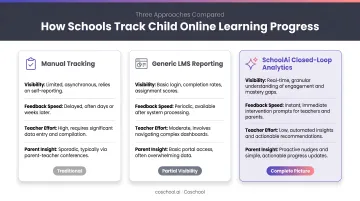
Most LMS platforms — Google Classroom, Canvas, school portals — show assignment completion, quiz scores, time-on-task, and teacher feedback. The mistake most parents make is skimming grades rather than reading the data underneath them.
What to look for beyond the grade:
- Completion rate trends over 3–4 weeks (not just this week)
- Time-on-task versus scheduled session length
- Teacher feedback comments that flag specific concept gaps
- Quiz attempt patterns — multiple attempts on the same question signal struggle
AI-powered platforms go further. Coschool's SchoolAi, for instance, provides parents with daily updates through its "Know Your Child" workflow — covering homework assigned, completion status, time spent, performance scores, and areas of struggle, with a three-level drill-down into each concept.
This matters because gaps appear as they form during homework practice, not weeks later on a test paper.
Pros: Objective, data-driven, minimal time once the habit is established. Keep in mind: Dashboard data tells you what happened, not why. Pair it with the approaches below.
Approach 2: Structured Observation and Conversation
The teach-back method is simple and reliable: within five minutes of a session ending, ask your child to explain what they learned in their own words. Not "did you understand?" — that gets a yes regardless of comprehension. Instead:
- "Explain to me how that works, as if I've never heard of it."
- "What was the hardest part today?"
- "What would you do differently if you got that question wrong again?"
Inability to explain a concept in plain language — even after completing the lesson — is a clear comprehension gap. Watching one session per week to note engagement level (is the child interactive or passive?) gives you qualitative data no dashboard provides.
Pros: Reveals comprehension depth that no metric captures. The trade-off: Time-intensive; not practical for every session.
Approach 3: Maintaining a Simple Progress Log
A weekly log takes under five minutes and creates the trend record that makes patterns visible. Use a notebook or a Google Sheet with these six columns:
| Field | What to Record |
|---|---|
| Date & Subject | e.g., Tuesday — Maths |
| Topic Covered | e.g., Fractions — division |
| Difficulty (1–5) | Child's self-rating |
| Assignment Outcome | Score or completion status |
| Observation Note | One sentence from your check-in |
The log's real value appears at the four-week mark. Consistently low difficulty ratings in one subject may mean your child is under-challenged. Consistently high ratings signal a knowledge gap needing attention.
Pros: Inexpensive, builds a history you can bring to teacher conversations. Limitation: Works best when the child fills it out alongside you — not as a form they hand to a parent.
How to Interpret What You're Seeing
Raw data tells you very little on its own. Without context, a dip in scores can feel catastrophic — or get dismissed when it shouldn't. What matters is knowing which patterns signal normal learning and which ones need a response.
On Track: What Healthy Progress Looks Like
- Assignment completion is consistent week to week
- Scores are stable or trending upward
- Your child can explain recent concepts in conversation without prompting
- Session duration roughly matches scheduled learning time
- Self-confidence in at least some subjects is visibly growing
Action: Maintain the routine. Explicitly acknowledge milestones — children who receive specific recognition ("you really understood that grammar rule") sustain motivation better than those who hear only vague praise.
Needs Attention: Early Warning Signs
- Score dips across two to three consecutive weeks
- Increasing reluctance before sessions
- Completing assignments but unable to apply the concept in conversation
- Dashboard shows completion but teach-back reveals confusion
Action: Have a calm, curious conversation with your child first — not an interrogation. Then flag the specific pattern to their teacher with data. "His fractions scores have dropped from 70% to 45% over three weeks" is a more actionable report than "he seems to be struggling."
If the pattern continues despite that conversation, it may be crossing into more serious territory.
Red Flags: When to Intervene
- Persistent failing scores across multiple topics
- Consistent non-submission or minimal time-on-task
- Emotional distress (tears, anger, shutdown) tied specifically to learning sessions
- Knowledge gaps spanning several interconnected subjects
Don't wait for the next report card. Request an urgent conversation with the teacher or platform support. Then review whether the curriculum format suits your child's learning style — and consider whether targeted one-on-one support is needed.
Common Monitoring Mistakes Parents Make
Three patterns consistently undermine parents' ability to track learning effectively:
Mistaking screen time for learning. A child can be logged in for two hours and retain almost nothing. OECD's 2015 Students, Computers and Learning report found that above-average school computer use was associated with significantly poorer results across reading, maths, and science. Time-on-task data only means something when paired with comprehension evidence.
Only checking in around tests. By the time a formal test reveals a gap, several weeks of compounding difficulty have already occurred. The IES review of formative assessment found that students who received ongoing feedback during instruction consistently outperformed those assessed only summatively — with effects particularly strong in mathematics.
Over-monitoring. Checking dashboards multiple times daily or reacting to every small dip creates anxiety and erodes the independent learning habits online education is designed to build.
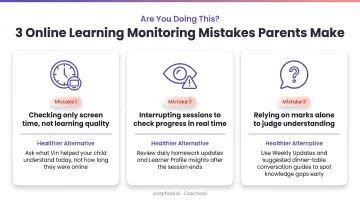
The healthier alternative scales with age: close supervision for primary school children, transitioning to periodic oversight for middle and secondary school students. The goal of monitoring is to build your child's self-regulation — not to sustain the monitoring indefinitely.
Best Practices for Balanced, Effective Monitoring
Build a sustainable rhythm:
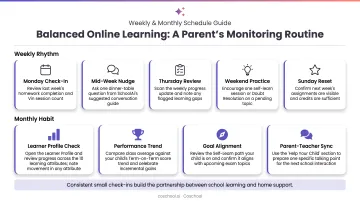
- Set a fixed weekly review window (20 minutes, same time each week) to check the dashboard and progress log — reactive checking creates stress for everyone
- Schedule a monthly 15-minute call with the class teacher to align on what you're both seeing
- Bring specific data to teacher conversations, not general concerns
Involve your child in their own data. The EEF's 2025 metacognition and self-regulation review, drawing on 355 studies, found an average impact of 8 additional months of progress from strategies that teach students to plan, monitor, and evaluate their own learning.
Try reviewing the progress log and dashboard together once a week. Ask:
- What did you complete this week?
- Where did you get stuck?
- What's one thing you want to improve next week?
Platforms like SchoolAi's "Help Your Child" workflow make this easier by suggesting specific, age-appropriate dinner-table questions tied to what the child studied — so parents can probe comprehension without needing to be subject experts themselves.
Use monitoring data to improve school conversations. Come prepared with specifics, and follow through:
- Arrive with concrete observations ("She's been rating maths difficulty 4-5 for three weeks, and her scores have dropped 15%")
- Ask for targeted strategies to address the identified gap at home
- Track whether the school's interventions show results over the following four weeks
Teachers can act on specific data. They can't do much with "she seems to be struggling."
Frequently Asked Questions
How can parents monitor children's activity online?
Use platform dashboards (completion rates, quiz scores, time-on-task), brief end-of-session teach-back conversations, and a simple weekly log. Each covers what the others miss — activity data alone won't tell you whether your child actually understood the lesson.
How to keep a record for tracking children's learning progress?
A weekly log noting subject, topic, self-rated difficulty (1–5), assignment outcome, and one observation sentence is enough. Digital tools like Google Sheets or platforms like SchoolAi can automate parts of this, giving you daily updates and weekly summaries without the manual effort.
What way can parents help their children during online learning?
Three roles work best: environment-setter (structured, distraction-free space and consistent schedule), progress partner (reviewing data together and celebrating specific wins), and bridge-builder (communicating with teachers when monitoring reveals a pattern that needs addressing).
How often should parents check on their child's online learning progress?
For primary-age children, a brief daily check-in plus a weekly dashboard review works well. For secondary students (above age 10), a fortnightly dashboard review and weekly conversation is sufficient — frequent interruptions can get in the way of the independent study habits older students need to build.
What are the signs that a child is struggling in online learning?
Watch for: consistently incomplete assignments, score drops across multiple subjects over two to three weeks, emotional resistance before sessions, and inability to explain recent lesson content. If two or more of these appear together, have a conversation with the teacher rather than waiting.
How do AI-powered learning platforms help parents track progress?
AI-powered platforms like Coschool's SchoolAi continuously track student interactions — practice attempts, areas of struggle, time spent per concept — and surface these as daily updates parents can act on. Knowledge gaps become visible as they form during homework, not weeks later when an assessment confirms what was already lost.