Introduction
Family involvement is one of the strongest predictors of student success — yet in most schools, parent engagement stays shallow, irregular, or limited to report cards and annual meetings. The gap between what schools intend and what parents actually experience is wider than most administrators realise.
A 2020 Center for American Progress survey of 932 parents, 419 teachers, and 408 school leaders captured this precisely: 92% of parents said they were involved in their child's learning, while only 64% of teachers agreed.
That gap isn't a motivation problem — it's a systems problem. Busy schedules, impersonal communication, and one-directional updates create the kind of friction that meaningful school-home connection can't survive.
EdTech tools are changing this equation. The best platforms make communication continuous, personalised, and two-way — not just event-based or grade-related. This article covers the main categories of tools available, what distinguishes genuinely useful platforms from notification apps, and how AI is raising the bar for what parent engagement can actually look like.
Key Takeaways
- EdTech tools for parent engagement span LMS platforms, digital portfolios, behavioural tracking, and AI-powered communication
- Consistent, personalised, two-way engagement outperforms one-way updates tied only to report cards
- Epstein's six types of involvement provide a proven framework for evaluating how EdTech tools support school-family partnership
- AI platforms can automate personalised parent updates, reduce teacher workload, and deliver actionable home-learning suggestions
Why Parent Engagement Still Falls Short in Most Schools
The Communication Gap Between Parents and Schools
CAP survey data reveals a striking disconnect: parents and teachers aren't just communicating poorly — they often disagree on whether communication is happening at all. When 37% of parents cite individual student achievement as the information type they want most, but schools are still sending generic newsletters, the mismatch is structural.
OECD TALIS 2024 data adds context: full-time teachers report spending just 1.8 hours per week communicating and cooperating with parents or guardians. That's less than 22 minutes per school day — spread across every student in their class.
Why Traditional Tools Fall Short
Robocalls, paper notes, and email newsletters all share the same flaw: they're generic, one-directional, and easy to ignore. Parents disengage when communication isn't tied to their specific child's progress.
Common failure points:
- No personalisation — the same message goes to every family regardless of their child's performance
- No response mechanism — parents receive information but have no easy way to follow up
- No actionability — updates describe what happened but don't tell parents what to do next
- Language barriers — India's 22 scheduled languages and hundreds of regional dialects mean many parents can't meaningfully engage with communications delivered only in English or Hindi
EdTech tools that address these gaps do so by making each communication specific to the child, actionable for the parent, and easy to act on — regardless of the family's language or schedule.
The Foundation: Epstein's Six Types of Involvement
Before selecting any tool, map what kind of engagement you're trying to support.
The authoritative framework in this space comes from Joyce Epstein and the National Network of Partnership Schools at Johns Hopkins University. Epstein's six types of involvement define the full scope of how families can partner with schools:
| Type | What It Looks Like |
|---|---|
| Parenting | Helping families establish home environments that support learning |
| Communicating | School-to-home and home-to-school communication about progress |
| Volunteering | Recruiting and organising family participation at school |
| Learning at Home | Giving families guidance on how to support classwork |
| Decision Making | Including families in school decisions and governance |
| Community Collaborating | Connecting families with community resources and services |
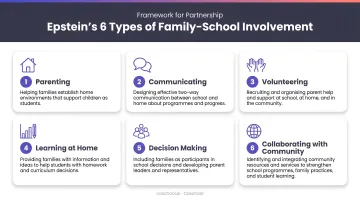
Most EdTech tools focus almost exclusively on the Communicating type. The stronger platforms also support Learning at Home — giving parents actionable guidance rather than just status updates.
Involvement vs. Engagement: A Critical Distinction
Goodall and Montgomery (2014) describe a continuum from parental involvement with schools toward parental engagement with children's learning. Involvement means showing up for events; engagement means sustained, two-way participation in a child's actual learning journey — a meaningfully higher bar.
EdTech tools should be evaluated on whether they deepen engagement or simply increase notification volume. A platform that sends daily alerts but offers no actionable guidance hasn't moved the needle on engagement at all.
EdTech Tools That Strengthen Family Involvement
Messaging and Communication Apps
Two-way messaging platforms allow teachers to send direct, timely updates via SMS or in-app notifications — with features like read receipts, scheduled messages, and translation. Language accessibility matters here: India's classrooms span 22 official languages and hundreds of regional dialects, meaning multilingual communication support isn't optional — it's the difference between a parent who's included and one who's left out.
Research supports the value of timely, personalised messages. A Harvard field experiment found that weekly one-sentence individualised teacher messages to parents reduced course failure from 15.8% to 9.3% in a high-school credit recovery setting — without AI, just specificity and consistency.
Learning Management Systems and Digital Portfolios
LMS platforms give parents a window into what their child is actually learning — assignments, grades, course materials — rather than waiting for quarterly report cards.
Digital portfolios go further. A 2017 study found parents who felt informed weekly about their child's studies rose from 26% before a digital portfolio intervention to 57% after. About 92% of parents in the same study agreed the tools made them more aware of what their child was studying.
The mechanism matters: when students share their own work with families, it drives deeper emotional investment than a teacher-generated summary.
Behavioural Tracking and Positive Reinforcement Tools
Academic updates aren't enough on their own. Behavioural tracking platforms allow teachers to share milestones — both positive and corrective — with parents in real time.
Positive reinforcement notifications build trust and keep parents connected between academic updates. A message saying "your child helped a classmate today" costs almost nothing to send — but it shifts the tone of the school-home relationship from transactional to collaborative.
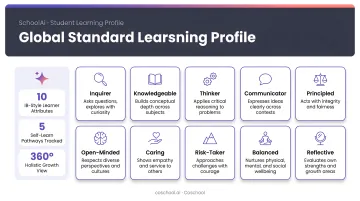
SchoolAi's Parent Engagement Platform takes this further with a Global Standard Learning Profile tracking 10 attributes across academic and personal dimensions — feeding into quarterly learner reports that give parents a developmental view, not just a grade snapshot.
Data Dashboards and Progress Reports
Most platforms stop at raw data — what parents actually need is insight they can act on. SchoolAi's Know Your Child module closes that gap with daily visibility across:
- Homework assigned and completion status
- Time spent per student
- Performance scores and specific areas of struggle
The accompanying Help Your Child workflow converts that data into actionable nudges — suggested conversation starters like "What was the most interesting thing you learned today?" that don't require subject expertise from parents.
How AI Is Transforming Parent Engagement in Schools
From Manual Updates to Automated Personalisation
The traditional model asks teachers to manually communicate with every parent about every student. Given that teachers already spend under two hours per week on parent communication — spread across entire classrooms — genuinely personalised updates almost never happen at scale.
AI changes the constraint. Gallup/RAND 2025 data shows measurable impact across U.S. K-12 classrooms:
- 60% of U.S. public K-12 teachers used AI tools for work in 2024–25
- Weekly AI users saved 5.9 hours per week on average
- 74% of teachers using AI for administrative work said it improved output quality
The upshot: parents receive communication that is both more frequent and better written — without adding to teacher workload.
Beyond Reporting: AI as a Home-Learning Partner
The more meaningful shift is what AI can do with performance data beyond summarising it. Rather than telling parents "your child scored 62% on Chapter 4," AI-powered platforms can:
- Identify the specific concepts behind the score gap
- Suggest relevant at-home activities or conversation topics
- Flag patterns (declining completion rates, consistent errors) before they compound
- Deliver weekly consolidated summaries without teacher intervention
That shift — from generic score reports to specific, actionable nudges — is where platforms like SchoolAi focus their design.
SchoolAi's Closed-Loop Approach
SchoolAi's Parent Engagement Platform is built on a closed-loop architecture that connects classroom teaching, student practice, and parent awareness in a single system. When a teacher assigns homework, the platform automatically surfaces updates through three parent-facing workflows:
- Know Your Child — daily homework completion status, time spent, performance scores, and areas of struggle
- Help Your Child — personalised engagement tips and suggested dinner-table questions tied to the actual lesson content
- Be a Smart Parent — resources to support learning without requiring curriculum expertise
Weekly Updates consolidate the picture across new chapters, homework, and performance insights, with three-level drill-down capability for each concept. The platform also includes a Digital Portfolio capturing academic and personal milestones that feeds into quarterly learner reports.
The design principle behind SchoolAi — built by Coschool, an Indian education institution with 33+ years of school-operating experience — is "transformation without disruption." That means embedding into existing school workflows rather than requiring schools to restructure operations around the technology.
Teachers gain back 2–3 hours daily by automating mechanical work, while parents receive the specific, continuous communication that traditionally only reached the most engaged families.
Choosing the Right EdTech Tools for Your School
Evaluate on These Criteria First
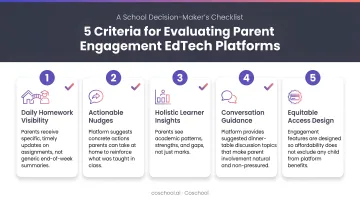
Not every tool that claims to improve parent engagement actually does. Evaluate platforms against these dimensions:
- Ease of use for both sides — if parents need training to navigate it, adoption will be low
- Two-way communication — broadcasting updates is not the same as enabling dialogue
- Data privacy compliance — schools are storing student information; verify that any platform you adopt complies with India's Digital Personal Data Protection (DPDP) Act, 2023, particularly around how student data is stored, shared, and used
- Personalisation depth — does the tool send the same message to every parent, or does it surface child-specific data?
- Integration with existing workflows — tools that require teachers to build parallel processes rarely survive
Adoption Planning Is Not Optional
The best tool fails if parents aren't onboarded properly. Use in-person events — parent nights, open days, PTMs — to introduce digital platforms and walk families through accessing them. When families first encounter a platform in a familiar, supported setting, they're far more likely to actually use it at home.
Start With Your Specific Gap
Define communication goals before selecting tools:
- Map which families are least engaged — are language barriers a factor? Work schedules? Distrust of digital channels?
- Identify which touchpoints are missing: is it daily homework visibility, or access to broader developmental data?
- Choose tools that close the specific gap — not tools that add more notification volume to the existing problem
Frequently Asked Questions
What are some EdTech tools for parent engagement?
The main categories include two-way messaging apps, LMS platforms, digital portfolios, behavioural tracking tools, virtual meeting platforms, and AI-powered communication systems. The right choice depends on your school's specific gaps — basic messaging needs differ from schools already communicating well but lacking actionable home-learning guidance.
What are the 4 types of parent engagement?
The authoritative framework is Epstein's six types of involvement from Johns Hopkins NNPS: parenting, communicating, volunteering, learning at home, decision making, and community collaborating. EdTech tools tend to focus on communicating and learning at home — but the strongest platforms create pathways across multiple types simultaneously.
What are the 5 R's of family engagement?
The NAEYC framework for early childhood family engagement identifies five Rs: respect, responsiveness and reassurance, relationship, reciprocity, and reflection. This framework applies specifically to early childhood education, not all K–12. Schools can still use these dimensions to assess whether a platform deepens genuine family partnership or simply increases message volume.
How does AI improve parent engagement in schools?
AI automates personalised, child-specific parent updates — cutting teacher workload while improving communication quality. It also generates actionable home-learning suggestions from individual student data, shifting parents from passive grade-recipients to active participants in their child's learning. Gallup/RAND research found 74% of teachers using AI for administrative tasks say it improves output quality.
What is the difference between parent involvement and parent engagement?
Involvement means attending school events and responding to school-initiated communication. Engagement is ongoing, two-way participation in a child's learning — including active support at home. EdTech tools deliver the most value when they enable the latter, turning daily performance data into guidance families can act on.
How can schools measure whether their EdTech tools are improving parent engagement?
Track metrics like message open rates, frequency of two-way communication (not just outbound), parent login frequency, and attendance at virtual meetings. Downstream indicators — homework completion rates, student attendance, assessment trends — also reflect the quality of the school-home connection. Engagement quality matters as much as quantity: 10 personalised, actionable messages outperform 50 generic broadcasts.