This disconnect has real consequences. When parents lack timely information about their child's progress, and teachers lack context about a student's home environment, both sides are working with an incomplete picture. The child, caught in the middle, receives inconsistent support.
The good news: research consistently shows that when parents and teachers communicate regularly and specifically, measurable outcomes improve — grades, attendance, homework completion, and early identification of challenges. This article covers what those benefits look like in practice, why the absence of communication compounds problems, and how to make parent-teacher communication a built-in habit rather than a crisis response.
Key Takeaways
- Regular parent-teacher communication improves student grades, homework completion, attendance, and classroom behaviour
- Consistent communication creates a shared early-warning system that catches learning and behavioural challenges before they compound
- Teachers gain a fuller picture of the whole child; parents gain confidence and clarity on how to support learning at home
- Impact is strongest when communication is specific and two-way — not a once-a-term broadcast, but an ongoing loop
- SchoolAi gives parents daily homework updates, specific learning nudges, and a Learner Profile — so the home-school loop stays active, not just open
What Is Parent-Teacher Communication?
Parent-teacher communication is the ongoing, two-way exchange of information between families and educators about a student's progress, behaviour, strengths, and challenges. Both parties share what they observe — it's not just the school reporting to parents.
It happens across a range of channels:
- Formal parent-teacher conferences (once or twice a year)
- Phone calls and emails for specific concerns
- School portals and progress reports
- Informal check-ins at drop-off or pick-up
- Digital platforms that provide real-time updates on homework, assessments, and learning gaps
The purpose is practical: both the teacher and the parent need context about the same child to support that child effectively. A teacher who knows a student is dealing with stress at home can adjust their approach. A parent who understands what's being taught this week can reinforce it at the dinner table.
When that shared context is missing, neither side can act with confidence — and the child is the one who loses out.
Key Benefits of Parent-Teacher Communication
Benefit 1: Higher Student Academic Performance and Engagement
Research consistently shows that parent-teacher communication lifts academic outcomes. Henderson and Mapp's synthesis of 51 studies found that students with involved families were more likely to earn higher grades, attend school regularly, be promoted, graduate, and pursue post-secondary education. Jeynes' 2005 meta-analysis of 41 urban elementary studies found parental involvement associated with achievement gains of 0.7 to 0.75 standard deviations.
The mechanism matters here. Communication creates academic lift not just by keeping parents informed, but by creating alignment between what is taught at school and what is reinforced at home. When teachers share specific progress updates and parents respond — through homework support, targeted questions, or simply encouraging effort — students receive consistent messaging from both environments.
The most direct evidence comes from Kraft and Dougherty's randomised field experiment, where frequent teacher-family communication increased:
- Homework completion odds by 40%
- Classroom participation by 15%
- Instances of off-task behaviour reduced by 25%
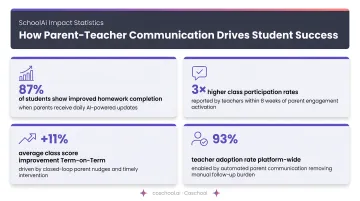
This effect was driven by brief, regular, student-specific contact — not lengthy reports.
When this benefit is strongest: During early primary years, when students are falling behind in specific subjects, and during transitions between grades or curriculum changes where home-school alignment prevents gaps from widening.
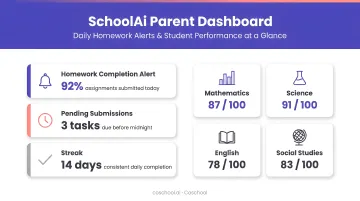
SchoolAi's Parent Engagement Platform puts this into practice through its Know Your Child workflow, which gives parents daily visibility into homework assigned, completion status, performance scores, and areas of struggle — shifting the parent's role from passive recipient to active participant in their child's learning.
Benefit 2: Early Identification of Learning and Behavioural Challenges
Consistent communication creates a shared early-warning system. Teachers observe changes in classroom engagement, work quality, and behaviour. Parents observe changes in mood, sleep, motivation, and anxiety at home. Separately, these observations are partial. Together, they form a pattern that enables early, coordinated action.
The CDC reports that approximately 1 in 6 children aged 3–17 have one or more developmental or behavioural disabilities. For many of these students, delayed identification (not the condition itself) is the primary driver of poor outcomes. Communication gaps between home and school are a direct contributor to that delay.
A 2013 randomised controlled trial of Conjoint Behavioral Consultation studied 207 K-3 children identified for disruptive conduct across 21 schools. The family-school partnership model produced significantly greater reductions in problem behaviours — including defiance, non-compliance, and arguing — compared to the control group. The key ingredient was structured, ongoing home-school communication, not just a one-time meeting.
When this benefit is strongest:
- In classrooms with diverse learning needs
- During stressful home or school transitions
- For younger students who cannot self-report academic difficulty
SchoolAi supports early identification through multiple signals: parents receive daily homework completion status, performance scores, and concept-level drill-downs that show exactly where a student is struggling. The platform's Principal Dashboard fires automated alerts when classes fall below 50% homework completion — enabling school leaders to act before a trend becomes a crisis, while parents receive their own student-specific alerts independently.
Benefit 3: Improved Teacher Effectiveness and Parent Confidence
Parent-teacher communication creates mutual gains that extend well beyond report cards.
For teachers: When parents share context about a child's home environment, learning preferences, or personal circumstances, teachers can adapt instruction and tone accordingly. Harvard's Graduate School of Education summarises this clearly: educators who engage families report increased job satisfaction and greater success motivating students from diverse backgrounds.
Teacher self-efficacy and communication frequency also reinforce each other. Teachers who feel confident in their communication tend to communicate more — and more communication tends to improve outcomes.
For parents: When families receive specific, actionable information rather than generic updates, they feel genuinely included rather than peripheral. They know what their child is working on this week, where the gaps are, and how to help without needing to be subject-matter experts themselves.
SchoolAi's Help Your Child and Be a Smart Parent workflows are built around this insight. Rather than overwhelming parents with raw data, the platform translates progress information into practical guidance — including suggested conversation starters like "What was the most interesting thing you learned today?" — that any parent can use regardless of their own academic background.
This benefit is most visible at the start of a school year, during grade or school transitions, and wherever culturally or linguistically diverse families need extra support to feel genuinely part of their child's education.
What Happens When Parent-Teacher Communication Is Missing
The absence of structured communication doesn't just represent a missed opportunity. It creates compounding problems:
- Students disengage when they sense that home and school are operating independently, with no shared investment in their progress
- Learning challenges go undetected until they are significant — by which point remediation requires far more time and resources than early intervention would have
- Parents feel excluded, develop negative perceptions of the school, and become less likely to reinforce learning at home or respond to outreach
- Teachers lose context, making it harder to personalise instruction or respond to behavioural patterns with any real understanding of what's driving them
The numbers behind these gaps are striking. A Journal of Human Resources study found that reducing parent-school information gaps was linked to 17% higher class attendance and 27% fewer course failures in the study context.
OECD PISA 2018 data adds an equity dimension: progress discussions between parents and teachers were far more common in socio-economically advantaged schools. That gap matters. Weak home-school communication isn't just an inconvenience — it mirrors and reinforces wider learning inequities.
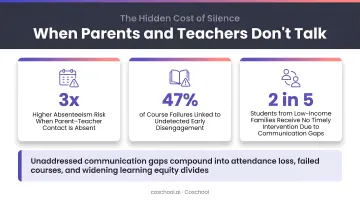
Structural barriers compound this further. NCES data shows that 48% of early-elementary families reported that family members cannot get time off work to attend school meetings, and 33% cited inconvenient meeting times. Low conference attendance is not a sign of low parental concern — it is a signal to redesign how communication happens.
How to Get the Most Value from Parent-Teacher Communication
Communication works best as a continuous practice, not a once-a-semester event. Three principles separate schools that do this well from those that don't:
1. Consistency over intensity Regular, brief touchpoints build more trust and context than a single detailed conference per semester. A short weekly update on homework trends, or a one-line note about a student's strong performance, compounds over time into a relationship — and into better outcomes.
2. Two-way, not broadcast Effective communication asks as much as it tells. Teachers who invite parents to share what they observe at home — changes in mood, sleep, motivation — gain information that genuinely changes how they teach. Parents who feel their observations are valued are more likely to stay engaged.
3. Insight to action Information exchanged between parents and teachers should close a loop, not just open one. If a parent flags a concern or a teacher notes a behavioural shift, both sides need to follow up with a response or an updated plan. Communication that generates no action erodes trust faster than no communication at all.
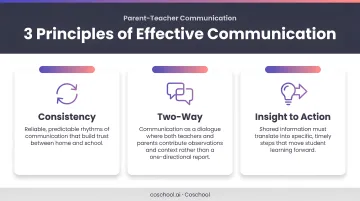
SchoolAi's Parent Engagement Platform is designed around these three principles. Daily learning updates through Know Your Child and home-support guidance through Help Your Child make structured communication the default — not the exception.
Teachers can send individualised one-click notes to specific families, and consolidated weekly progress summaries keep parents informed without adding to their workload. The closed-loop architecture ensures that insights surfaced in the classroom translate directly into steps parents can act on at home.
Conclusion
Parent-teacher communication is not a soft practice sitting at the edges of education. Its benefits are concrete: higher academic outcomes, faster identification of challenges, better-equipped teachers, and more confident parents who know how to help.
The impact compounds when communication is built into the regular rhythm of school life rather than reserved for problems or parent-teacher meetings. Both parties carry responsibility — teachers for making outreach consistent and specific, parents for engaging with what they receive and sharing what they observe.
The partnership between parents and teachers directly links what happens in school with what happens at home. When that link is strong and consistent, learning gaps surface early, interventions happen faster, and students don't fall behind waiting for the next parent-teacher meeting to surface a problem that started weeks ago. That's not a marginal gain — it's the difference between catching up and falling further behind.
Frequently Asked Questions
What are the benefits of communicating with parents?
Regular parent-teacher communication improves student academic performance, supports early identification of learning and behavioural challenges, and builds parent confidence in the school. Teachers also benefit, gaining richer insight into students' home context and improving their ability to personalise instruction accordingly.
How does parent-teacher communication affect student academic performance?
When parents are regularly informed and engaged, students tend to earn higher grades, complete more homework, and show greater classroom motivation. The effect is strongest when home and school are aligned — with habits reinforced at home matching what is being taught in the classroom.
How often should teachers communicate with parents?
There is no fixed optimum, but research supports regular, brief, student-specific touchpoints over sporadic formal meetings. More frequent communication is particularly valuable during grade transitions, subject-specific struggles, or for students with additional learning needs — where early alignment between home and school prevents gaps from widening.
What are the most common barriers to effective parent-teacher communication?
The most common barriers include work schedule conflicts (cited by 48% of early-elementary families in NCES data), inconvenient meeting times, language and literacy differences, and a lack of accessible communication channels. These are structural access constraints, not a reflection of how much parents care about their child's education.
How can technology improve parent-teacher communication?
Digital platforms can make communication more frequent, accessible, and easy to act on — surfacing real-time progress data, flagging learning gaps at a concept level, and translating that information into guidance parents can use at home. Platforms like SchoolAi go beyond administrative notifications to deliver daily learning insights and practical home-support tools, shifting parent engagement from passive to genuinely informed.