Introduction
A school with no teachers — just AI software and human "guides" who motivate but never instruct. That's not a thought experiment. It's Alpha School, a private school network operating across 13 US campuses where students complete core academics in roughly two hours each morning through adaptive AI software.
The model attracted enough national attention that US Education Secretary McMahon visited Alpha's Austin campus and called it "exemplary." That endorsement has pushed a genuinely important question into the mainstream: can AI actually replace teachers — or does it work best when it works with them?
This article breaks down what AI-powered schools actually deliver, where the evidence falls short, and what a smarter adoption model looks like for schools weighing this shift.
Key Takeaways
- Alpha School replaces traditional teachers with adaptive AI software and human "guides" who motivate but don't instruct
- Students spend roughly two hours on AI-led core academics; afternoons cover life skills and projects
- Alpha's academic results come from internal data only, with no independent research yet verifying their claims
- Mentorship, emotional support, and critical dialogue remain difficult to replicate with software alone
- AI works best alongside teachers — amplifying what they do, not replacing who they are
What Are AI-Powered Schools? The Alpha School Model Explained
Alpha School's "2 Hour Learning" model is built on a simple premise: adaptive AI software can deliver core academic instruction more efficiently than a teacher in a traditional classroom.
How the Model Works
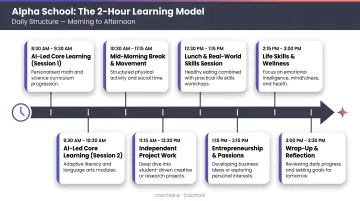
Each morning, students work through maths, reading, science, and social studies via AI-driven adaptive software: roughly two hours of personalised, self-paced instruction.
"Adaptive" here means the software adjusts difficulty based on student responses, identifies gaps, and requires mastery before progression. Think platforms like IXL or Khan Academy — structured drill-and-practice tools, not large language model chatbots.
The adults in the room are called "guides." They don't lecture, design curriculum, or grade work. Their role is motivational — monitoring engagement and keeping students on track. A teaching degree is not required to be a guide.
Afternoons shift to human-facilitated workshops covering life skills: public speaking, financial literacy, goal-setting, and leadership.
Key Facts About Alpha School
- Tuition: $10,000–$75,000 per year (approximately $40,000 average)
- Campus count: 13 locations across the US
- Regulatory note: US Education Secretary McMahon visited the Austin campus and described it as "exemplary"
The afternoon life-skills component is worth noting here: Alpha School hasn't removed humans from education — it has simply redefined what those humans do.
Do AI-Powered Schools Actually Work? What the Evidence Says
Alpha School's internal data is striking. The school claims students test in the top 1% on standardised assessments and grow academically at significantly faster rates than peers in traditional schools, based on NWEA MAP assessments analysed internally.
The Credibility Problem
The fundamental issue is that none of these claims have been independently verified. No peer-reviewed research exists. CNN's coverage quoted a Stanford University professor who noted that refusing independent scrutiny "implies there's something to hide."
State regulators have reached similar conclusions:
- Pennsylvania's Department of Education rejected an affiliated charter school application in 2025, calling the model "untested" and not demonstrably aligned with state academic standards.
- Multiple other states have denied similar applications on comparable grounds.
Where the Model Does Have a Real Argument
One area where the evidence is more solid: student disengagement in traditional classrooms is a real and documented problem. Gallup's research on student engagement shows engagement declining steadily through secondary school. For self-motivated students who have been bored by uniform pacing, a mastery-based, self-directed model can genuinely re-engage them.
That's a real benefit — but it serves a specific student profile, not all learners.
The Accessibility Gap
The engagement argument also runs into a hard ceiling: access. At an average of US$40,000 per year in tuition, Alpha School is not a scalable solution. The families who could most benefit from personalised learning — those in under-resourced schools with large class sizes — are the least likely to access it. The model serves affluent families experimenting with educational alternatives, not the broader population.
What AI Cannot Replace: The Case for the Human Teacher
The strongest argument against wholesale teacher replacement isn't sentimental. It's developmental.
Learning Is a Relational Process
Research published in Learning and Instruction and summarised by the American Psychological Association confirms that positive teacher-student relationships are linked to better academic outcomes, higher motivation, and improved wellbeing — particularly for younger learners. Teachers model how to handle failure, how to ask questions, how to sit with uncertainty. These aren't incidental to learning. They're central to it.
Software can adjust difficulty. It cannot read the room, notice that a student is quiet because something is wrong at home, or call a student by name with genuine warmth.
The Screen Isolation Risk
Even in a physical school building, a model where children spend their core learning time on individual screens risks something important: the social texture of learning. Children, especially in primary and middle years, develop trust, resilience, and interpersonal skills through their relationships with teachers and peers — not just through content mastery.
EdWeek coverage has noted that younger students in particular may struggle with self-directed learning without structured teacher presence. This isn't a criticism of technology — it's a recognition of developmental reality.
Alpha School's own model acknowledges this implicitly. Guides still exist precisely because the human element cannot be removed entirely.
What AI Genuinely Does Well
That said, adaptive software does handle several things genuinely well:
- Removes the constraint of uniform pacing — students aren't held back or rushed
- Identifies knowledge gaps in real time, more granularly than a single teacher managing 30 students can
- Frees up teacher time from repetitive mechanical tasks
- Provides consistent, patient practice without fatigue
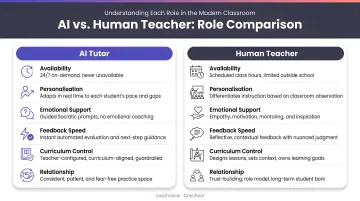
The real debate, then, isn't about AI's value — it's about where AI ends and where the teacher must begin.
The Better Model: AI That Empowers Teachers, Not Replaces Them
The real question isn't whether schools should use AI — it's whether AI works for teachers or instead of them. The better model puts AI in charge of the diagnostic and repetitive load, freeing teachers to mentor, challenge, and build the relationships that actually drive learning.
How This Works in Practice
Coschool's SchoolAI platform is built around this philosophy, which the company calls "transformation without disruption." Schools keep their existing teachers, curriculum, and timetable. The AI layer upgrades what happens around those existing structures: homework management, gap detection, lesson plan generation, parent communication, and governance visibility.
The platform's AI tutor, Vin, uses a Socratic guidance model. Rather than giving students direct answers, it asks questions that lead them to discover solutions themselves. After three unsuccessful attempts, the teacher is alerted and stays in the loop. Curriculum pacing remains under teacher control through chapter unlocking, so students can't race ahead of classroom instruction.
What Teachers Gain
SchoolAI's closed-loop system gives teachers back 2–3 hours per day by automating mechanical work:
- Instant homework evaluation, including pen-and-paper submissions photographed by students
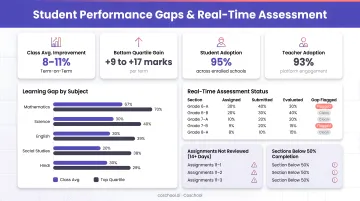
- Real-time dashboard showing which questions tripped up most students before the next class begins
- Dynamic lesson plans calibrated to each section's specific gap profile — not a generic plan applied uniformly
- One-click personalised interventions: remedial tasks for struggling students, challenge assignments for those ready to advance
Partner schools across India — including The Heritage School Delhi, Meridian School Hyderabad, and The Sri Ram School Hyderabad — report 8–11% class average improvement term-on-term and +9 to +17 marks improvement for bottom-quartile students, with 93% teacher adoption and 95% student adoption.
The Equity Dimension
Those outcomes point to something the pricing model makes even sharper. Alpha School charges up to $75,000 per year in tuition. SchoolAI operates on a B2B2C model: schools pay a fully-refundable setup fee, parents manage per-student usage through a credit system, and for every paying student, one-third of platform capacity is offered free to underprivileged students. Personalised learning at scale doesn't require premium pricing.
What School Leaders Should Consider Before Going AI-First
The right question for school leaders isn't "should we use AI?" It's "what should AI do, and what must remain human?"
Questions Worth Asking About Any AI Platform
Before committing to any AI platform or model, school leaders should ask:
- Does the AI empower teachers or sideline them? Platforms that remove teacher authority from the learning loop are making a pedagogical claim that deserves scrutiny
- Are outcome claims independently verified? Compelling internal data is not the same as rigorous evidence — look for third-party validation
- Does it fit existing workflows? Platforms that require schools to restructure their entire day create adoption risk and staff resistance
- Who owns the data? Student learning data is sensitive; vendor relationships and data governance deserve the same scrutiny as academic claims
The Vendor Scrutiny Lesson
Alpha School's regulatory rejections carry a clear lesson: examine whether AI platform claims are backed by independent data, and whether vendor relationships create conflicts of interest. Ask vendors directly — who conducted the outcome studies, and do they have a financial stake in the results?
A Practical Starting Point
Rather than restructuring the curriculum around an untested model, start contained:
- Pick one contained use case — personalised homework practice, formative assessment feedback, or parent communication work well as entry points
- Define measurable success criteria before launch, not after
- Track teacher adoption early. If teachers resist the tool, student outcomes won't follow regardless of the platform's capabilities
- Build evidence in your specific context before scaling
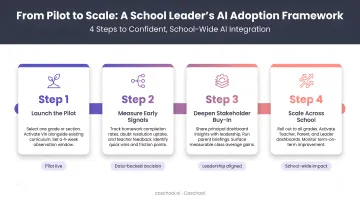
The schools seeing real gains from AI are treating it as infrastructure — reliable, invisible, and firmly under teacher control.
Frequently Asked Questions
Will AI replace teachers in schools?
No — at least not based on what's working today. AI handles diagnostics, personalisation, and repetitive tasks well, but human teachers provide mentorship, emotional support, and higher-order instruction that no platform replicates. The strongest models keep teachers central, not sidelined.
How much does an AI teacher cost?
Full AI-powered private schools like Alpha School (US) charge $10,000–$75,000 per year in tuition — a model that doesn't translate directly to the Indian context. School-integrated AI platforms operating in India, including credit-based models like Coschool's SchoolAi, are structured to keep costs manageable for schools while shifting per-student payment to parents. Free tiers and institutional licensing options make entry-level adoption far more accessible than standalone AI-first schools.
What is the difference between an AI tutor and a traditional teacher?
An AI tutor adapts content pacing and surfaces knowledge gaps in real time — but it cannot replicate what a human teacher does: model thinking, manage classroom dynamics, and build the trust that makes learning stick. The two serve different functions, which is why the best implementations combine both rather than swap one for the other.
Are AI-powered schools effective for all students?
AI-first models tend to work best for self-motivated learners with strong self-regulation. Students who need structured guidance, emotional support, or have learning differences often find purely AI-led instruction insufficient — human involvement remains essential for those learners. School-integrated platforms that keep teachers in control typically show broader impact across student profiles.
How do I become an AI teacher or guide?
It depends on the model. In AI-first schools like Alpha, guides don't need postgraduate teaching degrees — facilitation skills matter more. In mainstream schools integrating AI tools, certified teachers who upskill in AI-powered platforms remain the standard. Either way, the role evolves rather than disappears.