Introduction
Schools across India and beyond are facing a genuine tension: AI tools are arriving in classrooms faster than most institutions can meaningfully evaluate them. The question has shifted from "should we use AI?" to "how do we use it well — and for whom?"
The stakes are real. Research from WestEd's 2024 randomised controlled trial found that grade 7 students using an AI-assisted maths platform scored measurably higher on state assessments compared to peers in traditional classrooms. Meanwhile, RAND's 2025 data shows that high-poverty districts are roughly half as likely to have trained teachers on AI as low-poverty ones — meaning the students who could benefit most are often the last to access these tools.
That gap makes it worth examining AI in education carefully — not just the promise, but the full picture. This article covers:
- What AI in education actually means in practice
- The genuine benefits it brings to students, teachers, and schools
- The legitimate challenges institutions need to navigate
- What effective implementation looks like across different stakeholders
Key Takeaways
- AI personalises learning at scale, giving every student targeted support previously only available through 1:1 instruction
- Teachers save 2–3 hours daily as AI takes over grading, planning, and routine feedback tasks
- Key risks include student data privacy, the potential to widen inequality, and AI systems that reflect historical bias
- AI works best as a teacher-controlled tool, not an autonomous one
- Successful adoption requires clear policies, proper training, and evaluation against actual learning outcomes
What AI in Education Actually Means
AI in education is not a single product. The U.S. Department of Education describes it as "automation based on associations" — software that learns from data to make predictions, generate content, or adapt responses without manual human direction at each step.
In practice, schools are working with several distinct categories:
- Adaptive learning platforms that adjust content difficulty in real time based on how individual students respond
- AI tutoring tools that guide students through problems using conversational or Socratic methods
- Automated assessment tools that evaluate written work, flag errors, and surface performance patterns
- Predictive analytics that identify students at risk of falling behind before problems become serious
- Generative AI tools for teachers — drafting lesson plans, creating differentiated materials, and building assessments
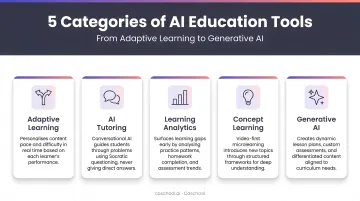
Understanding this spectrum matters. The evidence for each category varies considerably — a well-designed adaptive maths platform has a different evidence base than a general-purpose chatbot. Schools that treat all AI tools the same risk pouring budgets into tools with little evidence behind them — or writing off approaches that actually work.
The Benefits of AI in Schools
Personalised Learning at Scale
AI's clearest contribution to education is personalisation: matching instruction to each student's actual level, pace, and gaps rather than teaching to a class average.
In a traditional classroom of 35 students, a teacher simply cannot differentiate instruction for every individual simultaneously. AI makes this feasible. By continuously analysing how each student responds to questions, an AI system can adjust difficulty, surface targeted practice, and provide hints calibrated to where that student is stuck.
The WestEd ASSISTments trial found a statistically significant improvement (Hedges' g = 0.10, p = 0.011) for grade 7 students using an adaptive maths platform across 63 schools and nearly 6,000 students — a modest but meaningful effect from a rigorously evaluated tool.
Platforms like SchoolAi (by Coschool) are built around this principle. The Differentiated Assignment feature allows teachers to assign foundation-level questions to struggling students, stretch problems to advanced learners, and standard work to the rest — all from a single assignment action. No manual creation of three separate worksheets.
The outcome data from SchoolAi's partner schools reflects this approach: 8–11% class average improvement term-on-term and +9 to +17 marks improvement for bottom-quartile students — the students who typically fall furthest behind in undifferentiated classrooms.
Reducing Teacher Workload
McKinsey's research on teacher workload found teachers work roughly 50 hours per week, with an average of 11 hours on preparation across four studied countries. Existing AI technology could automate 20–40% of those hours.
The tasks where AI delivers the clearest time savings:
- Drafting lesson plans calibrated to each class section's learning state
- Generating differentiated question sets at different difficulty levels
- Checking homework submissions and surfacing question-level error patterns
- Creating unit tests and formative assessments
- Summarising student performance data before the next class
SchoolAi's Dynamic Lesson Plan feature generates section-specific plans using four data inputs — chapter timing, prerequisite gaps, recent homework performance, and Section Learning Index data — then offers four presentation styles (Classical, Humorous, Thought-Provoking, Gamified). Teachers report getting 2–3 hours back daily from automating this mechanical work.
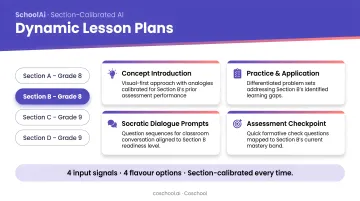
Those recovered hours go toward what teachers do best: building student relationships, mentoring, and running the discussions that no algorithm can facilitate.
Early Identification and Student Support
One of the least visible applications of AI in schools is also among the most valuable: early warning. Wisconsin's DEWS system, documented in the Journal of Educational Data Mining, generated dropout-risk predictions for over 225,000 students in grades 6–9 using standard administrative data, flagging at-risk students while they were still in middle school — international evidence that passive data already in schools carries predictive power.
Classroom-level applications work similarly. When a student repeatedly struggles with a specific concept, spends significantly more time on questions than peers, or suddenly performs unusually well after weeks of difficulty, these patterns carry information a teacher reviewing 35 notebooks might miss.
SchoolAi's Principal Dashboard operationalises this for Indian schools. Automated alerts fire when either of these thresholds is crossed:
- Any grade drops below 50% homework completion
- A teacher hasn't assigned work in 14 days
Teachers also receive individual student drill-downs across three concept levels, with quick-action options to send targeted remediation, encouragement, or intervention nudges before disengagement compounds.
Improving Accessibility and Inclusion
AI addresses specific barriers for learners that one-size-fits-all instruction consistently misses:
- Students with reading difficulties benefit from text-to-speech tools — peer-reviewed meta-analysis confirms read-aloud tools improve reading comprehension for students with reading disabilities
- Multilingual learners benefit from real-time translation and vocabulary support
- Students who process more slowly can revisit AI-guided explanations at their own pace, with unlimited retries and no social anxiety about asking again
India's NCFSE 2023 explicitly supports multilingual education, making AI tools with language-flexibility features particularly relevant for Indian classrooms serving linguistically diverse student populations.
SchoolAi supports multi-modal interaction — text, voice, and handwriting recognition — allowing students to engage through their most comfortable channel, whether that's typing, speaking, or photographing pen-and-paper work.
Challenges of AI in Education
Data Privacy and Student Safety
This is the most widely raised concern about AI in schools — and it deserves to be. AI tools require significant student data to function, which creates real questions about collection scope, storage security, access controls, and use beyond the original purpose.
In India, the Digital Personal Data Protection Act 2023 (DPDPA) defines a child as anyone under 18, requires verifiable parental consent before processing children's personal data, and prohibits child tracking, behavioural monitoring, and targeted advertising. In the US, FERPA protects the privacy of student education records.
Human Rights Watch documented in 2022 that many government-recommended EdTech products during school closures risked children's privacy. This isn't a theoretical risk.
Questions school leaders should ask AI vendors before adoption:
- What student data is collected, and is collection limited to what's necessary?
- Where is data stored, and under which jurisdiction?
- Is data ever shared with third parties, and for what purposes?
- What happens to student data if the school discontinues the platform?
- Is there a documented breach notification process?
SchoolAi stores all data on AWS servers in India, encrypts data in transit and at rest, and complies with the DPDPA 2023, IT Act 2000, and related Indian frameworks. Parental consent is collected via OTP, and users have full rights to access, amend, or delete their data.
The Risk of Widening Educational Inequality
There's a genuine paradox at the centre of AI in education: a technology that can theoretically personalise learning for every student is currently being adopted faster in schools that already have advantages.
RAND's 2025 research found 67% of low-poverty districts had provided AI training to teachers by fall 2024, versus 39% of high-poverty districts. CRPE reports that suburban, majority-white, and low-poverty districts are roughly twice as likely to provide AI-use training as urban, rural, or high-poverty ones.
In India, UDISE+ 2023–24 data shows only 57.2% of schools had computer facilities and 53.9% had internet access. Cloud-based AI platforms assume infrastructure that does not exist uniformly.
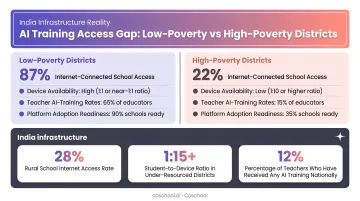
The equity gap isn't only about which schools adopt AI first. It's also about:
- Device access for students at home
- Internet connectivity for after-school AI-assisted learning
- Whether AI tools are available in students' home languages
Coschool's model includes an equity commitment: for every paying student, one-third of SchoolAi capacity is offered free to underprivileged students — an attempt to build equitable access into the commercial structure rather than treating it as an afterthought.
Over-Reliance, Academic Integrity, and Critical Thinking
When students use AI to complete work without genuine engagement, the risk is that they accumulate completed assignments without accumulating understanding. This matters most in writing, problem-solving, and analytical tasks where the struggle itself is the learning.
Detection tools don't solve this cleanly either. A 2023 study published in Patterns found that AI detectors had a 61.3% average false-positive rate on TOEFL essays by non-native English writers — meaning enforcement through detection disproportionately harms the students least likely to be cheating.
Schools also need to prepare for AI hallucination: generative AI tools can produce confident, coherent, and completely wrong information. This isn't a bug that will be patched out — it's an architectural characteristic of current models.
Practical responses for schools:
- Redesign assessments to require process evidence, not just final outputs
- Build explicit AI literacy into the curriculum
- Use disclosure policies rather than relying on detection tools alone
SchoolAi's Vin tutor is designed specifically to prevent shortcut-seeking. It never provides direct answers — only Socratic guidance that requires students to reason through problems. Copy-paste is blocked, ABCD random-entry patterns are flagged, and inconsistent performance spikes are surfaced to teachers for verification.
Bias in AI Systems
AI systems reflect the data they were trained on. When that data embeds historical biases — around race, language, socioeconomic background, or disability — the AI's outputs replicate those biases at scale.
The 2020 UK Ofqual grading algorithm is the clearest documented school AI bias case: algorithmic grades systematically disadvantaged students from lower-income backgrounds, with enough public outcry that the government abandoned the results entirely. The same Patterns study on AI detectors found that non-native English writers are disproportionately misclassified as AI-generated — meaning multilingual learners face higher false-accusation rates from the very tools schools use to enforce integrity.
The OECD's 2023 digital education outlook identifies algorithmic bias affecting students across race, ethnicity, nationality, gender, native language, and disability. Schools adopting AI tools should ask vendors what bias testing has been conducted on their specific models — not just general AI fairness claims.
Implementation Challenges and Teacher Readiness
Even a well-designed AI tool fails if teachers don't understand it, don't trust it, or feel it was imposed on them without input.
RAND found only 18% of K-12 teachers used AI for teaching in fall 2023. District training has expanded — rising from 23% of districts in fall 2023 to 48% by fall 2024 — but the gap between tool availability and teacher confidence remains wide. The self-reported barriers: anxiety about AI in general, concerns about cheating, and uncertainty about whether AI actually improves learning outcomes.
Effective implementation starts with teacher buy-in. In practice, that means:
- Involving teachers in tool selection before purchase decisions are made
- Providing sustained professional development, not a single onboarding session
- Framing AI as a tool that gives teachers time back — focused on reducing administrative load, not on surveillance or replacement
How Teachers Use AI in Schools Today
The most common practical applications teachers report:
- Generating multiple versions of the same content at different reading or complexity levels
- Drafting question sets and rubrics that teachers review, modify, and approve before use
- Surfacing which concepts are causing the most difficulty across the class, via performance dashboards
- Providing first-pass writing feedback that teachers build on with their own observations
- Flagging students who need additional support early, using platform alerts before gaps compound
Across educator accounts, one principle holds: effective AI use is human-guided. Teachers decide which outputs to keep, which to modify, and when a tool's suggestion doesn't fit their class. AI doesn't make instructional decisions.
The boundary experienced educators draw is consistent: AI handles the repeatable and administrative dimensions of teaching. The relational and pedagogical work stays human.
A teacher who knows a student is going through something difficult at home, adjusts their tone, and finds the right moment to check in — that judgment belongs to a person, not a platform.
Making AI Work: What Schools Need to Get Right
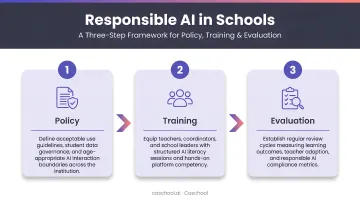
Three things separate schools that genuinely benefit from AI adoption from those that spend money on tools that create more confusion than value.
1. Establish a clear policy foundation first
Before deploying AI tools widely, schools need communicated guidelines that cover:
- Acceptable use by students and teachers
- Data privacy expectations and vendor requirements
- How AI-generated content should be attributed in student work
- What oversight mechanisms exist and who is accountable
Vague or absent policies don't prevent AI use — they just make it inconsistent and ungoverned.
2. Prioritise teacher training and genuine buy-in
The RAND data is clear: training is the bottleneck, not tool availability. Teachers who receive adequate time and support to understand both the capabilities and the limits of AI tools adopt them at high rates. Teachers handed tools without context resist or ignore them.
Coschool's 93% teacher adoption rate across partner schools suggests framing matters. When AI is positioned as something that gives teachers time back — rather than something that monitors or replaces them — adoption responses differ significantly.
3. Evaluate tools against learning outcomes, not technological impressiveness
The test of any AI tool in a school is whether it improves learning, supports teachers, and serves the students who need it most. Schools should define measurable educational goals before rolling out AI at scale — then evaluate whether the tool moves those specific metrics.
The WestEd ASSISTments trial illustrates this precisely: a modest but real effect (Hedges' g = 0.10) in a specific subject with a specific tool, evaluated rigorously. That kind of evidence — tool-specific, outcome-measured, context-grounded — is what schools should demand before adopting AI platforms at scale.
Frequently Asked Questions
How do teachers use AI in schools?
Teachers primarily use AI to generate lesson materials, create differentiated assignments, analyse student performance data, build assessments, and provide writing feedback. In all cases, the teacher reviews and approves AI outputs — the tool supports preparation and analysis; the teacher makes instructional decisions.
Will AI replace teachers in schools?
No. Teaching involves human judgement, emotional connection, and mentorship that AI cannot replicate. AI reduces mechanical workload, giving teachers more time for the work that matters most — building relationships, mentoring students, and facilitating meaningful learning.
What are the biggest risks of using AI in education?
The main risks include:
- Data privacy — student data must be protected under clear usage policies
- Widening inequality — adoption that follows existing advantage can deepen the gap
- Over-reliance — uncritical use can undermine students' independent thinking
- Algorithmic bias — AI systems may disadvantage multilingual learners and students from lower-income backgrounds
How does AI help students with learning difficulties?
AI tools like Vin personalise content to each student's pace, support multi-modal interaction (text, voice, visual), and surface specific concept gaps to teachers for targeted support. Rather than providing answers directly, Vin guides students through problems using Socratic questioning — letting them reach understanding on their own terms.
How can schools implement AI responsibly?
Three essentials for responsible adoption:
- Clear usage policies covering students, teachers, and data privacy
- Genuine teacher training — sustained support, not one-off sessions
- Outcome-linked evaluation — measure AI tools against specific learning goals before scaling
Is AI in education suitable for all age groups?
AI can be adapted for different age groups with appropriate safeguards. Younger students benefit most from AI tools used under direct teacher supervision, with guardrails that prevent open internet access. Older students can engage more independently with AI for research support, personalised practice, and exam preparation — with explicit guidance on evaluating AI output critically.