Introduction
Schools today face a real tension: classrooms are larger, learning needs are more varied, and academic expectations keep climbing — yet most educators still rely heavily on end-of-term grades to understand where students stand.
By then, it is often too late. A student who disengaged in Week 3 has already missed foundational content. A knowledge gap that went undetected in Grade 5 is now blocking comprehension in Grade 7.
Learning analytics changes this equation. Applied consistently, it gives teachers early warning signals and replaces reactive grading with real-time evidence. A study across 73 high schools and 37,671 students found that early warning and monitoring systems meaningfully reduced chronic absence and course-failure risk after just one year.
This article breaks down how learning analytics improves student outcomes — and the strategies that make it work in real classrooms.
Key Takeaways
- Learning analytics is the systematic collection and analysis of student data to improve teaching decisions and learning outcomes.
- Three core advantages: spotting at-risk students early, personalising instruction to close knowledge gaps, and giving teachers data to act on.
- Without it, educators intervene after failure, teach to the middle, and miss warning signs until they compound into bigger problems.
- Insights only matter when acted on. Data that sits in dashboards and never reaches classrooms changes nothing.
- AI-powered platforms like SchoolAi by Coschool turn analytics into real-time classroom action, not just reports.
What Is Learning Analytics?
Learning analytics is the collection, analysis, interpretation, and communication of data about learners and their learning behaviours — with the goal of generating insights that educators can act on. SoLAR's 2025 definition frames it specifically as providing "theoretically relevant and actionable insights to enhance learning and teaching."
In schools, this draws on data from:
- Digital learning platforms and LMS tools
- Assessment and quiz performance records
- Assignment submission rates and completion patterns
- Engagement frequency, time-on-task, and participation signals
- Attendance records
The key distinction worth making: learning analytics is a feedback system, not a monitoring mechanism. Its purpose is to understand where students currently are, where they are headed, and what support will get them to where they need to be.
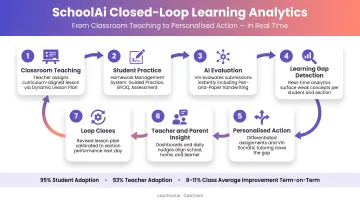
Platforms like SchoolAi by Coschool operationalise this through a 7-stage closed-loop workflow (Assign, Practise, Evidence, Intervene, Inform, Adapt, Govern), where insights gathered during student practice feed directly into the next day's instruction, parent communication, and school leadership decisions. Each data point connects to a concrete next step — whether that's adjusting a lesson plan, sending a parent alert, or flagging a student for early intervention.
Key Advantages of Learning Analytics
These advantages are measurable and operational — schools that apply analytics consistently and act on its signals see them play out in real student outcomes.
Early Identification of At-Risk Students
Learning analytics enables schools to detect early warning signals — declining engagement, missed assignments, poor quiz performance — before they escalate into failure. This shifts educator response from reactive to proactive.
Analytics platforms build a running picture of each student by tracking behavioural and performance indicators over time. When a student deviates from expected progress patterns, teachers and counsellors get flagged early — while recovery is still straightforward.
Why this matters:
Ninth-grade attendance, behaviour, and course performance indicators can flag 50–75% of future dropout risk, and 6th-grade signals like attendance below 80% or failing core subjects can identify at-risk students years before they exit — well before traditional report-card cycles would surface the problem.
Late interventions — grade retention, remedial courses, dropout recovery — are far more resource-intensive than early, targeted support. The cost argument for acting early is straightforward.
KPIs impacted:
- Course completion rates
- At-risk identification timelines
- Intervention response rates
- Retention and grade recovery rates
When this matters most: Large classrooms and multi-section programmes, where teachers cannot closely monitor every student, and in grade transitions where gaps tend to accumulate silently.
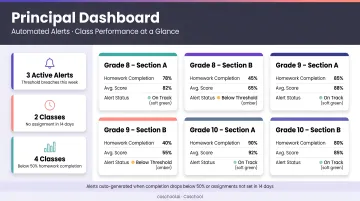
SchoolAi addresses this through automated threshold alerts — the Principal Dashboard fires nudges when any grade drops below 50% homework completion, when teachers haven't assigned in 14 days, or when a class is trending below expected performance. These alerts reach leadership without requiring manual data collection.
Personalised Learning and Closing Knowledge Gaps
Learning analytics enables educators to move from uniform instruction — same content, same pace, for all students — to differentiated learning, where instruction is adjusted based on each student's demonstrated strengths and gaps.
Critically, analytics reveals not just that a student is underperforming, but precisely where they are struggling: a specific algebra concept, a recurring reading comprehension gap, or missing prerequisite knowledge from a prior term.
Why this matters:
RAND research found that students in personalised-learning schools gained approximately 3 percentile points in mathematics relative to comparable peers. Modest on its own — but compounding across terms, it represents real academic lift.
The stakes are higher in mathematics and science, where prerequisite dependencies are strong. Early math knowledge at kindergarten level predicts math achievement through Grade 3, and first-grade math skills show measurable associations with outcomes at age 15. An unaddressed gap at one level becomes a barrier at the next.
KPIs impacted:
- Individual assessment scores
- Knowledge gap closure rates
- Concept mastery rates
- Teacher time spent on reteaching
When this matters most: Subjects with strong prerequisite chains — mathematics, physics, chemistry — where leaving a gap unaddressed in one chapter directly limits comprehension in the next.
SchoolAi's Vin, India's first school-integrated AI tutor, delivers this at scale. Through Socratic questioning — never giving answers, always guiding students toward them — Vin adapts in real time to each student's responses, using a 3-strike support system with progressive hints, hesitation detection, and unlimited retries.
The RUAH question framework (Recall, Understand, Apply, Higher-Order) diagnoses exactly where a student's understanding breaks down: foundational recall, conceptual understanding, or higher-order application. Teachers then assign Differentiated Assignments and Level-Up Tasks in one click based on these specific gap profiles, rather than reteaching the full curriculum.
Data-Driven Teacher Decisions and Smarter Resource Allocation
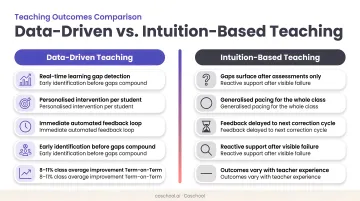
Learning analytics gives teachers objective data on which approaches are working, which content modules are causing friction, and where individual or class-wide attention is needed — so instructional decisions rest on evidence, not intuition.
A 2025 meta-analysis on teacher data-use professional development reported a pooled student-achievement effect of g = 0.41 — meaning teachers who actively use data as part of their instructional practice produce meaningfully better student outcomes. Training teachers to act on analytics, not just access it, is where the value lives.
Why this matters:
Educators working with data spend less time on what students already know and more time on what they don't. That shift in instructional efficiency compounds across a full academic year.
There is also a direct parent engagement benefit. When teachers have clear, specific data on each student, they can communicate precise, actionable updates to parents — replacing vague feedback like "doing okay" with something concrete: "struggling with fractions since Week 4." This bridges the home-school gap in a way that generic report cards never could.
KPIs impacted:
- Instructional time efficiency
- Curriculum redesign cycles
- Parent communication quality
- Teacher-student support ratios
- Resource allocation accuracy
When this matters most: Schools managing large cohorts across multiple grades, where curriculum decisions made without data tend to repeat the same inefficiencies year after year.
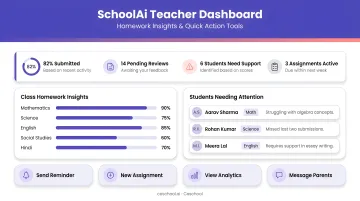
SchoolAi's Teacher Dashboard surfaces Homework Insights — which questions tripped up most students, individual completion rates, time spent, and attempt counts — before the next class begins. Teachers save 2–3 hours daily because homework checking, question bank generation, lesson plan preparation, and parent communication are handled by the AI layer. That reclaimed time goes directly into targeted student support.
That visibility extends beyond the classroom. The Parent Engagement Platform gives families daily insights on homework completion, specific areas of difficulty, and actionable suggestions — including conversation prompts for the dinner table — replacing the term-end grade as the primary feedback signal.
What Happens When Learning Analytics Is Missing
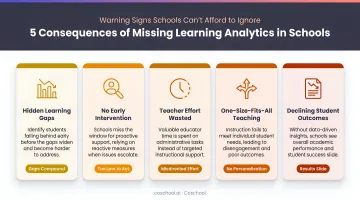
Schools that rely solely on end-of-term grades and teacher intuition face a predictable set of consequences:
- Struggling students are identified only after a failure has occurred — when recovery is harder and remediation costs more time
- Advanced students are under-challenged while peers fall further behind in the same lesson, because instruction has no way to adapt mid-course
- Schools rush additional support after results arrive, rather than acting during the term when intervention still makes a difference
- A concept not mastered in Grade 4 quietly becomes a barrier in Grade 6 — and teachers encounter the consequences without knowing the root cause
- Parent communication stays limited to twice-yearly report cards shared at PTMs, replacing the ongoing dialogue that research consistently links to better outcomes
The two consequences that hurt most are late identification and hidden prerequisite gaps — both preventable with a continuous feedback loop between teaching and student performance data.
How to Get the Most Value from Learning Analytics
Learning analytics delivers its full value only when embedded into routine teaching workflows. Insights that live in dashboards but never reach classrooms have no impact.
Three conditions determine how much value analytics actually delivers:
Applied consistently — Data must be collected continuously throughout the term, not just at assessment points. Trends need to be visible early enough to act on.
Reviewed by the right people — Teachers, school leaders, and parents should each receive information relevant to their role. A principal doesn't need question-level performance data; a teacher does. A parent doesn't need school-wide aggregates; they need their child's specific gap.
Acted upon, not just documented — Schools must build a culture where analytics insights trigger specific follow-up actions: a teacher reaching out to a struggling student, a curriculum lead redesigning a module, a parent receiving a targeted nudge.
This is where SchoolAi's architecture is specifically designed to help. Rather than generating reports for teachers to manually interpret, the platform embeds insights directly into existing workflows:
- The Teacher Dashboard is mobile-accessible for real-time in-class decisions
- Automated alerts fire when thresholds are crossed, removing manual monitoring
- Quick Actions enable one-click intervention: reminders to non-completers, nudges to students near improvement thresholds, and recognition for high performers
- Dynamic Lesson Plans calibrate the next day's instruction to section-level gaps using four input signals, including prerequisite gaps and recent homework performance
The closed-loop architecture (Assign, Practise, Evidence, Intervene, Inform, Adapt, Govern) ensures insights don't accumulate as unused data. Every signal triggers a specific action — before the next class begins.
Conclusion
Learning analytics works because it makes the invisible visible. Every educator gets a clearer picture of where each student stands, what support they need, and how instruction should adapt — before the gap becomes a grade problem.
These advantages compound over time. When implemented consistently, learning analytics:
- Identifies struggling students early enough to intervene — not after the exam
- Personalises learning pathways to close gaps before they widen
- Gives teachers feedback loops that sharpen their instruction each term
Learning analytics is not a one-time implementation — it is an ongoing practice. Its value grows every term it is used and every student it catches before a small gap turns into a lost year. Schools that build it into routine workflows, rather than pulling reports only at term-end, are the ones that see sustained academic improvement.
Frequently Asked Questions
What are the benefits of learning analytics?
Learning analytics improves student outcomes by enabling early identification of at-risk learners, personalising instruction to individual gaps, and giving teachers objective data to make better instructional decisions. The result is higher retention rates, better grades, and narrower learning gaps across the school.
How does learning analytics support early intervention for struggling students?
Analytics platforms continuously track engagement and performance signals — missed assignments, declining quiz scores, less time spent on coursework — and flag at-risk students before failure occurs. Teachers and counsellors can act while recovery is still relatively straightforward, rather than discovering the problem at the end of term.
What types of data does learning analytics typically track?
Common data points include assignment submission rates, quiz and assessment scores, time spent on learning materials, engagement frequency, participation patterns, and attempt counts. In AI-enabled platforms like SchoolAi, real-time responses to questions and hesitation signals are also captured during practice sessions.
Can learning analytics help personalise learning for individual students?
Yes — analytics identifies exactly where each student's understanding breaks down, whether by concept, subject, or skill level, allowing teachers to assign targeted resources rather than reteaching the entire topic. Adaptive platforms adjust content in real time based on each student's learning responses.
What are the limitations of learning analytics in schools?
Data privacy considerations require responsible governance: in India, the DPDP Act mandates verifiable parental consent before processing child data. Analytics also only reflects what the platform captures, meaning offline learning may be underrepresented unless schools bridge it through tools like handwriting recognition. Insights only add value when teachers have the time, training, and tools to act on them.
How can teachers use learning analytics without adding to their workload?
The key is choosing platforms that surface insights within existing workflows, using mobile dashboards, automated alerts, and AI-generated recommendations, rather than requiring manual data extraction. SchoolAi, for instance, delivers homework insights before the next class begins and saves teachers 2–3 hours daily by automating checking, tracking, and communication tasks.