Introduction
Walk into most classrooms today and you'll see the same reality: one teacher, thirty students, and learning needs that span three to four grade levels simultaneously. Teachers work through lesson plans designed for the average student — while some students race ahead bored, others fall further behind with each chapter.
The numbers are stark. ASER 2024 data shows that only 27.1% of Standard III children in rural India can read a Standard II-level text, and just 33.7% can do basic subtraction — gaps that compound silently when instruction doesn't adapt to where each student actually is. Meanwhile, in the US, Gallup research found that 60% of public K-12 teachers used AI tools in 2024–25, with weekly users saving roughly 5.9 hours per week — suggesting the productivity value of AI in education is real.
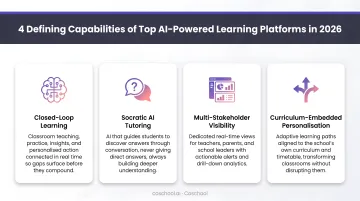
The best AI-powered learning platforms go well beyond digitizing content. Across 2025 and into 2026, the strongest platforms share four defining capabilities:
- Detect knowledge gaps before they compound
- Adapt pacing and content to each student in real time
- Give teachers actionable data before the next class begins
- Keep parents informed with specific, usable updates
Not every platform does all four well. This guide evaluates the top 10 AI-powered learning platforms for schools in 2026 — what each does well, where it fits, and what to look for when comparing options.
Key Takeaways
- The best AI platforms adapt content, pacing, and support to each individual student
- Top school platforms close learning gaps, help teachers personalise at scale, and bring parents into the loop
- Selection criteria: adaptive AI depth, teacher tools, student engagement, school integration fit, and data privacy
- Platforms span AI math tutors, Socratic conversation tools, and full school-integrated ecosystems
- Coschool's SchoolAi leads among Indian school platforms: closed-loop learning, curriculum-aligned AI tutoring, and parent engagement in one school-native product
What Is an AI-Powered Learning Platform?
An AI-powered learning platform uses machine learning, natural language processing, and generative AI to personalise the learning experience for each student. Rather than delivering the same lesson to everyone, it adapts content, adjusts difficulty, and provides targeted support based on each learner's individual performance data.
Unlike a standard school app or LMS, a true AI platform doesn't just host content. It detects what a student doesn't understand, adjusts what comes next, provides conversational guidance, and gives teachers the insight to intervene before a gap widens.
For schools, the best AI platforms do three things well:
- Adapt to each child's current level so gaps don't compound
- Surface data and tools that make differentiation practical for teachers
- Connect home and school with specific, actionable updates for parents
Each platform on this list is evaluated against all three.
Top 10 AI-Powered Learning Platforms for Schools in 2026
These platforms were shortlisted based on AI depth, student-centricity, teacher support features, and fit for school environments. The list spans full school-integrated platforms, subject-specific adaptive tutors, teacher productivity tools, and student self-study apps — so school leaders can identify what fits their specific need.
1. Coschool SchoolAi
Coschool is an Indian EdTech company built under People Combine Group, with 33+ years of K-12 institution-building experience including Oakridge International School. SchoolAi is their school-integrated, closed-loop AI learning platform purpose-built for Indian K-12 private schools.
What sets it apart: SchoolAi is built on a philosophy of transformation without disruption: schools keep their existing curriculum, teachers, and timetable while AI upgrades homework, practice, doubt resolution, parent communication, and leadership visibility underneath.
The platform achieves a 1:1 teacher-student ratio through generative AI, anchored by Vin, India's first school-integrated AI tutor. Vin never gives direct answers; it guides students to discover them through Socratic questioning.
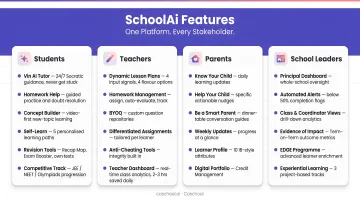
Key platform capabilities include:
- For students: 24/7 AI tutoring via Vin, doubt resolution, adaptive practice, exam revision, and competitive exam preparation (JEE, NEET, Olympiads)
- For teachers: Real-time homework completion data, concept-level knowledge gap detection, dynamic lesson plan generation, and AI-assisted question banks — saving 2–3 hours daily
- For parents: Daily updates on homework and performance, actionable nudges, suggested dinner-table conversation guides, and a longitudinal Digital Portfolio
- For school leaders: Principal Dashboard with automated alerts, grade-to-student drill-down, and academic outcome tracking
Typical adoption outcomes: 95% student adoption, 93% teacher adoption, 8–11% class average improvement term-on-term, and +9 to +17 marks improvement for bottom-quartile students. Partner schools include The Heritage School Delhi, Meridian School Hyderabad, and Suchitra Academy Hyderabad.
Coschool is the only AI-Ed company recognised as LinkedIn Top Startup in both 2025 and 2026.
| Best For | K-12 schools in India seeking a comprehensive, curriculum-aligned AI learning platform |
| Key AI Features | Adaptive AI Tutor (Vin), real-time knowledge gap detection, dynamic lesson plans, parent engagement platform |
| Pricing/Availability | Fully-refundable school setup fee; parents pay via credit-based model. Contact info@coschool.ai for details |
2. Khan Academy (Khanmigo)
Khan Academy is a nonprofit platform serving hundreds of millions of learners worldwide. Khanmigo is its generative AI-powered tutor and teaching assistant that guides students through problem-solving using the Socratic method rather than simply providing answers.
The key difference: Khanmigo asks guiding questions instead of giving solutions, building genuine understanding. It also helps teachers create lesson plans, write rubrics, and generate discussion prompts.
| Best For | Self-paced learners across grades; teachers seeking AI-assisted lesson planning |
| Key AI Features | Socratic AI tutoring, guided problem-solving, teacher co-pilot for lesson creation |
| Pricing/Availability | Free for teachers; $4/month for learners and parents (currently US-restricted for learner plans) |
3. Carnegie Learning (MATHia)
Carnegie Learning's MATHia is a research-backed AI maths tutoring platform for middle and high school students (grades 6–12). It uses cognitive science and machine learning to model each student's unique mathematical thinking.
Where the evidence stands out: MATHia builds a real-time student knowledge model that identifies exactly which concepts a student understands and which need reinforcement. A RAND RCT across 147 schools and 19,000+ students showed a 0.20 SD learning gain, with the blended solution achieving ESSA Tier 1 "Strong" evidence — the strongest research base in this category.
| Best For | Middle and high school maths instruction requiring deep adaptive tutoring |
| Key AI Features | Cognitive student modelling, adaptive hints, real-time mastery tracking per concept |
| Pricing/Availability | School and district licensing; pricing available upon request |
4. DreamBox Learning (by Discovery Education)
DreamBox, now part of Discovery Education, is an adaptive maths and reading platform for K-8 students. It adapts lesson difficulty and strategy in real time based on how students interact with each problem — not just whether they get the answer right.
Why teachers value it: DreamBox's adaptive engine gives teachers granular data on where each student is in their learning journey, down to concept level. DreamBox Maths has independently earned an ESSA "Strong" evidence rating.
| Best For | K-8 schools focused on maths and reading through deeply adaptive, game-like learning |
| Key AI Features | Real-time lesson adaptation, intelligent hint engine, teacher progress dashboards |
| Pricing/Availability | School and district licensing; pricing upon request |
5. Century Tech
Century Tech is a UK-based AI learning platform used across schools in the UK, Middle East, and beyond. It combines neuroscience, learning science, and AI to create personalised learning pathways while reducing teacher workload.
What makes it different: Century identifies individual knowledge gaps at the concept level and builds a unique "learning road" for each student across English, maths, and science. Automated marking and detailed reporting save teachers significant administrative time.
| Best For | Secondary schools seeking a cross-subject AI platform with strong teacher reporting |
| Key AI Features | AI-generated personalised learning paths, automated marking, knowledge gap mapping |
| Pricing/Availability | School subscription; pricing available upon request |
6. Quizlet
Quizlet is a widely used student study tool with adaptive flashcard sets, AI-generated practice tests, and conversational study features. Note: Quizlet's Q-Chat AI tutor, which used the Socratic method via OpenAI's API, was discontinued as of June 2025 — check Quizlet's current feature set before adoption.
Where it fits: Quizlet works well for exam preparation, vocabulary building, and self-study across subjects, with adaptive study modes that adjust to each learner's accuracy patterns.
| Best For | Students in grades 6–12 seeking AI-assisted self-study and exam preparation tools |
| Key AI Features | Adaptive flashcard sets, practice test generation, spaced repetition |
| Pricing/Availability | Free basic plan; Quizlet Plus at approximately $3.75/month (billed annually) |
7. Synthesis
Synthesis is an AI-powered learning platform originally developed for students at the Ad Astra school at SpaceX. It focuses on building problem-solving, critical thinking, and collaboration skills through simulation-based challenges.
The core difference: Synthesis doesn't follow a traditional curriculum. It builds higher-order thinking through complex, multi-step challenges, with an AI tutor that adapts to each student's reasoning ability. Well-suited for schools looking to develop skills beyond rote learning.
| Best For | Schools or parents seeking AI-focused critical thinking and problem-solving development |
| Key AI Features | Adaptive problem simulations, AI-driven challenge scaling, collaborative modules |
| Pricing/Availability | Individual and school plans; verify current pricing at synthesis.com |
8. Nearpod
Nearpod (now part of Renaissance) is a classroom engagement and interactive lesson delivery platform. Its AI tools help teachers create immersive, multimedia lessons and monitor real-time student comprehension during class.
What teachers notice: Nearpod's AI lesson builder converts any topic or document into an interactive lesson with embedded quizzes, polls, and virtual reality experiences. Teachers get live comprehension data while the lesson is still running.
| Best For | K-12 teachers seeking AI-assisted lesson delivery with real-time engagement tracking |
| Key AI Features | AI lesson builder, live formative assessment, real-time class comprehension data |
| Pricing/Availability | Free plan available; school and district plans with expanded features upon request |
9. Duolingo for Schools
Duolingo for Schools brings the widely used AI-driven language learning app into the classroom. Teachers can monitor student progress across language courses while students learn through adaptive, gamified micro-lessons.
Why schools adopt it: Duolingo's AI personalises lesson content and spacing based on each learner's accuracy and memory retention. The teacher dashboard provides class-level and individual progress reports at a glance, and the school dashboard is free.
| Best For | K-12 schools offering language learning; students building conversational skills independently |
| Key AI Features | Adaptive spaced repetition, AI pronunciation feedback, personalised lesson paths |
| Pricing/Availability | Free for students and teachers; Duolingo for Schools dashboard free to access |
10. Brisk Teaching
Brisk Teaching is an AI-powered Chrome extension designed specifically for teachers. It helps educators create assignments, generate feedback, detect AI-written student work, and differentiate content across student levels — all without leaving their existing workflow.
Where it stands out: Unlike student-facing platforms, Brisk is entirely teacher-focused. It integrates directly into Google Classroom, Docs, and Slides, so teachers can generate differentiated reading materials, rubrics, and real-time feedback in minutes.
| Best For | Teachers in Google Workspace schools seeking AI tools to reduce lesson prep and feedback time |
| Key AI Features | AI content differentiation by reading level, real-time feedback generation, AI-detection for student work |
| Pricing/Availability | Free educator plan; Pro unlocks additional tools. School/district pricing available upon request |
How We Selected These Platforms
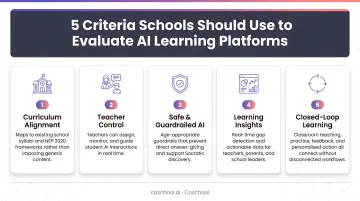
These platforms were assessed on five core criteria:
- Depth of AI personalisation — does the AI genuinely adapt, or does it serve static content with a smarter interface?
- Teacher empowerment features — does the platform give teachers actionable data and reduce workload, not add to it?
- Student engagement design — will students actually use it, or does it feel like another obligation?
- School integration capability — does it embed into existing workflows, or force schools to restructure around it?
- Data privacy standards — is the platform compliant with regulations protecting minors, including COPPA, GDPR, and India's Digital Personal Data Protection Act 2023?
A common mistake schools make: choosing tools that look impressive in demos but don't survive contact with how teachers and students actually work. UNESCO's 2023 GEM Report found that only 11% of surveyed teachers and administrators requested peer-reviewed evidence before adopting EdTech.
Every platform on this list was selected because it fits into existing school workflows — not because it promises disruption.
Conclusion
The best AI learning platform for your school isn't the most feature-rich one. It's the one that aligns with how your teachers teach, how your students learn, and how your leadership measures outcomes.
Before scaling any platform, pilot it with a small cohort. Measure actual learning outcomes and teacher satisfaction — not just engagement metrics. Prioritise vendors who offer ongoing support, not just an onboarding call and a help centre link.
For Indian schools specifically, the selection criteria should also include:
- Curriculum alignment — NCERT, CBSE, ICSE, and State Board coverage
- NEP 2020 compliance — alignment with the National Education Policy's learning outcomes framework
- DPDP Act 2023 readiness — clear, auditable protections for student data
If your school is evaluating a platform designed specifically for Indian K-12 classrooms, Coschool's SchoolAi is worth a close look. It runs as a closed-loop system — connecting classroom teaching, student practice, learning insights, and personalised action in one place — with Vin as its curriculum-aligned AI tutor, a full teacher productivity suite, and a parent engagement platform included by design.
Frequently Asked Questions
What is an AI-powered learning platform for schools?
An AI-powered learning platform uses adaptive algorithms and generative AI to personalise instruction for each student — adjusting content, pace, and support based on individual performance rather than delivering the same material to everyone. This distinguishes it from a standard school app or LMS, which hosts content without adapting to the learner.
How does AI personalise learning for individual students?
AI tracks each student's responses, progress, and struggle points to build a model of their knowledge state. The platform then recommends the right content, adjusts difficulty, and provides targeted hints — building a unique learning path for each student.
Are AI learning platforms safe for school-age children to use?
Reputable platforms comply with data privacy regulations protecting minors — including India's Digital Personal Data Protection Act 2023 (DPDP Act), COPPA (US), and the GDPR/UK Children's Code. Schools should request explicit compliance documentation from any vendor before adoption.
Do AI learning platforms replace teachers?
No. AI platforms are designed to support teachers, not replace them. They handle repetitive tasks like adaptive content delivery, progress tracking, and initial feedback — freeing teachers to focus on mentorship, deeper instruction, and relationship-building with students.
What should schools evaluate before choosing an AI learning platform?
Before adopting any platform, schools should verify five things:
- Does the AI genuinely adapt to each student's level?
- Does it give teachers actionable, real-time insights?
- Does it integrate with existing systems and curriculum?
- Is student data privacy built into the design?
- Does it fit the school's language and grade-level needs?
Can AI learning platforms serve students with different levels in the same classroom?
AI platforms handle mixed-ability classrooms well. By identifying each student's knowledge level and adjusting content automatically, a single platform can serve advanced, on-level, and struggling students in the same class — making differentiation practical without extra teacher workload.