
Yet many classrooms still operate on a model where a single test score determines whether a student moves forward — regardless of whether they genuinely understood the material. Students pass. Gaps accumulate. By secondary school, the foundations have quietly crumbled.
This article explains what competency-based assessment actually is, why it matters in day-to-day classroom practice, and what measurable benefits it delivers for students, teachers, and schools.
Key Takeaways
- CBA measures what students can demonstrate and do — not just what they recall under timed conditions.
- It shifts students from passive grade-receivers to active participants who understand their learning goals and know what to do next.
- Students benefit from higher engagement, personalised pathways that close gaps early, and feedback that drives real improvement.
- Without CBA, students can advance through grades while carrying unresolved foundational gaps that compound over time.
- Tools like Coschool's SchoolAi make CBA practical at classroom scale — without adding to teachers' workload.
What Is Competency-Based Assessment in Education?
Competency-based assessment (CBA) is an approach where students are evaluated on their ability to apply skills and knowledge in meaningful contexts — rather than on how much content they can reproduce under timed conditions. As CBSE's CBE portal defines it: CBE focuses teaching, learning, and assessment on a student's demonstration of learning outcomes.
The emphasis is on transferable competencies — reasoning, communicating, problem-solving, collaborating — alongside subject content. A student doesn't just know the formula; they can use it when the problem looks different from the textbook example.
How CBA Works in Practice
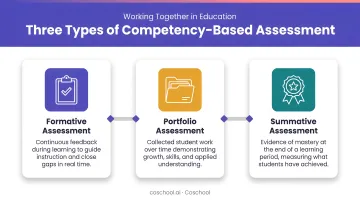
CBA typically involves three assessment types working together:
- Self-assessments — students reflect on their own abilities using tools like "I can…" learning targets or four-point rating scales, even from early primary years
- Authentic/formative assessments — performance tasks, projects, and rubrics used throughout a unit to check understanding as it develops, not just at the end
- Standardised checks — periodic benchmarks that verify progress against defined outcomes
Rubrics are central to this approach — they define exactly what mastery looks like at each level, giving both teachers and students a shared reference point before work begins. A student who completes a project demonstrating they can construct an argument has shown something a multiple-choice test cannot verify.
That distinction matters when deciding how to move students forward.
CBA vs. Traditional Testing
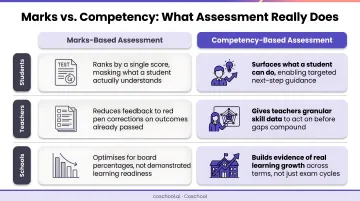
In a traditional model, a student can score 60% on a test — passing — without having mastered the foundational skill being assessed. CBA ties progression to demonstrated mastery, not to time spent in class or marks accumulated. The result is a clearer, more honest record of what each student can actually do — which is what teachers and parents need to make informed decisions about next steps.
Key Benefits of Competency-Based Assessment
The benefits below are most visible when CBA is applied consistently across subjects and year levels — not just in isolated projects. They show up in real classroom data: engagement rates, mastery per concept, teacher instructional decisions, and how quickly gaps get addressed.
Benefit 1: Students Become Active Owners of Their Learning
CBA shifts students from passive recipients of grades to participants who understand their learning goals, can articulate where they stand, and know their next step. When assessment is built around authentic tasks rather than memory tests, students see why what they are learning matters.
That relevance drives genuine effort. Gallup research across 128 schools and 110,000+ students found that student engagement and hope were strongly linked to academic achievement growth in maths, reading, and all subjects. The same Gallup Student Poll found engagement drops from 74% in Grade 5 to just 32% in Grade 11 — a collapse that happens precisely when schooling starts to feel abstract and disconnected from real purpose.
CBA counteracts this through practical structures:
- "I can…" learning targets that make goals concrete and personal
- Four-point self-assessment scales that give students language to describe their progress
- Student-designed mastery criteria that build ownership even in young learners
- Performance tasks where the work itself feels purposeful rather than procedural
Dweck and Leggett's research on mastery goals versus performance goals is relevant here. When students pursue mastery — understanding for its own sake — they respond to challenge with effort rather than avoidance. CBA's formative checkpoints reinforce that orientation rather than rewarding compliance with the right answer at the right time.
This matters most in: mixed-ability classrooms where traditional tests consistently demotivate lower-performing students, and in secondary years where disengagement tends to peak.
Benefit 2: Personalised Learning Pathways That Close Knowledge Gaps
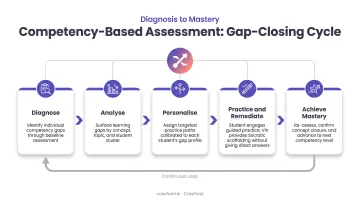
CBA ensures students progress only when they have genuinely demonstrated mastery — meaning no student silently advances while carrying unaddressed gaps. Each student's next step is determined by where they actually are, not by the calendar.
ASER 2024 found only 27.1% of rural Std III children could read a Std II-level text, and only 33.7% could perform basic subtraction. ASER 2023 showed those early gaps don't disappear: roughly 25% of rural youth aged 14–18 still could not fluently read a Std II text in their regional language. Age-grade progression and actual mastery are not the same thing.
Formative assessments in CBA function as ongoing diagnostic checkpoints, not final verdicts. Teachers can see exactly which competency a student hasn't yet mastered and provide targeted support before the class moves forward. Rubrics remove ambiguity about what "good enough" means.
Platforms like Coschool's SchoolAI support this at classroom scale. The Teacher Dashboard provides a 3-level concept drill-down per student — showing question-level performance, common error patterns, and time spent — before the next class begins. When a teacher identifies that a section is struggling with a specific concept, Level-Up Tasks assign personalised remediation per student in one click. The closed-loop architecture means gaps surface early and get addressed before they compound.
The downstream impact shows up in mastery rates per concept, fewer students falling below grade-level benchmarks, and reduced remediation needs over time — particularly in post-disruption recovery contexts, sequential subjects like maths and language, and classrooms with high variation in prior learning.
Benefit 3: Richer Feedback That Drives Continuous Improvement
CBA replaces end-of-term marks with structured, skill-specific feedback cycles that give students, teachers, and parents a clear picture of where learning stands — and what to do next.
Hattie and Timperley reported feedback effects with an average effect size of 0.79 across their synthesis of educational interventions. Black and Wiliam's foundational formative assessment review reported effect sizes between 0.4 and 0.7 — among the highest documented for any classroom intervention. The consistent finding: specific, timely feedback tied to clear criteria outperforms summative grades in improving student performance.
What this looks like in practice:
- After each formative checkpoint, students and teachers discuss what went well, where challenges remain, and what the next learning step looks like
- Rubrics linked to competency levels replace subjective impressions with observable, discussable evidence
- Students build a portfolio of work that tracks their own progress — not just their scores
- Parents receive insight into their child's skill development rather than a single percentage
Coschool's Parent Engagement Platform extends this feedback loop beyond the classroom. The Know Your Child and Help Your Child workflows give parents daily visibility into homework performance, specific areas of struggle, and suggested questions for dinner-table conversations about learning. Weekly Updates consolidate progress with a 3-level concept drill-down. Parents become informed partners rather than a passive audience for a twice-yearly report card.
This matters most in: writing, collaborative projects, scientific inquiry, and any subject where a single score fails to reveal what the student understands or where they are stuck.
What Happens When Competency-Based Assessment Is Absent
When schools rely solely on marks-based assessment, the consequences compound.
Students advance through grade levels without demonstrating actual mastery. In sequential subjects — maths, reading comprehension, scientific reasoning — later learning gets built on unstable foundations. By the time the gap is visible in a Class VIII or X result, years of compounding have made it far harder to address.
The impact shows up differently across stakeholders:
- Teachers face diagnostic blindness. Without competency-specific data, a teacher can see that a student underperformed — but not where or why. Instruction becomes reactive, adjusting after the test rather than before the gap compounds.
- Students learn to optimise for marks. Copying homework, asking "will this be on the test?", chasing extra credit — these are rational responses to a marks-first system, not preparation for real-world application.
- Schools lose early warning signals. By the time chronic underperformance surfaces in board results, the window for low-cost intervention has long closed.
None of these habits build what WEF's Future of Jobs 2025 identifies as the skills employers increasingly need: analytical thinking, problem-solving, and the ability to apply knowledge in unfamiliar situations.
NEP 2020 recognises this directly. As quoted on CBSE's CBE portal, the policy calls explicitly for moving away from summative rote memorisation toward regular, formative, competency-based assessment that tests higher-order skills. Competency-based assessment is the mechanism that closes that gap — identifying skill deficits early enough to act on them, not after the next board exam confirms them.
How to Get the Most Value from Competency-Based Assessment
CBA delivers its full value when it is embedded consistently into classroom practice — not deployed as a one-off project. Three conditions matter most:
- Define competencies clearly — teachers and students need a shared understanding of what mastery looks like before assessment begins, not after
- Build formative checkpoints into every unit — not just at the end; ongoing diagnostic data is what makes the approach functional
- Act on the data — recording gaps without responding to them is the most common implementation failure
The practical challenge at scale is real. Tracking each student's progress individually across 30–40 students, across multiple subjects, is demanding. Purpose-built tools address this directly. SchoolAI's dashboards, for example, are designed around exactly this workflow:
- Teacher Dashboard surfaces question-level performance and common error patterns, then enables personalised task assignment — saving teachers 2–3 hours daily previously spent on manual checking
- Principal Dashboard sends automated alerts when classes fall below 50% homework completion or when performance trends downward, giving leadership visibility without manual data collection
Tools handle the data side — but the human side matters just as much. When students understand what mastery looks like and have a role in defining it, their investment in the process deepens. When parents receive competency-level insights rather than raw marks, the feedback loop extends beyond the classroom and learning continuity improves.
Conclusion
Competency-based assessment reframes how schools understand learning itself: moving from measuring what students remember to verifying what they can actually do. Its advantages compound when applied consistently: more engaged students, fewer unaddressed gaps, and teachers equipped to respond to each learner rather than the class average.
As Indian schools align with NEP 2020's competency-based direction and as the world increasingly asks graduates to demonstrate real skills, CBA is not a future aspiration. It is an approach schools can start implementing today — through formative checkpoints, structured rubrics, and teacher-led feedback cycles that gradually replace snapshot testing with ongoing evidence of learning.
Frequently Asked Questions
What is competency-based assessment in education?
CBA is an approach where students are assessed on their ability to demonstrate and apply skills in real-world contexts, rather than recalling content on a test. Progression is tied to demonstrated mastery rather than time spent in class or marks accumulated.
What are the key competencies in competency-based education?
Key competencies include transferable, real-world skills: critical thinking, communication, collaboration, problem-solving, and self-directed learning. These skills are relevant across subjects and carry forward into further education and careers.
What types of assessment are used in competency-based education?
The three main types are self-assessments (student reflection on their own learning), authentic and formative assessments (performance tasks, projects, and rubrics used throughout learning), and standardised checks. Authentic assessments sit at the core of CBA, generating ongoing evidence of mastery rather than a single final score.
How is competency-based assessment different from traditional grading?
Traditional grading measures how much content a student recalled at a point in time. CBA instead measures demonstrated skill mastery through ongoing evidence, shifting focus from a final score to a continuous feedback cycle that tells teachers and students what to do next.
How can teachers implement competency-based assessment in the classroom?
Practical starting points: write objectives as "I can…" learning targets, introduce a four-point self-assessment scale for students, build formative checkpoints into the rhythm of each unit, and use skill-based rubrics that students help design. Consistency across units matters more than perfection in any single one.
What role does technology play in supporting competency-based assessment?
Technology helps teachers manage individual competency tracking at scale. Tools like SchoolAI provide real-time data on student progress through question-level analytics, enable personalised feedback through adaptive task assignment, and surface learning gaps before they compound — without adding to teachers' workloads.