Introduction
Most schools still measure student progress the same way they did decades ago: collect assignments, run a term-end exam, issue grades. By the time a teacher identifies that a student has fallen behind in fractions or chemical equations, three more chapters have already been taught on top of that gap.
The stakes are real. India's UDISE+ data covers 24.69 crore students across 14.71 lakh schools—and student-wise data collection only began in 2022-23 specifically to track learning levels and prevent dropouts. Meanwhile, the OECD's 2023 Digital Education Outlook found that while 65% of surveyed education systems had a national student information system, only 31% had built-in analytics dashboards—meaning most schools record data but can't act on it in time.
This guide breaks down what to look for when evaluating student learning tracking software in 2026: the key features that separate useful tools from data-collection exercises, the questions to ask before committing, and the criteria that matter most for Indian K-12 schools. The goal is to help teachers intervene before gaps compound, keep parents genuinely informed, and give school leaders the visibility to drive consistent improvement—grade by grade, section by section.
Key Takeaways
- Student learning tracking software covers far more than grades: engagement, attendance, and knowledge gaps, all in real time.
- The right platform surfaces struggling students before the teacher notices, not after the term ends.
- Key selection factors: real-time analytics, early-warning alerts, teacher usability, parent communication, and data security.
- Software that fits existing school workflows gets used; software that disrupts them gets dropped.
- The best platform is the one that helps every student keep up, not the one with the longest feature list.
What Is Student Learning Tracking Software?
Student learning tracking software is a digital system that collects, organises, and analyses student data—including grades, assessment results, attendance, engagement, and learning behaviour—to give teachers, administrators, and parents a continuous, accurate picture of each student's academic progress.
This is different from a basic gradebook or LMS. A gradebook stores scores. An LMS manages content delivery and assignments. Tracking software does something neither does well: it turns ongoing performance signals into actionable insights—identifying which students need help and on which specific concepts before the next lesson begins, not after the next test confirms it.
What Does It Typically Monitor?
Modern platforms capture several distinct data categories:
- Academic performance — test scores, assignment completion, subject-wise proficiency, and concept-level mastery
- Attendance patterns — absence frequency, chronic absenteeism signals, and correlation with performance trends
- Classroom engagement — session activity, time-on-task, question attempts, and tool interaction
- Behavioural indicators — where applicable, early signals related to disengagement or social-emotional concerns
- Knowledge gaps at the concept level — not just that a student scored 40% on a chapter test, but which specific topics they haven't yet mastered
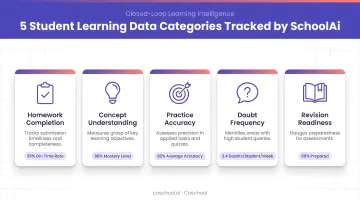
Aggregate scores confirm that something went wrong. Concept-level gap data tells you precisely where—and that distinction is what makes intervention possible before the gap compounds.
Why Schools Rely on Learning Tracking Software
The operational case is straightforward:
- Earlier identification of at-risk students — internationally validated research, including a US Institute of Education Sciences study across 73 high schools, found measurably reduced chronic absence and course failure risk after just one year of early warning monitoring
- Data-backed teacher interventions — teachers can target support to specific students on specific concepts rather than re-teaching entire chapters
- Personalised learning plans — performance data enables differentiated assignments calibrated to individual student needs
- Stronger parent communication — research shows teacher-family communication increases the odds of on-time completed homework by roughly 40%, and tracking software makes that communication specific and frequent
- Evidence for curriculum decisions — aggregate gap data across sections reveals whether a topic needs to be taught differently, not just assessed differently
Key Factors to Consider When Choosing Student Learning Tracking Software in 2026
No single platform suits every school. Needs vary based on school size, grade levels, existing technology, and teaching philosophy. The factors below connect specific software capabilities to measurable educational outcomes—use them as your evaluation checklist.
Real-Time Data Tracking and Adaptive Feedback
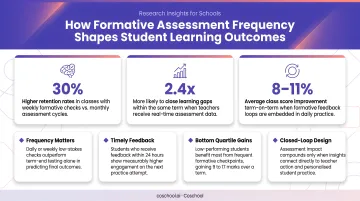
Software that generates reports after a term ends tells teachers what already went wrong. Real-time tracking tells them what to fix right now, while the next class is still 24 hours away.
The practical questions here:
- Does the platform surface performance data between lessons, or only after formal assessments?
- Can teachers see which specific questions tripped up the most students before they walk into class the next morning?
- Does the system support formative assessment at a concept level, not just chapter averages?
Key KPIs this capability supports: reduction in time-to-intervention for struggling students, increased formative assessment frequency, and measurable improvement in concept mastery rates across sections.
A 2022 meta-analysis of 48 qualified studies confirmed that formative assessment has a positive effect on student learning outcomes. Without real-time data, formative feedback collapses into a once-per-term event—too infrequent to catch gaps before they compound across topics.
AI-Powered Analytics and Early Warning Systems
Rule-based alerts—"student missed three classes" or "score below 50%"—were a useful first step. In 2026, they're no longer sufficient. AI-driven platforms detect declining performance trends before they cross a threshold, predict which students are at risk before the teacher notices, and recommend specific next steps.
What to look for in an AI-capable platform:
- Does it use adaptive algorithms that adjust content or difficulty based on individual student responses?
- Can it flag knowledge gaps at the topic level and suggest targeted remediation tasks?
- Does it include hesitation detection or behavioural disengagement signals, not just wrong-answer detection?
- Is there a teacher-governed override—so AI recommendations support teacher judgment rather than replacing it?
One important caution applies here. IES research found that a machine-learning risk model and a traditional prior-performance early warning system performed similarly when using equivalent risk-score cutoffs.
AI accuracy claims deserve scrutiny. Ask vendors for confusion-matrix metrics (precision, recall, and false-positive rates) and local validation data before accepting generic precision claims.
Teacher Usability and Workflow Integration
Even the most analytically powerful platform fails if teachers find it cumbersome alongside their existing daily routines. A tool requiring manual data re-entry or constant platform-switching will see low adoption regardless of its capabilities.
Gallup and NewSchools research found only 45% of teachers rated digital learning tools as easy to use—making usability one of the most documented adoption barriers in ed-tech.
McKinsey estimated automation could free approximately 13 hours per teacher per week, but that only happens when the platform reduces work, not adds another dashboard to monitor.
Practical questions to ask during evaluation:
- How many steps does it take for a teacher to view a student's progress snapshot?
- Does the software integrate with existing lesson planning or assessment workflows?
- Is there a mobile-accessible interface for in-class, real-time use?
- Does the platform automate the mechanical tracking tasks—homework checking, performance logging, parent updates—that currently consume teacher evenings?
Parent and Stakeholder Communication Integration
Teacher-facing insights only create impact if they reach home. Parents who receive regular, actionable updates on their child's progress are far more likely to reinforce learning at home—and the evidence is specific: regular teacher-family communication raises on-time homework completion odds by roughly 40%.
What to evaluate in parent communication features:
- Does the platform include a parent portal or app that translates academic data into plain-language progress summaries?
- Can parents see learning milestones, upcoming assessments, and specific areas of struggle without scheduling a meeting?
- Are updates frequent (daily or weekly) and specific, or are they periodic and generic?
- Does the platform go beyond informing parents to guiding them—suggesting what to discuss with their child based on that day's learning data?
Compatibility with Existing School Systems
A new tracking platform should connect to existing systems—not compete with them. Poor integration creates duplicate data entry, disconnected student records, and avoidable administrative overhead.
Before signing a contract, ask:
- Does the software support API integrations with common school management systems used in Indian schools?
- Can it import historical student data during onboarding, or does every student start from scratch?
- Does it support single sign-on for teachers and administrators?
Data Privacy, Security, and Scalability
Student data involving minors carries significant legal and ethical responsibilities. For Indian schools, India's DPDP Act 2023 is the primary legal anchor—it requires verifiable parental consent before processing children's personal data and explicitly restricts tracking, behavioural monitoring, and targeted advertising directed at children.
Privacy checklist for procurement:
- Does the vendor demonstrate DPDP Act compliance, including consent flows, purpose limitation, and data retention policies?
- Are role-based access controls in place—so students, teachers, parents, and administrators each see only what they should?
- Does the platform use industry-standard encryption for data in transit and at rest?
On scalability: a platform suitable for a 300-student school needs different evaluation than one required for a 3,000-student institution. Ask whether performance degrades as enrollment grows and whether pricing models remain viable at scale.
How Coschool's SchoolAi Supports Student Learning Tracking
Coschool brings an unusual starting point to this problem: its founders built and operated schools for over 30 years before building software. SchoolAi is the product of that experience, built by educators who understand learning gaps from the inside, not just from the technology side.
The platform's core design philosophy is "transformation without disruption." Schools continue with their existing curriculum, teachers, and timetable. The AI layer upgrades what happens around those structures — homework evaluation, performance tracking, parent communication, and leadership visibility — without requiring schools to restructure around the technology.
How SchoolAi Addresses Each Selection Factor
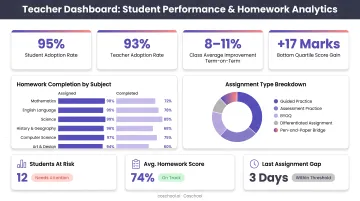
- Real-time tracking: The Teacher Dashboard captures homework completion rates, time-on-task, question-level performance, and common error patterns — all surfaced before the next lesson begins. Teachers get a 3-level drill-down per concept, from chapter overview to specific subtopic mastery, with a student's full year history in one click.
- AI gap detection: Vin, SchoolAi's school-integrated AI tutor, uses a 3-strike support system: hints unlock progressively after three wrong attempts, and if a student remains stuck, the teacher receives a specific alert. Hesitation detection picks up disengagement signals beyond what shows in responses alone.
- Teacher usability: Homework checking (including pen-and-paper submissions via handwriting recognition at 85-90% accuracy), performance logging, parent updates, and lesson plan preparation are all automated. Teachers report 2-3 hours saved per day, with a mobile dashboard for in-class decisions.
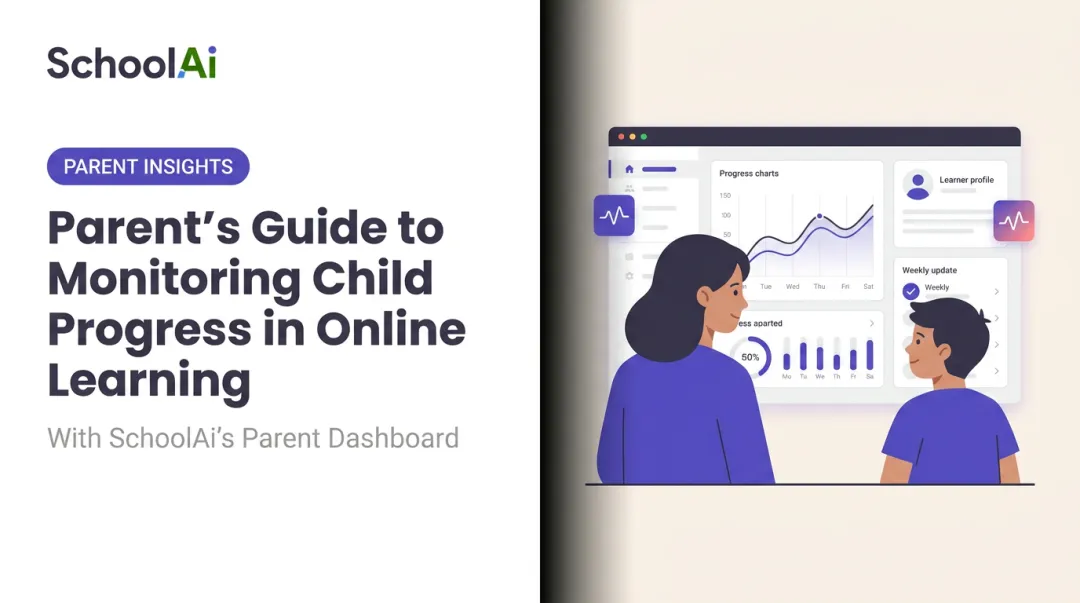
- Parent communication: The Parent Engagement Platform delivers Know Your Child (daily homework data, struggle areas), Help Your Child (conversation starters, practical guidance), and Weekly Updates (consolidated learning picture). Parents receive specific, actionable nudges rather than two report cards a year.
- School leader visibility: The Principal Dashboard provides hierarchical drill-down from grade to section to teacher to student to subtopic. Automated alerts fire when any grade falls below 50% homework completion or when a teacher hasn't assigned homework in 14 days.
Outcomes Across Partner Schools
Schools using SchoolAi have reported an 8-11% class average improvement Term-on-Term and +9 to +17 marks improvement for bottom-quartile students across partner schools including The Sri Ram School Hyderabad, The Heritage School Delhi, and Meridian School Hyderabad.
Conclusion
The right student learning tracking software in 2026 is the one that fits your school's teaching philosophy, slots into existing workflows without friction, and moves the needle for students who need the most support — not the one with the longest feature checklist.
Student needs shift, curricula evolve, and teaching approaches change. Plan for periodic evaluation of your tracking tools — not just at onboarding, but every term — to confirm the platform still delivers real impact as your school grows.
Ultimately, the best platform is the one your teachers open every day, your parents check every week, and your students genuinely benefit from. That value should show up now, not after the next report card cycle.
Frequently Asked Questions
Which software is used for student tracking?
Common categories include LMS platforms, student information systems (SIS), and dedicated performance tracking tools. AI-powered platforms like Coschool's SchoolAi go further, offering real-time adaptive capabilities that detect knowledge gaps at the concept level and trigger timely interventions—something static records can't do.
How do you assess student learning and track progress?
Effective tracking combines formative assessments (quizzes, classwork, exit tickets), summative evaluations, attendance data, and engagement signals. Digital platforms aggregate all of these into a continuous progress picture for teachers—moving well beyond periodic report cards.
What types of data should student learning tracking software capture?
Core data includes academic performance by subject and concept, attendance patterns, assignment completion, and classroom engagement levels. Advanced platforms also capture knowledge gap indicators at the topic level, attempt counts, time-on-task, and behavioural disengagement signals.
How does student learning tracking software help teachers personalise instruction?
Tracking data reveals exactly which concepts individual students have and haven't mastered. Teachers can then group students by learning need, assign differentiated tasks based on specific gaps, and adjust pacing, rather than moving the entire class through content at a single pace.
Can student tracking software integrate with existing school management systems?
Most modern platforms offer API-based integrations with common SIS and LMS tools. Schools should verify compatibility with their specific existing systems before committing, and confirm whether historical data can be imported during onboarding.
What is the difference between an LMS and student learning tracking software?
An LMS primarily manages course content delivery and assignments. Student learning tracking software continuously monitors and analyses academic performance data to generate actionable insights. Some modern platforms, including SchoolAi, combine both functions within a single closed-loop system.