According to UDISE+ 2024-25 data, 30.6% of Indian schools — over 450,000 institutions — now have functional smart classrooms. That's up from 24.4% just one year earlier. Growth at that pace means school administrators, teachers, and parents are making adoption decisions without always having a clear picture of what "smart classroom" actually means.
This guide covers exactly that: a working definition, the core elements, the different tiers, what the evidence says about outcomes, and how AI is pushing the concept beyond hardware entirely.
Key Takeaways
- A smart classroom integrates technology to deepen the learning process itself — improving understanding, retention, and engagement, not just content delivery
- Hardware (interactive panels, devices) + software (LMS, AI tools) + reliable internet = the three-part foundation
- Three tiers exist: teacher-led standard, shared-device intermediate, and full 1:1 student-led
- Research shows smart board use has a large positive effect on academic achievement (ES = 0.94 across 47 studies)
- AI takes smart classrooms beyond connectivity: it identifies individual learning gaps and personalises instruction at scale
What is a Smart Classroom?
A smart classroom is a technology-enhanced learning environment that integrates digital tools — interactive displays, connected devices, software platforms — to improve teaching and learning outcomes.
The key word is how. A classroom with 30 tablets but no coherent pedagogical structure isn't smart. A classroom where a teacher uses a single interactive panel to deliver real-time formative assessment absolutely is.
The Defining Characteristics
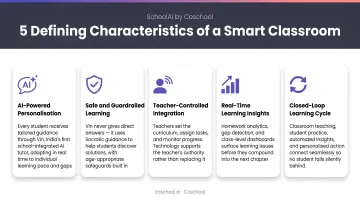
Five characteristics separate a smart classroom from a room with expensive equipment:
- Interactive content delivery — lessons involve multimedia, annotation, and two-way engagement rather than one-directional presentation
- Real-time feedback loops — teachers see student understanding during or immediately after a lesson, not days later
- Adaptive learning tools — software adjusts difficulty and pacing to individual students
- Cloud-based resource access — content is updated, shareable, and accessible beyond school hours
- Data-informed instruction — teachers make decisions based on performance data, not guesswork
The Indian Context
NEP 2020 explicitly mandates extensive technology use across teaching, learning, assessment, and teacher preparation — and proposes the National Educational Technology Forum (NETF) to guide implementation. The funding is already allocated.
Under Samagra Shiksha, the government provides a non-recurring grant of ₹2.40 lakh per school for up to 2 smart classrooms, plus a ₹0.38 lakh recurring grant. As of January 2025, 82,120 smart classrooms have been sanctioned across states and UTs. The hardware is arriving. What school leaders now need is a clear answer to what happens pedagogically once it does.
Key Elements of a Smart Classroom
Hardware Components
The interactive flat panel or smartboard sits at the centre of most setups. It replaces the static blackboard with a touch-enabled, multimedia-capable surface where teachers can annotate, embed videos, pull live content, and allow students to interact directly. The shift from chalk-and-talk to dynamic two-way surfaces changes classroom participation fundamentally.
The panel works alongside a set of supporting components:
- Student devices — tablets or laptops, either 1:1 or shared, for independent and collaborative work
- Document cameras — project physical objects, textbooks, or student work onto the main display
- Audio systems — directional microphones and speakers ensure clarity in rooms of 30–40 students
- Video conferencing equipment — enables hybrid or remote learning scenarios, a requirement that accelerated sharply after 2020
Additional components like student response systems (clickers), digital podiums, and RFID attendance tools appear in more advanced setups but aren't essential initially.
Software and Digital Infrastructure
The software layer is what makes hardware functional. Core components include:
| Component | Function |
|---|---|
| Learning Management System (LMS) | Organises content, tracks attendance, manages assignments, monitors progress |
| Classroom management software | Gives teachers visibility into device activity and keeps students on task |
| Educational apps and content libraries | Pre-built lesson materials, digital worksheets, assessments |
| AI-driven learning tools | Adaptive practice, personalised feedback, real-time gap detection |
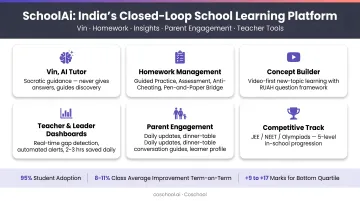
Platforms like Coschool's SchoolAi add a closed-loop layer on top of this — connecting classroom teaching, student practice, performance insights, and personalised action in a single workflow. It runs on any browser-enabled device with no app download, which matters in schools with mixed device availability.
Reliable internet connectivity underpins all of it. UDISE+ 2024-25 data shows 36.5% of Indian schools still lack internet access — making connectivity the first constraint any smart classroom strategy must address, before a single device is purchased.
Types of Smart Classrooms
Not every school starts at the same point. There are three practical tiers:
Standard Smart Classroom
Teacher-led setup with a computer, interactive whiteboard, and projector. Technology enhances lesson delivery, but the structure stays front-of-class. Students have limited or no individual device access. This is the entry point for most Indian schools and the format most commonly funded under Samagra Shiksha.
Intermediate Smart Classroom
Includes standard tools plus shared devices — laptops or tablets that rotate between students or groups. Not every student has a personal device. Learning blends teacher-led instruction with some independent digital exploration. Most school computer labs fall into this tier.
Student-Led Smart Classroom
Every student has a personal device, and the learning model shifts toward student-driven inquiry, collaboration, and content creation. Teachers act as facilitators rather than primary content deliverers. This tier is the most resource-intensive, but it also delivers the highest degree of personalisation — and the clearest conditions for AI-integrated tools like adaptive tutoring to work at full capacity.
Key characteristics of this tier:
- Students direct their own learning pace and inquiry paths
- Collaboration and content creation replace passive note-taking
- Teachers shift from instruction delivery to learning design
- Personalised digital tools (including AI tutors) operate per student, not per class
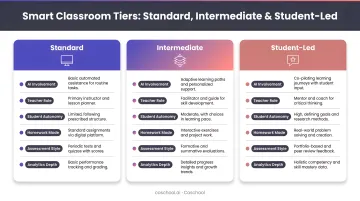
Moving between tiers doesn't mean starting over. Most schools upgrade one element at a time — adding shared devices first, then expanding access — which keeps disruption low while building teacher familiarity with each new layer before the next arrives.
Benefits of Smart Classrooms
Improved Comprehension Through Multimedia
3D animations, embedded videos, and virtual simulations make abstract concepts tangible — particularly in science and mathematics. A 2020 meta-analysis of 47 experimental studies covering 2,920 students found that smart board use produced a large positive effect on academic achievement (ES = 0.94). For context, an effect size above 0.8 is considered large in education research — meaning smart board integration consistently outperforms traditional instruction by a meaningful margin.
When students can see a cell dividing or a circuit completing in real time, they build mental models faster than through text descriptions alone.
Higher Engagement and Active Participation
Interactive quizzes, collaborative digital whiteboards, and gamified activities move students from passive listeners to active contributors. The same smart board meta-analysis noted qualitative evidence that smart classrooms make learning more visual, auditory, and engaging — though it also warned that poor teacher use can waste time and disrupt flow. A well-designed lesson with a smart board outperforms a poorly designed one every time; the technology amplifies whatever the teacher brings to the room.
Real Teacher Productivity Gains
Smart classrooms reduce the mechanical burden on teachers in several ways:
- Pre-built content libraries cut lesson preparation time significantly
- Automated assessment tools eliminate manual grading for standardized tasks
- Real-time progress dashboards surface which students are struggling before the next class begins
- Dynamic lesson planning uses actual class performance data rather than assumptions
According to SchoolAi's school data, teachers recover 2–3 hours daily — through automated homework checking, lesson plans calibrated to each section's gap profile, and one-click intervention tools.
21st-Century Skill Development
NEP 2020 explicitly includes digital literacy, coding, and computational thinking among the skills Indian students need. Smart classrooms create the conditions to develop them — through project-based learning, peer collaboration tools, and simulations that put students inside real-world problems. The P21 Framework and OECD Education 2030 both identify these competencies as non-negotiable for student success beyond school.
Personalised Learning at Scale
Adaptive software adjusts content difficulty and pacing to individual students. Advanced learners get stretch tasks; students who need more time receive additional support. This happens without the teacher manually managing 35 different learning tracks. When AI is layered in, the system responds to where each student actually is — not where the curriculum assumes they should be.
Smart Classroom vs Traditional Classroom
| Dimension | Smart Classroom | Traditional Classroom |
|---|---|---|
| Learning materials | Digital, multimedia, updateable | Printed, static, uniform |
| Student engagement | Active, interactive, participatory | Passive, observational |
| Feedback speed | Real-time or same-day | Days to weeks later |
| Teacher role | Facilitator and learning architect | Primary content deliverer |
| Personalisation | Adaptive to individual pace | One-size-fits-all |
| Cost structure | Higher upfront, lower consumables | Lower upfront, ongoing print costs |
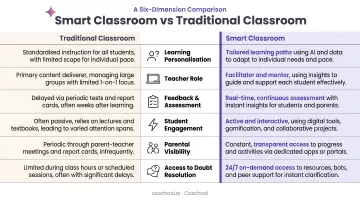
Smart classrooms do not replace teachers. The teacher's role evolves — from information deliverer to learning architect — but it remains central. Technology is only as effective as the educator who wields it. A well-prepared teacher with basic smart tools will outperform a disengaged teacher with a ₹10 lakh setup.
That teacher-first reality shapes how schools should approach adoption. Starting with a standard setup, running it well, and building from there is more sustainable than attempting a complete overhaul from day one. Incremental integration lets educators find their footing before the technology scales.
How AI Is Redefining the Smart Classroom
Hardware makes a classroom connected. AI makes it intelligent.
The difference is adaptive capacity. A smartboard displays content. An AI platform learns from student behaviour, identifies knowledge gaps in real time, and adjusts what each student sees next — something static tools cannot do regardless of price.
What AI Adds for Teachers
AI tools shift teacher time from mechanical tasks to meaningful instruction:
- Generates dynamic lesson plans calibrated to each section's gap profile, not generic templates applied uniformly across all classes
- Produces question banks for assessment with teacher review and customisation, cutting test preparation from hours to minutes
- Flags at-risk students automatically when work is incomplete, classes fall below performance thresholds, or gaps appear to be compounding
- Handles homework checking, progress tracking, and parent communication with minimal teacher input
AI-Powered Personalised Learning at Scale
A 2024 K-12 tutoring RCT (Tutor CoPilot) found that students whose tutors had AI support were 4 percentage points more likely to master math topics — with lower-rated tutors' students improving by 9 percentage points. This matters because it suggests AI support doesn't just help the best educators; it raises the floor.
The benchmark behind this ambition comes from Bloom's 1984 research: one-to-one tutoring produces achievement roughly 2 standard deviations above conventional classroom instruction. AI tutors make that degree of personalised support practically achievable across an entire school.
SchoolAi as a Practical Example
SchoolAi by Coschool is a working example of this model applied to the Indian K-12 context. Its core is Vin — India's first school-integrated AI tutor — which operates within the school's specific curriculum sequence, under teacher control, with guardrails for age-appropriate Socratic guidance. Vin never gives direct answers; it asks guiding questions that lead students to discover answers themselves.
The platform's closed-loop architecture connects seven stages: Assign → Practise → Evidence → Intervene → Inform → Adapt → Govern. At each stage, AI works alongside teachers rather than replacing them:
- Teachers see which questions tripped up most students before the next class
- Parents receive specific, actionable nudges — not generic PTM cards twice a year
- Principals get automated alerts when classes fall below 50% homework completion or when teachers haven't assigned work in 14 days
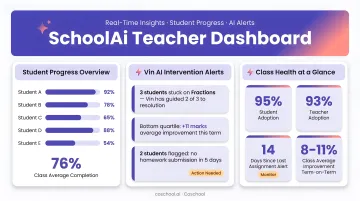
Coschool calls this "transformation without disruption" — the same curriculum, same teachers, same timetable, but with an AI layer that connects teaching, practice, and real-time intervention. Schools across metros and Tier 2 cities are already running on this model, including The Sri Ram School Delhi, Heritage School Delhi, Meridian School Hyderabad, Edify School Tirupati, Loyola Public School Guntur, and Hayde Heritage Academy Kotdwar.
For schools with budget constraints, the platform's browser-based architecture means no dedicated hardware, no app downloads, and no per-device costs — removing the infrastructure barrier that keeps many Tier 2 and Tier 3 schools from adopting AI-powered learning.
Frequently Asked Questions
What is a smart classroom used for?
Smart classrooms are used to make teaching more effective and learning more engaging through interactive content delivery, real-time assessment, personalised learning pathways, and digital collaboration between students and teachers. They support both in-class instruction and independent learning beyond school hours.
What are the elements of a smart classroom?
The core elements are: an interactive display (flat panel or smartboard), student devices (tablets or laptops), audio-visual systems, reliable internet connectivity, educational software or LMS, and increasingly, AI-powered learning tools that adapt to individual student needs.
What is an example of a smart classroom?
A teacher uses an interactive flat panel to deliver a 3D science lesson on cell division. Students work on shared tablets to annotate diagrams collaboratively. An AI platform simultaneously tracks each student's comprehension, flags those who are struggling with the concept, and alerts the teacher before the next period begins.
How is a smart classroom different from a traditional classroom?
Smart classrooms personalise learning, enable real-time feedback, and make lessons interactive. Traditional classrooms follow a uniform pace with delayed feedback and limited student-to-content interaction. The teacher's role also shifts from lecturer to facilitator, a shift that changes how learning actually happens, not just how it looks.
What are the challenges of setting up a smart classroom?
The main challenges are upfront hardware and infrastructure costs, reliable internet access (particularly relevant given that 36.5% of Indian schools still lack internet facilities per UDISE+ 2024-25), teacher training, and ongoing maintenance. AI-based software platforms that run on existing devices can significantly reduce hardware dependency and accelerate adoption.
Can smart classrooms support personalised learning for every student?
Yes, especially when AI-driven platforms are part of the setup. Adaptive tools adjust content difficulty and pace per student, while AI tutors provide individualised guidance at scale. Platforms like SchoolAi even support pen-and-paper submissions through handwriting recognition, making personalisation accessible in mixed-device environments.