Micro teaching was designed to solve exactly this problem. Since its origins at Stanford in the 1960s, it has given teachers a controlled, low-stakes environment to practise one skill at a time, collect targeted feedback, and improve in measurable ways. This guide covers everything — from the five-stage cycle and feedback models to practical tips for embedding it into your school's existing routines.
Key Takeaways
- Micro teaching is a short, focused teaching session (5–20 minutes) delivered to a small group for the purpose of practising one specific skill
- It follows a teach → feedback → re-teach cycle that isolates and builds skills deliberately
- Originated at Stanford in 1963; Dwight W. Allen is credited as the primary researcher behind its development
- Visible Learning MetaX records an effect size of d = 0.86 for micro-teaching — drawn from 5 meta-analyses across 270 studies
- Both new and experienced teachers benefit — micro teaching is about deliberate skill-building, not fixing poor performance
What Is Micro Teaching?
Micro teaching is a teacher training technique where an educator delivers a short, focused lesson — typically 5 to 20 minutes — to a small group of 3 to 10 participants. Those participants might be peers, trainees, or student volunteers. The goal is not to teach a complete unit but to practise and refine one specific teaching skill under observation.
Where It Came From
The method originated at Stanford University in the early 1960s, first implemented in Stanford's teacher intern programme in 1963. Dwight W. Allen, widely credited as its co-inventor, shaped the foundational model that most training programmes still reference today.
The original Stanford format was deliberately stripped back:
- Lessons ran approximately 5 to 10 minutes
- Groups consisted of 4 to 5 paid high school student volunteers
- Sessions were video recorded for later review
- Each session followed a teach → critique → reteach structure
That early model also used the Stanford Teacher Competence Appraisal Guide to give feedback a consistent framework — a practice still reflected in structured micro teaching today.
What Makes It "Micro"
The word "micro" refers to deliberate reduction across four dimensions:
| Dimension | Regular Lesson | Micro Lesson |
|---|---|---|
| Class size | 25–40 students | 3–10 participants |
| Duration | 40–60 minutes | 5–20 minutes |
| Content scope | Full topic unit | Single concept or skill |
| Variables in play | Many simultaneous | One isolated skill |
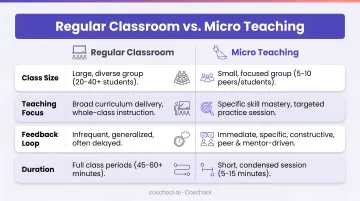
The constraints are intentional. By narrowing class size, time, and content scope simultaneously, micro teaching isolates a single skill — so the teacher gets clear, actionable feedback rather than a tangle of competing variables.
Why Micro Teaching Matters for Teachers
It Builds Confidence Before It's Needed
Practising in front of a small, supportive group removes the pressure of a live classroom. For early-career teachers, this matters directly: Arsal's 2014 study of 70 pre-service teachers found that the group using micro teaching showed statistically significant greater progress in teaching self-efficacy compared to the control group.
That confidence shift is measurable — and it carries into every lesson a teacher delivers afterward.
It Makes Improvement Concrete
General professional development workshops cover broad strategies. Micro teaching does the opposite: it targets one skill per session. That specificity means progress is visible and measurable.
A 2019 study by Wangchuk examining 64 Bachelor of Education students found teaching-skill assessment scores improved from a mean of 32.4 to 74.6 out of 90 following micro teaching.
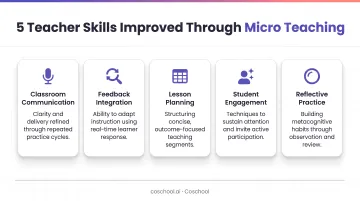
A 2025 literature review in Frontiers in Education covering 36 studies published between 2006 and 2023 found positive outcomes across:
- Classroom management
- Instructional delivery
- Communication skills
- Differentiated instruction
- Reflective practice
It Is Not Just for Trainees
Those research gains are concentrated in pre-service settings — but the method transfers. Experienced teachers use micro teaching to test a new pedagogical approach, integrate a technology tool, or revisit a skill that has become habitual rather than intentional. A teacher who has been asking predominantly closed questions for five years may not notice the pattern until a micro session makes it visible.
When embedded into staff development routines, it also normalises peer observation — shifting school culture from isolated teaching towards collective professional growth.
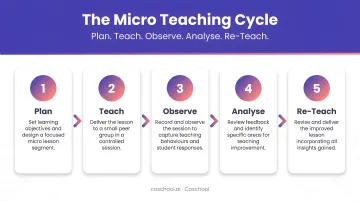
The Micro Teaching Cycle: 5 Key Stages
Stage 1 — Planning
The teacher selects one specific skill to practise and builds a concise lesson plan around a defined learning objective. The lesson should be contextualised within a full class (even if only 10 minutes are delivered) so observers can assess coherence and intent, not just execution.
Good planning questions to ask upfront:
- What is the one skill I am targeting this session?
- What will observable improvement look like?
- What should students be able to do or say by the end?
Stage 2 — Teaching the Lesson
Deliver the micro lesson to 5–10 participants. The session should include:
- Clear instruction
- At least one moment of active learner participation
- Deliberate demonstration of the skill being practised
Record the session wherever possible. Even a smartphone propped against a stack of books is enough. Video catches what peer observers miss: filler words, uneven eye contact, how long wait time actually lasts.
Stage 3 — Feedback Collection
Structured feedback follows immediately. NIU's Center for Innovative Teaching and Learning describes the Stanford 2+2 model: each observer provides two specific positive observations followed by two actionable suggestions for improvement.
The structure matters for three reasons:
- It keeps feedback balanced — not exclusively critical
- It focuses on observable behaviour, not personality or perceived intent
- It produces actionable outputs the teacher can act on in the re-teach
Stage 4 — Revision and Reflection
Review the feedback and, if available, the recording. The goal is analysis, not self-criticism.
Watching yourself back with a specific checklist makes this far more useful than a general watch-through. Focus on:
- Questioning balance
- Wait time length
- Pacing
- Eye contact distribution
Identify one or two adjustments with the clearest potential impact — not everything at once.
Stage 5 — Re-teaching
Deliver the same or a closely related segment again, this time incorporating the feedback. Unlike a standard classroom observation, micro teaching gives you a structured second attempt — and that repetition is where skill actually consolidates.
Repeat the cycle until the skill feels natural, then shift focus to the next.
Core Micro Teaching Techniques
Mini-Lesson Design
An effective micro session is built around a single, well-scoped mini-lesson that isolates one concept or skill. A useful test: if you cannot describe the skill being practised in one sentence, the lesson scope is probably too broad.
Example: A science teacher practises explaining photosynthesis using a factory analogy — inputs, outputs, and an energy source — rather than covering the full biological process. The skill being targeted is using analogies to make abstract concepts concrete.
Keep the content narrow enough that feedback can stay specific.
Effective Questioning
Questioning is one of the most commonly practised skills in micro teaching. The reason it gets so much attention: small adjustments in how a teacher frames a question can visibly shift the quality of student responses within a single session.
The distinction that matters most:
- Closed (convergent) questions — seek a specific or narrow response; useful for checking recall
- Open (divergent) questions — invite a wider range of responses and require elaboration; useful for stimulating critical thinking
A teacher can deliberately practise shifting their questioning distribution during a micro session: start with a closed question to establish baseline understanding, then build to an open question that requires students to reason. The feedback loop then reveals whether the shift actually changed student responses.
Learner Engagement Strategies
Micro teaching is an ideal space to trial engagement techniques before deploying them in a full class. Even a 10-minute session should include at least one moment of active participation. Options to practise:
- Think-pair-share — low-prep, immediately observable
- Brief collaborative tasks — shows how the teacher manages transitions
- Real-world examples — tests whether the connection lands or falls flat
Each technique also generates concrete feedback: did students engage, hesitate, or disengage? That data shapes what you refine before taking it to a full class.
How to Give and Receive Feedback in Micro Teaching
Ground Rules That Make It Work
Productive micro teaching depends on psychological safety. NIU CITL's framework outlines ground rules that should be established before the first session:
- Maintain confidentiality about what is observed
- Focus on observable behaviour, not personality or motive
- Respect time limits during feedback
- Approach critique as collegial support, not evaluation
- Respect the teacher's willingness to experiment and take risks
Without these in place, feedback becomes guarded and the session loses its value.
Giving Feedback That Drives Improvement
Feedback must be specific, observable, and actionable. Here is what that looks like in practice:
| Vague Feedback | Specific, Actionable Feedback |
|---|---|
| "You seemed nervous" | "You referred to your notes for the first 3 minutes — try writing key points on a single cue card" |
| "Good energy" | "You used wait time effectively after your second question — students' responses were noticeably more detailed" |
| "The explanation was confusing" | "When you introduced the analogy, you used three different terms for the same concept — pick one and stay with it" |
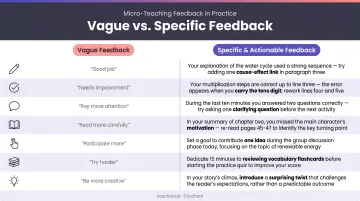
That specificity is what makes the re-teach worthwhile — the teacher walks away knowing exactly what to adjust, not just that something felt off.
Receiving Feedback Productively
Giving good feedback is only half the equation. How a teacher receives it determines whether anything actually changes in the next cycle:
- Listen without defending. The impulse to justify a choice — even a reasonable one — signals to peers that critique isn't welcome, and they'll soften it next time.
- Ask for specifics. "Can you describe the moment when the pacing slipped?" surfaces far more usable detail than a nod and a thank-you.
- Limit changes to one or two per cycle. Trying to fix everything simultaneously often means fixing nothing well.
Most teachers find that three or four cycles around the same skill — say, questioning technique or wait time — produce more lasting change than a single broad sweep across multiple areas.
Making Micro Teaching Work: Practical Tips for Teachers
Start Small and Stay Consistent
Teachers do not need a formal programme to begin. A 15-minute practice session with two or three colleagues, focused on one skill, is enough to start the cycle. The most effective approach is to embed micro teaching into time that already exists — staff meetings, CPD days, or shared free periods — rather than creating a new obligation.
Consistency matters more than frequency. One session per month, done well, builds more than sporadic intensive workshops.
Use Video Recording to Bridge the Feedback Gap
Recording a micro session, even on a smartphone, gives teachers something peer feedback alone cannot: a view of themselves that is not filtered through self-perception.
Rewatching with a specific checklist makes the review far more actionable:
- How many open versus closed questions did I ask?
- What was my actual wait time after each question?
- Did I maintain eye contact across the group, or anchor to one participant?
- How often did I use filler words?
Without a checklist, most teachers rewatch and simply feel uncomfortable rather than identify specific changes.
Use Real-Time Data to Extend the Reflect-and-Improve Mindset
The "teach → reflect → improve" cycle does not have to stay confined to dedicated micro teaching sessions — it can operate every day. SchoolAi's Teacher Dashboard, for instance, surfaces question-level performance data, common error patterns, and concept-level comprehension gaps before the next class begins.
When a teacher sees that most students struggled with a specific question on last night's homework, that is the same signal a micro teaching feedback session would surface — drawn from real students, without scheduling a separate observation. Gaps identified after one lesson feed directly into how the next one is planned.
Frequently Asked Questions
What is meant by micro teaching?
Micro teaching is a structured teacher-training technique where an educator delivers a short lesson (5–20 minutes) to a small group, with the specific goal of practising and improving one teaching skill. Feedback and re-teaching follow each session, creating a deliberate improvement cycle.
What are the key stages of micro teaching?
The five stages are: planning, teaching the lesson, feedback collection, revision and reflection, and re-teaching. The cycle is designed to repeat: each loop builds skill mastery incrementally before a new skill becomes the focus.
What is an example of micro teaching?
A trainee teacher delivers a 10-minute lesson on fractions to five colleagues acting as students. Observers provide 2+2 feedback on questioning technique. The teacher incorporates the suggestions and re-delivers the segment, this time with stronger use of open questions.
What is the difference between micro teaching and regular classroom teaching?
Micro teaching is deliberately scaled down in time, group size, and content scope to isolate one skill for focused practice. Regular teaching involves managing many variables simultaneously, which makes it much harder to isolate and improve any specific behaviour.
What skills are developed through micro teaching?
Core skills include lesson planning, questioning technique, learner engagement, pacing, classroom communication, and giving and receiving constructive feedback. With repeated cycles, teachers also develop stronger classroom management, differentiated instruction, and reflective practice.
How long does a micro teaching session typically last?
Most sessions run between 5 and 20 minutes. Some programmes extend to 30 minutes, but the brevity is intentional — it forces focus on one skill and keeps the feedback cycle fast and actionable.