Introduction
School leaders in 2026 are navigating pressures that compound on each other: post-pandemic learning gaps that haven't fully closed, teacher workloads at breaking point, and the need to prepare students for roles that don't yet exist — all at the same time.
ASER 2024 data tells part of the story — only 23.4% of Grade III government-school students can read a Grade II text, and while that's up from 16.3% in 2022, the gap remains large. Meanwhile, NCERT's 2022 survey found 81% of school students report anxiety related to studies and exams.
Closing those gaps matters — but meaningful school development goes further. It's about building systems and a culture where learning feels sustainable for teachers and purposeful for students.
This post covers 25 specific, actionable ideas grouped into five areas — teaching and learning, technology and AI, school culture, community engagement, and data-driven improvement — that school leaders can implement in 2026.
Key Takeaways
- Teaching and learning (Ideas 1–5): Shift from passive delivery to active, personalised, skills-based models.
- Technology and AI (Ideas 6–10): Use AI and EdTech to personalise learning at scale while keeping teachers in control.
- School culture and well-being (Ideas 11–15): Build environments where students feel genuinely supported and motivated to engage.
- Community engagement (Ideas 16–20): Bring parents and the broader community into the learning process as active partners.
- Data and improvement (Ideas 21–25): Use evidence to make decisions and sustain progress over time.
Teaching and Learning Innovation (Ideas 1–5)
What happens inside the classroom is still the foundation of everything. These five ideas focus on shifting how learning is designed and delivered to make it more active, relevant, and effective for every student.
Idea 1: Adopt Inquiry-Based and Project-Based Learning
Project-based learning (PBL) positions students as active investigators rather than passive recipients. Lucas Education Research reports gains of +8 percentage points in Grade 3 science and +11 percentage points in middle-school science where PBL was implemented with proper teacher support.
A practical starting point: one cross-subject PBL unit per term. Keep the scope manageable, tie it to curriculum outcomes, and debrief with teachers afterward to refine the approach before scaling.
SchoolAi's Experiential Learning module supports this with three structured project types:
- Design & Build — hands-on construction challenges tied to curriculum concepts
- Digital Simulations — virtual experiments using low-cost or no-cost tools
- Observation & Research — structured inquiry with rubrics-based assessment
Each type uses 1–7 day timelines, so schools don't need dedicated project weeks to make it work.
Idea 2: Implement Differentiated Instruction
Differentiated instruction means varying content, process, or product based on where each student actually is, not where the syllabus assumes they should be. A 2023 meta-analysis of 49 studies found an average effect size of g = 1.109 for differentiated instruction on student learning outcomes.
In practice, tiered assignments are the easiest entry point: one set of questions for students who need foundational reinforcement, a standard set for the class average, and stretch questions for advanced learners, all drawn from the same lesson.
SchoolAi's Differentiated Assignment feature does this at scale. Teachers build a question repository using BYOQ (Bring Your Own Questions), and the platform assigns calibrated work to different student groups in a single action, without requiring separate lesson plans.
Idea 3: Introduce Microlearning and Bite-Sized Content
Breaking lessons into short, focused segments reduces cognitive overload, a principle rooted in Mayer's segmenting research on multimedia learning. The key is pairing each segment with active retrieval, not just passive viewing.
SchoolAi's Concept Builder puts this into practice. Short videos introduce each subtopic, followed immediately by RUAH-framework questions (Recall, Understand, Apply, Higher-Order) that build understanding in layers rather than testing recall alone.
The Recap Map complements this with a 7–8 minute chapter scan and a 3–5 minute overview video for revision, keeping study sessions focused rather than sprawling.
Idea 4: Flip the Classroom
In a flipped model, students access instructional content at home (videos, readings, Concept Builder modules) and arrive in class ready for discussion, problem-solving, and application. Achievement effects are generally positive when students have consistent device access and teachers are prepared to use reclaimed class time well; without those two conditions in place, the model underdelivers.
SchoolAi tracks engagement with pre-class content through the Teacher Dashboard, surfacing completion rates, time spent, and question-level performance before the next lesson. Teachers arrive knowing exactly which concepts landed and which need in-class reinforcement.
Idea 5: Embed Social-Emotional Learning into Daily Routines
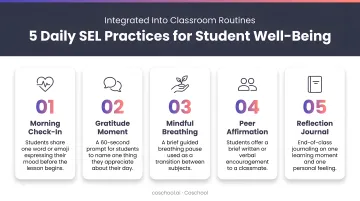
SEL works best as a set of daily practices woven into existing routines: check-in circles, reflective journaling, peer collaboration norms. A CASEL meta-analysis of 213 SEL programmes covering 270,034 students found participants scored 11 percentile points higher academically than controls.
That positions SEL as academic infrastructure, not a wellbeing add-on. Simple structural moves compound over time without requiring a curriculum overhaul:
- A 5-minute morning check-in to surface how students are arriving emotionally
- Explicit norms for group work that reduce conflict and increase participation
- Normalising discussion of mistakes as part of the learning process
Technology and AI Integration (Ideas 6–10)
2026 is a real inflection point for school technology — not because AI is new, but because it's now capable of personalising learning for every student. The guiding principle: technology that serves teachers, not replaces them.
Idea 6: Deploy AI-Powered Personalised Learning Platforms
AI-powered platforms can analyse individual student performance in real time and adapt content, pacing, and remediation to address specific gaps — at a scale no teacher can achieve alone.
SchoolAi's closed-loop system does this across a 7-stage workflow:
- Teachers assign work; Vin (the AI tutor) guides students through it
- The Teacher Dashboard surfaces which concepts tripped up which students before the next class
- Dynamic Lesson Plans auto-calibrate to each section's gap profile using four input signals
- The Principal Dashboard adds governance visibility — including automated alerts when homework completion in any grade drops below 50%
Reported outcomes across partner schools including The Heritage School Delhi, Meridian School Hyderabad, and The Sri Ram School: 95% student adoption, 93% teacher adoption, 8–11% class average improvement Term-on-Term, and +9 to +17 marks improvement for bottom-quartile students.
Idea 7: Use AI Tutors for 1:1 Student Support
Benjamin Bloom's foundational research showed one-to-one tutoring produced performance 2 standard deviations above conventional instruction. A meta-analysis of 50 intelligent tutoring evaluations found a 0.66 SD median effect — raising scores from roughly the 50th to the 75th percentile.
Scale has always been the barrier. AI tutors solve it.
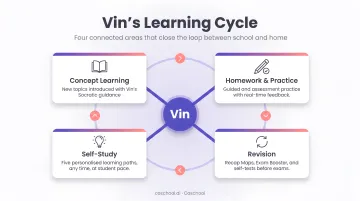
Vin, India's first school-integrated AI tutor, provides on-demand support 24/7 without ever giving direct answers. It guides students through Socratic questioning, uses a 3-strike hint system before alerting the teacher, and detects hesitation patterns that go beyond what visible responses show.
Coverage spans the full learning cycle:
- Homework & practice — guided problem-solving with escalating hints
- Doubt resolution — Ask-a-Doubt for curriculum-specific questions
- Revision — Exam Booster, Recap Map, and Create Your Own Test
- Self-study — 5 structured learning paths
All within curriculum guardrails, with copy-paste blocked and no open internet access.
Idea 8: Integrate Gamification and EdTech Tools
A 2023 meta-analysis confirmed gamification has positive effects on student learning outcomes when tied to learning goals rather than rewards alone. Points, badges, and challenge structures increase consistent practice — which matters most in subjects that require repetition, like maths fact fluency or vocabulary.
Pick one subject, run a evidence-backed gamification platform for a full term, and let the engagement and performance data make the case for expansion.
Idea 9: Adopt a Learning Management System to Streamline Workflows
An LMS centralises assignments, resources, feedback, and communication — but only creates value if it integrates with existing workflows rather than adding another disconnected system.
SchoolAi's Homework Management System reduces teacher administrative load by 2–3 hours daily — all within the same platform teachers already use for curriculum delivery:
- Automated homework checking, including handwriting recognition for pen-and-paper submissions (85–90% accuracy)
- Question bank generation and lesson plan creation
- Performance tracking and parent update push notifications
No parallel system. No double data entry.
Idea 10: Explore AR/VR for Immersive Learning Experiences
A meta-analysis of 21 experimental K–6 studies found VR produced a 0.64 global effect size on learning gains, with immersive VR reaching 1.11. Virtual science experiments, historical site visits, and 3D geometry have clear applications.
The cost barrier is real, but manageable. Begin with low-cost AR apps on existing devices, pilot one subject, and let measured outcomes — not enthusiasm — make the case for headset investment.
School Culture and Student Well-being (Ideas 11–15)
Academic outcomes don't happen in a vacuum. Students learn better when they feel safe, valued, and motivated. These five ideas build the conditions that make learning possible.
Idea 11: Build a School-Wide Growth Mindset Culture
A national experiment published in Nature found that even a brief growth mindset intervention improved grades among lower-achieving ninth graders and increased advanced mathematics course-taking.
The shift has to be structural, not just rhetorical. One practical signal: introduce a "best mistake of the week" acknowledgement in classrooms. When teachers model learning from errors publicly, students absorb the message faster than any poster on the wall.
That same principle needs to extend beyond the classroom into:
- Grading language and feedback framing
- How retakes and second attempts are handled
- How school leadership publicly discusses performance and setbacks
Idea 12: Prioritise Student Mental Health with Counselling Programmes
NIMHANS reports 7.3% prevalence of mental disorders among Indian adolescents aged 13–17 — an estimated 9.8 million young people needing active intervention. And 81% of NCERT-surveyed students reported exam-related anxiety.
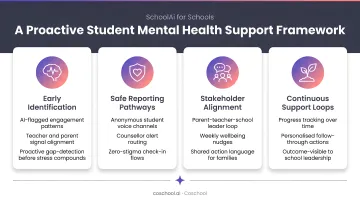
These aren't fringe concerns. Schools need to move from reactive counselling — addressing crises after they escalate — to proactive support:
- Regular counsellor check-ins scheduled into the timetable
- Peer support programmes trained and supervised by professionals
- Stress management workshops before exam seasons
- Anonymous reporting pathways for students who won't seek help directly
Idea 13: Create Inclusive and Culturally Responsive Classrooms
A 2025 study of 863 students found culturally responsive teaching improved engagement, belonging, and achievement, with identity affirmation accounting for 42.3% of the intervention's measured impact.
In practice, this doesn't require a curriculum overhaul. Incorporating local contexts, regional stories, and students' linguistic backgrounds into existing lessons signals to students that their experience belongs in the classroom — and that signal affects engagement measurably.
Idea 14: Launch Student Voice and Leadership Programmes
Student councils and feedback surveys only matter if students believe their input actually shapes decisions. Symbolic participation — students consulted but rarely heard — tends to reduce trust rather than build it.
Genuine student voice means:
- Surveys with published results and visible responses
- Student representation in reviewing school policies
- Student-led initiatives with real budgets or resources attached
Schools that have moved to this model report stronger student attendance and lower disciplinary incidents — outcomes that follow naturally when students feel ownership over their environment.
Idea 15: Expand Extracurriculars and Interest-Based Clubs
Research links extracurricular participation to stronger academic motivation within the same school year — students who engage in activities they genuinely care about tend to transfer that drive to their academic work.
Before launching new programmes, survey students on their actual interests. Build clubs around the top five responses rather than defaulting to standard sports and arts. Schools that have done this report higher participation rates and stronger cross-activity engagement — including in academic pursuits.
Community and Parental Engagement (Ideas 16–20)
Schools that treat parents and the community as genuine partners consistently outperform those that treat them as audiences for report cards. These five ideas build that two-way relationship.
Idea 16: Launch a Structured Parent-Teacher Communication Framework
The difference between one-way communication (newsletters, PTM cards) and genuine engagement is specificity and frequency. A meta-analysis of 50 studies confirmed parental involvement is positively associated with middle-school achievement.
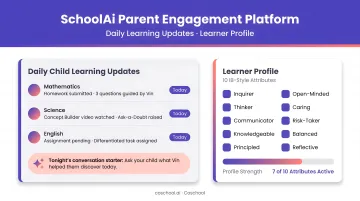
SchoolAi's Parent Engagement Platform replaces twice-yearly report cards with daily, actionable updates:
- Know Your Child — daily homework status, time spent, performance scores, areas of struggle
- Help Your Child — specific conversation starters and engagement tips
- Be a Smart Parent — resources for parents without subject expertise
- Weekly Updates — consolidated picture preventing information overload
Parents also receive a Learner Profile tracking 10 development attributes and a Digital Portfolio capturing academic and personal milestones — giving a longitudinal view far beyond test scores.
Idea 17: Bring Real-World Learning Through Guest Speakers and Industry Visits
Career talks work best when schools structure them deliberately: brief speakers on student context beforehand, and run a debrief session afterward. Connecting classroom content to real careers is especially motivating for middle and secondary students beginning to think about their futures.
A practical starting structure:
- Schedule one professional visit or virtual talk per term
- Coordinate with the relevant subject teacher in advance
- Assign a follow-up task that links the visit back to curriculum content
Idea 18: Organise Community Service Projects and Local Campaigns
A 2011 meta-analysis found service-learning students showed significant gains in attitudes toward school, civic engagement, social skills, and academic performance. Students who connect their learning to real-world impact simply find more reasons to show up and do the work.
Student-led projects — environmental drives, literacy campaigns, neighbourhood improvement — work best when students have ownership of the design, not just execution.
Idea 19: Host Regular Family Engagement Events
Beyond PTMs, schools can host learning fairs, cultural celebrations, and open classroom days where families see student work in action. These events build trust and give parents a concrete picture of what their child is actually learning, which leads to more targeted conversations and support at home — not just generic encouragement.
Idea 20: Build an Alumni Engagement Network
Alumni are an underused resource: they offer mentorship, career connections, and a credible lived perspective on what comes after school. A simple starting point — an annual alumni career talk series or a digital community group — creates a pipeline without needing a formal programme in place.
For secondary students exploring career paths, hearing from alumni two or three years ahead of them is often more persuasive than hearing from established professionals.
Data, Assessment, and Continuous Improvement (Ideas 21–25)
Sustainable school development requires measuring what matters — not just what's easy to measure. These five ideas help schools move from intuition to evidence while keeping teachers and students at the centre.
Idea 21: Build a Culture of Data-Driven Decision-Making
Data-driven culture isn't about dashboards — it's about regular habits. Weekly team reviews of attendance patterns, homework completion, and learning signals that inform small, timely adjustments before problems compound.
The distinction that matters: actionable data versus collected-and-ignored data. If a report sits in a folder after the meeting, it's not driving decisions. If a teacher adjusts tomorrow's lesson because of what the dashboard showed this morning, it is.
SchoolAi's Principal Dashboard makes this practical with automated alerts when grades fall below 50% homework completion or teachers have been inactive for 14 days — so leaders don't need to manually monitor what the system can surface automatically.
Idea 22: Use Formative Assessment Tools to Continuously Track Learning Gaps
Black and Wiliam's foundational review found formative assessment interventions produce effect sizes of 0.4 to 0.7 — among the highest of any instructional intervention. The difference from summative tests: formative assessment guides learning as it happens rather than measuring it after the fact.
Exit tickets, quick polls, observation checklists, and question-level homework data all serve this function. SchoolAi's Teacher Dashboard surfaces question-level performance and error patterns before the next class. Teachers get the information they need to intervene before gaps widen — without waiting for a test to confirm what the homework data already showed.
Idea 23: Establish Professional Learning Communities Among Teachers
Research by Vescio, Ross, and Adams found well-developed PLCs had positive impact on both teaching practice and student achievement — consistently outperforming one-off training events.
PLCs work when they're structured, recurring, and focused on a specific shared challenge. A practical starting point: identify one student learning problem the team shares (e.g., low performance in fractions across Grade 6), then work backward together to examine pedagogy, share lesson approaches, and track whether changes move the needle.
Idea 24: Create a Transparent School Improvement Plan with Measurable Goals
An effective School Improvement Plan (SIP) isn't a compliance document. It's a living roadmap the whole school community can see and use. Core components:
- A data-backed needs assessment
- 2–4 priority goals with specific, measurable targets
- Named owners and clear timelines
- A regular review cadence (not just annual)
- Visible to staff, parents, and students — not filed away
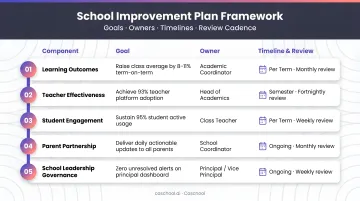
The review cadence matters as much as the plan itself. Monthly check-ins against specific metrics catch drift early.
Idea 25: Invest in Ongoing Teacher Professional Development
Kraft, Blazar, and Hogan's 2018 meta-analysis found teacher coaching effects of 0.49 SD on instruction and 0.18 SD on student achievement — outperforming isolated workshops in every study reviewed. Teacher quality is the single highest-leverage variable schools control, which makes sustained PD a strategic priority rather than a line-item afterthought.
High-quality PD in 2026 looks like:
- Coaching embedded in actual classroom observations, not delivered off-site
- Peer observation cycles with structured, specific feedback
- AI-assisted lesson planning that broadens a teacher's instructional range over time
- Reflection practices tied to real student outcomes
SchoolAi's Dynamic Lesson Plan Generator contributes here by exposing teachers to four pedagogical approaches for every subtopic (Classical, Humorous, Thought-Provoking, Gamified) — building instructional range through daily use rather than a separate workshop.
The 93% teacher adoption rate SchoolAi reports across partner schools reflects a simple reality: when a tool saves time, improves lessons, and treats teachers as professionals rather than problems to be solved, adoption takes care of itself.
Frequently Asked Questions
What are your ideas for improving the school?
Start by assessing where the biggest gaps actually are — in learning outcomes, teacher capacity, student well-being, or parent engagement. Set 2–3 measurable goals, assign ownership, and build momentum through visible early wins. Trying to change everything simultaneously stalls most improvement efforts.
What are the 5 essential supports for school improvement?
Strong instructional leadership, high-quality curriculum and teaching practices, data-informed decision-making, ongoing teacher professional development, and meaningful family and community engagement. These five pillars are interdependent — progress on one accelerates the others, and a gap in any one creates a ceiling on the rest.
What are 5 areas of improvement for students?
Academic skill development (especially literacy and numeracy), social-emotional skills, attendance and engagement, growth mindset and self-regulation, and access to personalised support that addresses individual learning gaps before they compound.
How can AI help in school development?
AI can personalise learning at scale by adapting content to each student's pace and gaps. It also supports teachers with real-time insights and lesson planning, and keeps parents informed with specific, actionable daily updates — across teaching, operations, and family engagement, it works best when embedded directly into existing school workflows rather than added on top.
How do I write a school improvement plan?
Collect and analyse student and school data, then identify 2–4 priority improvement goals with specific action steps, responsible owners, and timelines. Communicate the plan to all stakeholders and build in regular review checkpoints to adjust based on what the data shows.
What is the role of teachers in school development?
Teachers are the highest-leverage variable in any school improvement strategy. Their instructional quality, student relationships, and willingness to try new practices directly shape outcomes. That's why schools that invest in teacher empowerment, professional voice, and embedded development consistently outperform those that treat professional growth as an afterthought.