Introduction
A teacher managing 30 students cannot pause for every child who needs a moment to wrestle with a problem. There is no time to let one student ask the same question three different ways, or to wait while another slowly articulates their reasoning. The classroom moves forward — and many students simply follow along, passively.
That passivity is the structural problem at the heart of traditional schooling. Agency and character are built through individual experiences: making choices, facing difficulty, reflecting on failure, and trying again. None of those things happen on a group schedule.
AI tutors are now being used as environments where qualities like resilience, curiosity, and self-regulation can be cultivated at scale. According to the OECD Learning Compass 2030, student agency (the capacity to set a goal, reflect, and act responsibly to effect change) sits at the centre of what education must develop. This article examines how AI tutors create the conditions for that development — and what schools need to make it work.
Key Takeaways
- AI tutors create personalised, adaptive learning paths that give students real ownership over their progress
- Character traits like resilience and self-regulation develop naturally in low-stakes environments where failure becomes a learning signal rather than a permanent judgement
- Conversational AI tutors that ask guiding questions instead of giving answers act as Socratic learning partners
- Teachers and parents remain irreplaceable; AI works best when it amplifies their impact, not when it substitutes for it
What Is Student Agency — and Why Does Traditional Schooling Struggle to Build It?
Defining Agency in the Classroom
The OECD defines student agency as the capacity to set a goal, reflect, and act responsibly to effect change. In practice, this means a learner who does not simply receive instruction but actively participates in their own education — choosing how to approach a problem, monitoring their own understanding, and adjusting course when something is not working.
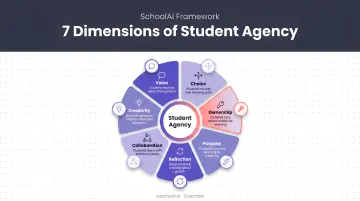
Researchers typically describe agency across seven dimensions:
- Voice — students can express their perspectives and preferences
- Choice — students make meaningful decisions about their learning
- Engagement — students are invested, not just present
- Motivation — students have internal reasons to learn, not just external pressure
- Ownership — students feel responsible for their outcomes
- Purpose — students connect learning to something that matters to them
- Self-efficacy — students believe they are capable of growth
The Scale Problem
Building all seven of these qualities requires time, differentiation, and individual attention — precisely what traditional classroom structures cannot reliably deliver at scale.
India's school system serves over 24.69 crore students across 14.71 lakh schools, with student-teacher ratios reaching 21:1 at the secondary level — and those are the official figures, which represent averages that many schools exceed. At that scale, uniform pacing, standardised assessments, and limited individual feedback are not failures of will. They are structural necessities.
The World Bank and partners estimated global learning poverty at 57% in 2019, simulated at 70% by 2022 — reflecting how many children lack even foundational literacy and numeracy. A system stretched thin on meeting foundational needs has little room left to systematically build agency.
AI tutors don't solve this by replacing teachers. They extend what teachers can do — providing the personalised, student-driven interactions that sustain agency development across every student, not just those who raise their hand.
How AI Tutors Build Student Agency Through Personalised Learning
Adaptive Pathways That Give Students Real Choice
A traditional curriculum sequence is fixed. Every student follows the same path, at the same pace, in the same order — regardless of where they actually are. An AI tutor can map each student's current knowledge state and offer something different: branching paths where the student's choices are meaningful and consequential.
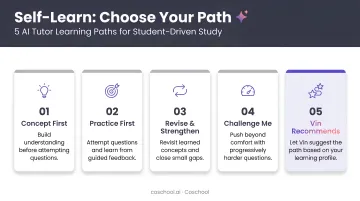
Coschool's SchoolAI operationalises this through the Self-Learn Module, which gives students five distinct ways to engage with any topic:
- Quick Review — a fast refresh for familiar material
- Thorough Understanding — deeper engagement for new or difficult concepts
- Problem-Solving Focus — skill-building through practice
- Exam Simulation — test-style preparation
- Mixed — variety across approaches
Choosing between these paths is not cosmetic. A student who missed class selects differently from one preparing for an exam. That act of choosing — assessing your own needs and deciding how to address them — is itself an exercise in agency. RAND's study of 40 K-12 schools found that students in personalised learning environments gained roughly 3 percentile points in both reading and mathematics relative to comparison groups — a modest but meaningful signal that choice-based learning has measurable effects.
Feedback That Puts Students in the Driver's Seat
There is a meaningful difference between feedback that corrects and feedback that develops. The first tells a student what went wrong. The second asks the student to figure it out.
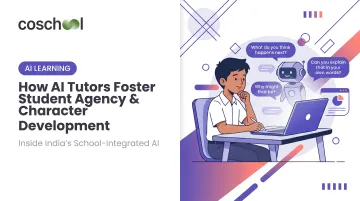
Vin, SchoolAI's AI tutor, is designed around the second approach. It never gives direct answers. Instead, it uses Socratic guiding questions that lead students toward discovery. When a student hits a wall, the system responds with a question, not a solution.
The structure is deliberate: after three wrong attempts, progressive hints unlock. If a student is still stuck, the teacher is alerted — not Vin providing the answer. This 3-strike support system preserves the learning-through-discovery model even when students struggle most.
When students see a direct link between their effort and their progress — rather than between their compliance and their grade — intrinsic motivation begins to build. That shift is exactly what the next piece of the system is designed to make visible.
Progress Visibility as an Agency Tool
Traditional schooling keeps most performance data invisible between assessments. Students wait for report cards, often weeks after the learning has already moved on. SchoolAI surfaces that progress in real time — and puts it directly in the student's hands.
Three tools drive this transparency:
- Assessment Practice delivers immediate, detailed feedback — not just right or wrong, but what was missed, what the correct reasoning was, and where the gap lies
- Recap Map gives students a clickable view of the full chapter structure, showing what they have covered and what remains
- Post-assessment AI discussions surface key takeaways and clarify misconceptions right after practice, not days later
This transparency shifts the student's relationship with their own learning. Knowing where you stand — and what to do next — is what makes self-directed study possible rather than aspirational.
Beyond Academics: How AI Tutors Support Character Development
Resilience Through Low-Stakes Struggle
Resilience is not built by avoiding difficulty. Students build it by experiencing difficulty in conditions where failure costs nothing permanent. Traditional homework rarely provides this — a wrong answer is recorded, returned, and largely done with.
AI tutors create a different environment. In Vin's Guided Practice module, a student can attempt a problem, fail, receive a guiding question, and try again with no social cost, no peer judgment, and no permanent record of the attempt. The system is patient by design: unlimited retries, unlimited questions, and no fear of wrong answers.
This cycle of attempt-fail-reflect-retry is precisely the mechanism through which persistence develops. SchoolAI's internal outcomes support this: bottom-quartile students (those most likely to give up in traditional settings) show +9 to +17 marks improvement term-on-term across partner schools. Students in that cohort are not making those gains passively. They are sticking with difficult problems long enough for understanding to develop.
Self-Regulation and Metacognition as Learned Habits
Metacognition (thinking about one's own thinking) and self-regulation (managing one's own learning behaviour) are among the most transferable skills education can develop. The Education Endowment Foundation's guidance on metacognition and self-regulated learning identifies these as high-impact approaches that help pupils plan, monitor, and evaluate their learning.
AI tutors can be specifically designed to build these habits. SchoolAI's Concept Builder uses the RUAH framework (Recall, Understand, Apply, Higher-Order) to move students through progressively deeper levels of cognitive engagement. Rather than confirming recall, the framework asks students to explain, apply, and reason with what they know.
Vin's post-assessment discussions push further: after completing practice, students see not just what they got wrong but why, and receive prompts to reflect on their approach. When students encounter these reflection prompts consistently, the habit of self-monitoring begins to form. Over time, students carry that self-monitoring instinct into tests, group work, and independent study beyond school hours.
Accountability Built Through Ownership
When a student's learning history is surfaced back to them concretely and without judgment, a vague sense of "I've been struggling with this" becomes something specific they can act on.
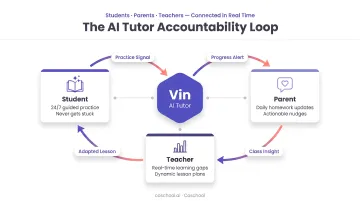
SchoolAI's platform captures a student's complete learning journey (attempt patterns, time spent, areas of struggle) and connects this to parents through the Know Your Child workflow. Parents receive daily updates with specific insights and conversation starters like "What was the most interesting thing you learned today?"
This extends accountability into the home without it feeling punitive. The result is a feedback loop where students know their effort is visible, parents know how to respond, and progress builds on itself rather than stalling between school terms.
The Conversational Advantage: AI Tutors as Socratic Learning Partners
The Socratic method works because questions develop reasoning in a way that explanations alone cannot. When a student is asked "What do you think?" and required to articulate an answer, they are doing cognitive work that passive listening never demands.
A quiz-based AI tool tests recall. A conversational AI tutor develops something different: it asks why, prompts students to explain their reasoning, and responds to confusion with another question rather than an answer. Research on natural-language tutoring systems over 17 years found average learning gains of approximately 0.8 sigma over static materials, with the gains attributed to dialogue, collaborative reasoning, and timely feedback.
A meta-analysis of self-explanation prompts found a weighted mean effect size of approximately 0.55 — meaning that requiring students to explain their reasoning, rather than just answer, produces meaningfully stronger learning outcomes. Vin is designed around exactly this: every interaction prompts students to surface their thinking, not just select an answer.
There is a character dimension here too. The habit of articulating one's thinking builds skills that extend well beyond academics:
- Confidence — students learn to trust their own reasoning process
- Communication — expressing ideas clearly becomes a practised reflex
- Self-advocacy — standing behind one's thinking, even under gentle challenge
A student who regularly explains their reasoning to an AI tutor is rehearsing, repeatedly, one of the most transferable skills they will ever develop.
Keeping AI in Its Place: Teachers, Parents, and the Human Side of Development
What AI Should — and Shouldn't — Do
Student agency and character are ultimately developed through relationships. A patient AI tutor can create conditions for growth, but it cannot model values, provide emotional attunement, or make a student feel genuinely seen. Those remain inherently human.
The most productive framing is this: AI handles personalised content delivery, adaptive practice, and progress visibility — and in doing so, it frees teachers to do what no AI can. Coschool's SchoolAI gives teachers back 2-3 hours per day by automating homework checking, performance tracking, and parent updates. A teacher who is not spending evenings marking notebooks can invest that time in discussion, mentoring, and the relational work of education.
UNESCO's guidance on generative AI in education is clear on this point: human-centred, age-appropriate use must remain the standard, and teacher oversight is not optional. The World Bank's 2024 AI education brief frames AI as a tool to enhance human judgment, not replace it.
Parents as Agency-Building Partners
OECD PISA data suggests that globally, roughly 41% of parents discuss their child's progress with a teacher on their own initiative — meaning most do not. The barrier is rarely disengagement. It's the absence of specific, timely information that would make those conversations meaningful.
SchoolAI's Parent Engagement Platform addresses this directly. Key features include:
- Help Your Child — translates AI-generated insights into specific engagement tips and suggested conversation starters, so parents can support learning at home without subject expertise
- Weekly Updates — consolidates homework completion, new chapters, and performance trends into a single weekly picture
- Global Standard Learning Profile — tracks 10 IB-style attributes, giving parents a longitudinal view of their child's development beyond test scores
Guarding Against Over-Reliance
The risk of any AI tool is that students outsource thinking to it rather than developing independent judgment. This is not hypothetical — it is a structural possibility that must be designed against.
SchoolAI builds several protections directly into the platform:
- Socratic guardrails — Vin never provides direct answers, only guiding questions that push students to reason through problems
- Anti-cheating mechanisms — block copy-paste shortcuts and flag suspicious patterns like random answer entry
- Teacher dashboard alerts — surface performance inconsistencies, so when a student suddenly aces a topic after weeks of struggle, that signal reaches the teacher for verification
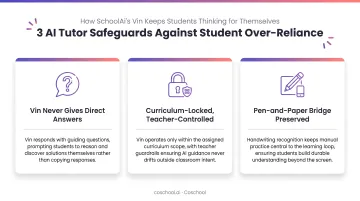
These aren't add-ons. They're built into the product because over-reliance is a design problem, and design is where it has to be solved.
Frequently Asked Questions
What are the 7 elements of learner agency?
The seven elements are voice, choice, engagement, motivation, ownership, purpose, and self-efficacy. Together, they describe how a learner moves from passive recipient to active driver of their own education.
How can AI be used to personalise a student's learning experience?
AI personalises learning by continuously assessing each student's knowledge state and adapting content difficulty, pacing, format, and feedback in real time. This creates a learning path unique to each student's strengths, gaps, and preferences — rather than following a fixed sequence designed for an average learner.
Can AI tutors replace human teachers in building student character?
No. AI tutors create conditions — safety, consistency, reflection prompts — that allow character traits to emerge. But human teachers provide the relationships, values modelling, and emotional responsiveness that are irreplaceable in character formation. The two work best together, not in competition.
At what age should students start using AI tutors?
AI tutors can be adapted across a wide age range, with younger students needing more scaffolding and teacher oversight while older students engage more independently. Age-appropriate design and consistent teacher involvement are essential at every stage.
How do AI tutors prevent students from becoming too dependent on technology?
Well-designed AI tutors ask guiding questions rather than supply direct answers, and reduce scaffolding gradually as competence grows. Teacher dashboards that flag performance inconsistencies help educators catch over-reliance early.
How do parents stay involved when their child is learning with an AI tutor?
SchoolAI shares daily progress insights, flags areas of struggle, and provides suggested conversation starters for home — turning learning data into family engagement rather than replacing it. Parents receive specific, actionable information rather than waiting for biannual report cards.